

음악의 우화적 인물
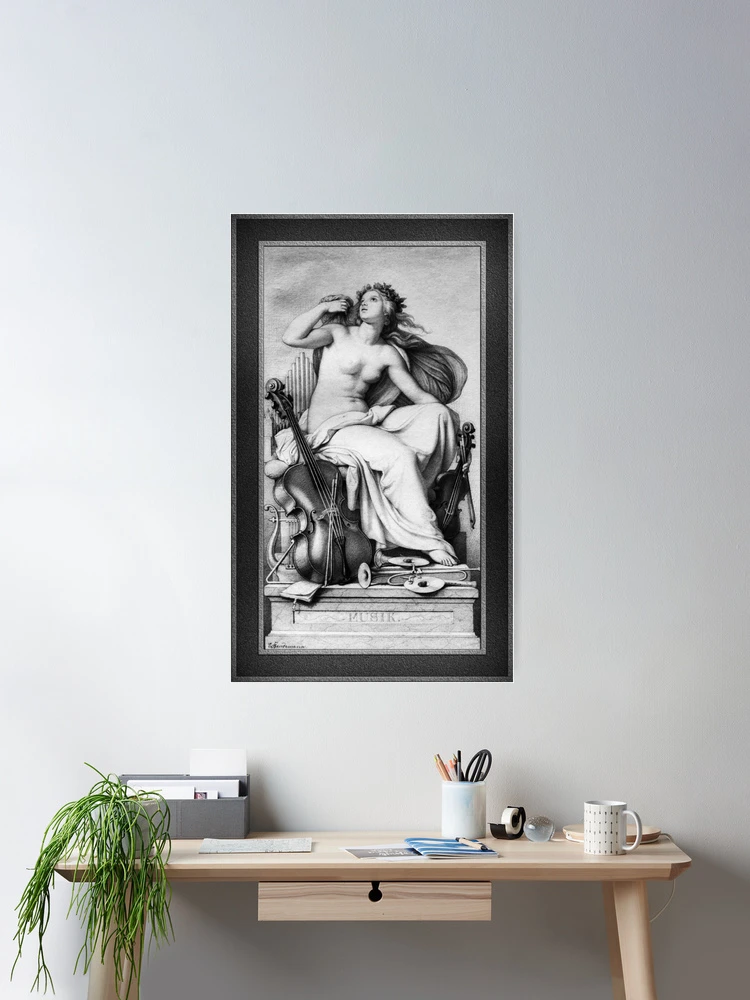
Eduard Julius Friedrich Bendemann’s 19th-century 고전 걸작, “음악의 우화적 인물,” serves as a striking visual representation of music’s transcendent and powerful nature. Created by the German artist Eduard Julius Friedrich Bendemann, 태어났다 1811 그리고 들어가 1889, this artwork conveys the allegorical relationship between music and human expression through meticulous craftsmanship and symbolism. In this powerful rendering, Bendemann intertwines elements of classical beauty, 인간 형태, and musical instruments to bring forth an emotive and awe-inspiring depiction of music’s divine essence.
목차
Subject of the Artwork
의 중심 인물 “음악의 우화적 인물” is a graceful female figure, seated in a position that suggests both contemplative repose and quiet strength. The figure is portrayed in a semi-reclined posture, leaning slightly to one side, which draws the viewer’s attention to her commanding yet serene presence. She is captured without clothing from the waist up, which emphasizes the purity and universality of the allegorical theme. The delicate yet confident expression on her face, coupled with her gentle yet deliberate hand gesture, invites the viewer to contemplate the intangible force of music she personifies. Her facial features are rendered with great sensitivity, reflecting the classical ideals of beauty that were so highly regarded during the 19th century.
The figure’s crown of laurel leaves further reinforces her role as a symbol of divine inspiration, similar to the way musicians and poets were traditionally honored in antiquity. The flowing hair, 모션 중에 포착됨, evokes the dynamic nature of music itself, suggesting that it is both a still and active force that can flow freely like the winds.
Objects and Instruments
The most prominent objects surrounding the allegorical figure are the various musical instruments scattered around her. The central instruments, a violin and a flute, are positioned near her feet, while additional musical elements, such as cymbals, 뿔, and an oboe, are subtly placed in the composition. These instruments are not merely incidental, but carefully selected to represent the variety and breadth of music as an art form. They are part of a visual symphony that complements the figure’s larger-than-life symbolism.
The violin, 특히, is a prominent instrument in the painting, lying close to the figure’s form and perhaps symbolizing the emotional depth and complexity of music. The flute, known for its ethereal and delicate sound, reinforces the more sublime and transcendent nature of music. 그 동안에, the scattered cymbals, horn, and oboe add a sense of balance to the scene, suggesting that music encompasses a wide range of emotional tones, from the delicate to the powerful, and from the introspective to the grandiose.
The strategic placement of these instruments around the figure highlights their connection to her, implying that she is not merely a passive representation of music but rather an active force that channels and gives shape to these instruments. Through this thoughtful arrangement, Bendemann portrays music as an entity that exists in a harmonious relationship with both the artist and the audience.
지형과 배경
The background of the artwork is sparsely detailed, which serves to focus attention on the figure and the instruments. In the top left corner, faint architectural elements suggest a classical or temple-like structure, evoking ancient Greece and Rome, which were historically seen as the origins of both music and the arts. The columns that appear to frame the figure’s body further reinforce the classical motif and allude to the timeless nature of music. This choice of minimalism in the setting underscores the notion that the essence of music transcends earthly boundaries and can exist without a specific geographical context.
Bendemann’s use of shading and contrast brings depth to the scene, with light falling softly across the figure’s body and the surrounding objects. This creates a chiaroscuro effect that enhances the overall sense of depth and dimensionality. The careful attention to light and shadow also contributes to the mood of the piece, imbuing the figure with a sense of divine otherworldliness. Her form is bathed in a soft glow, highlighting her as an exalted, almost ethereal figure who embodies the very spirit of music.
스타일과 분위기
Bendemann’s work is deeply rooted in the classical tradition, both in its reverence for ancient ideals and in its technical execution. The meticulous rendering of the human form and the soft blending of light and shadow reflect the artist’s academic training and his commitment to classical realism. The emotional tone of the piece, 하나, extends beyond mere technical proficiency. The allegorical figure, surrounded by musical instruments, conveys a deep sense of harmony and balance, both in the composition itself and in the wider message it communicates about the role of music in the human experience.
The mood of the painting is one of reverence and introspection. The figure’s posture and expression suggest an inner calmness, yet her presence is commanding, as though she is not only a muse but also an active force. This sense of calm is counterbalanced by the dynamic quality of the flowing hair and the positioning of the musical instruments, which imbue the scene with energy and motion. 함께, these elements create a mood of divine tranquility fused with creative potential.
The work’s classical composition and serene tone encourage viewers to reflect on the timeless role of music in culture and the arts. The artist’s use of symbolism invites an exploration of music as both a divine gift and a human expression of emotion, 지식, 그리고 초월.
결론
“음악의 우화적 인물” by Eduard Julius Friedrich Bendemann captures the essence of music as a timeless, transcendent force. Through its careful depiction of a central allegorical figure, surrounded by musical instruments and framed by architectural elements, the painting conveys both the emotional depth and the divine inspiration that music embodies. The artist’s mastery of classical techniques, combined with the thoughtful composition, evokes a mood of serene contemplation and reverence for the art form. 이 걸작, emblematic of the Romantic and Classical traditions, continues to resonate with audiences, reminding us of the enduring power and beauty of music.
우화적인 음악 그림은 공개 도메인 이미지를 수정한 디지털 아트 오래된 거장입니다..
아래에서 파생 된 정보 Wikipedia.org
에두아르드는 베를린에서 태어났다, 12월 독일 3, 1811 유대인 은행가인 Anton Heinrich Bendemann과 Fanny Eleonore Bendemann née von Halle에게; 유대인 은행가 조엘 사무엘 폰 할레의 딸.
Eduard는 어릴 때부터 예술에 재능을 보였습니다., 그리고 그 당시 아들들은 일반적으로 아버지와 유사하거나 관련된 학업과 직업을 추구했지만, 그는 미술 공부를 허가받았고 독일 화가 빌헬름 폰 샤도우(Wilhelm von Schadow)의 미술 학교에 등록했습니다. (1789 – 1862), 뒤셀도르프에 위치한, 독일.
에 1828 세의 나이에 17, 그는 할머니를 그린 그림으로 주목을 끌었습니다.; 그리고 1830 이탈리아로 수학여행을 갔다, 그는 그곳에서 1년 동안 머물며 일련의 그림 작업을 하게 됩니다.; 사람들이 그를 주목하는 것과 함께 1832 유배되어 애도하는 유대인 그림; 베를린 미술전시회에 출품되었던.
같은 해에 그는 또한 우물가의 두 소녀를 만들었고 예루살렘 폐허 가운데 예레미야와 함께 그 뒤를 따랐습니다.; 이 작품으로 파리에서 메달을 받았습니다, 프랑스 1837, 그의 가장 잘 알려진 작품은 The Harvest입니다..
에 1838 Eduard는 드레스덴 미술 아카데미의 교수로 임명되었습니다. (설립된 1764); 드레스덴 왕궁의 세 홀을 벽화로 장식하라는 의뢰를 받았습니다.; 왕좌의 방이 포함된 곳, 타워 룸, 그리고 타워 홀.
이 대규모 사업은 다음 작업을 위해 그의 시간 대부분을 차지할 것입니다. 15 년도; 그때부터 1859 NS 1867 그는 뒤셀도르프 아카데미의 원장이었습니다.