

Ariadne Engraving
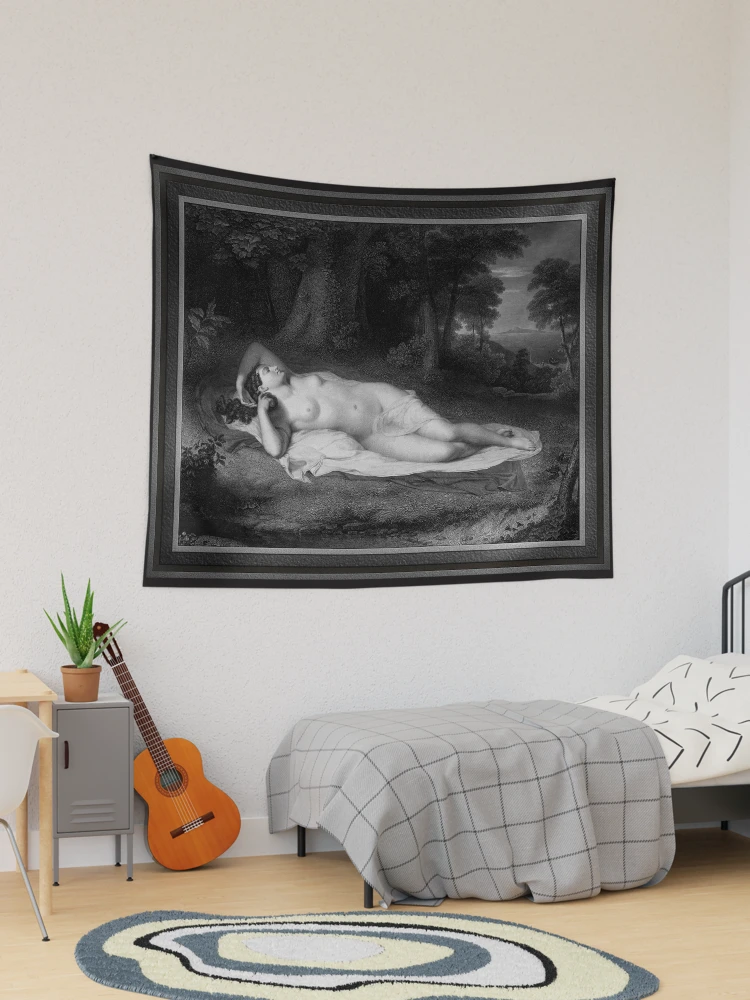
Ariadne Engraving c1835 by American Painter & 조각사 애셔 브라운 듀런드 (1796 – 1886) 낭만주의 미술 운동의 일원이었고 허드슨 강 학교를 졸업했습니다.. Asher의 주요 초점은 풍경화였습니다..
개요
The Ariadne engraving by Asher is from a copy of a painting he made from an original painting by John Vanderlyn (1776 – 1852). Ariadne is the Cretan Princess who was briefly loved by Theseus (신화 속 왕이자 아테네의 창시자 영웅), who abandoned her on the island of Naxos.
“아리아드네” is an exquisite engraving created by Asher Brown Durand, one of the prominent American artists and engravers of the 19th century. 이 작품, completed circa 1835, is a masterful interpretation of classical themes in the Neoclassical style.
The subject of this engraving, 아리아드네, is a figure from Greek mythology, whose image has been captured through Durand’s engraving with remarkable sensitivity and depth. The mood and narrative conveyed in this piece are deeply entwined with the themes of abandonment, solitude, and longing, presenting Ariadne as a symbol of romantic melancholy.
목차
주제와 구성
At the heart of the composition lies Ariadne, the central figure who is often depicted in ancient myths as the abandoned lover of Theseus. Durand has rendered her lying on the ground, draped in soft, flowing cloths that seem to merge with the natural world around her.
Her posture suggests a sense of relaxation or even resignation, with one arm resting behind her head, while the other lies gracefully on her torso. 그녀의 얼굴, serene yet distant, looks toward the horizon as though lost in thought or perhaps anticipating the return of her lover, a theme which resonates with the classical myths of lost love and abandonment.
The depiction of Ariadne in this engraving speaks volumes about Durand’s understanding of the human form, especially in the rendering of the female body. The curves of her limbs, the delicate folding of the fabric, and the naturalistic contours of her face all contribute to the timeless beauty and vulnerability of the figure. Durand’s use of shading and fine details in the engraving enhances the texture of the flesh and the fabric, lending a sense of life to the image despite its static nature.
The Setting and Environment
The background and setting of the engraving contribute significantly to its thematic weight. Ariadne is positioned in a lush, idyllic natural setting—likely an open glade or secluded forest. 지형, gently sloping and dotted with trees, provides a soft contrast to the hard, chiseled forms of the figure.
A distant view of rolling hills and a river suggest a harmonious integration of human and natural elements. The setting appears to be at the cusp of day and night, as a hazy light filters through the trees, subtly illuminating Ariadne’s form while casting the landscape in a soft, dreamlike glow.
The artist skillfully renders the trees and foliage with intricate lines, creating a sense of depth and dimension. The distant hills add a sense of scale to the composition, further enhancing the naturalistic style that Durand excelled at. The fine linework and delicate shading are characteristic of the engraving medium, a technique that requires patience and precision, both of which Durand applied expertly to bring the landscape into harmonious balance with the figure of Ariadne.
The Medium: Engraving
각인으로는, this piece is executed with meticulous attention to detail. 듀런드, known for his skill in this medium, uses sharp, clear lines and intricate crosshatching to achieve a wide range of tonal values. The engraving’s fine lines lend it a delicate quality, but the use of contrast and shadow provides a deep, almost three-dimensional sense of volume. Durand’s technique is particularly adept at capturing textures, from the softness of Ariadne’s skin to the rough bark of the trees surrounding her.
The use of engraving as a medium also reflects Durand’s engagement with the tradition of classical art and his desire to produce works that could be widely disseminated, popularizing such mythological themes among American and European audiences. Engraving, being more accessible than original paintings, allowed for greater distribution of this image, making it not only an artistic achievement but also a vehicle for promoting classical ideals.
Themes and Symbolism
The figure of Ariadne in this engraving embodies themes of isolation, abandonment, 그리고 시간의 흐름. In Greek mythology, Ariadne helps Theseus escape the Labyrinth, only to be later abandoned by him on the island of Naxos. This image captures her at a moment of quiet reflection, perhaps contemplating her fate or lost love.
The serene expression on her face juxtaposes with the emotional turmoil that her myth entails. The soft folds of her drapery and the calm surroundings may symbolize a fleeting moment of peace before the inevitable sorrow that comes with being left alone.
추가적으로, the natural setting of the piece complements these themes. The trees and foliage suggest a timeless, unchanging world, while Ariadne’s figure contrasts with this permanence, hinting at the transient nature of human life and emotion. Her presence in such a setting evokes the tension between humanity and nature, a theme that is deeply ingrained in classical art and literature.
분위기와 분위기
분위기 “아리아드네” is deeply melancholic. Durand has chosen to portray the moment of Ariadne’s solitude after her abandonment, and the peaceful yet somber expression on her face enhances this emotional atmosphere. The engraving’s lighting, with its soft contrast between light and shadow, imbues the piece with a quiet, 거의 미묘한 품질. The trees in the background create a feeling of shelter, yet their distance and the softness of their outlines evoke a sense of isolation, reinforcing the emotional undercurrent of the narrative.
While the scene is bathed in the calm of nature, there is an undercurrent of sadness that is palpable. The solitude of the figure, combined with the longing gaze and the distant landscape, creates an atmosphere that is both tender and tragic. It speaks to the human experience of abandonment and the quiet resignation that often accompanies it.
결론
Asher Brown Durand’s “아리아드네” stands as a fine example of 19th-century American engraving and a representation of classical themes through a Neoclassical lens. The serene yet poignant depiction of Ariadne, set against a natural backdrop, invites the viewer to contemplate the fragility of human emotion, 시간의 흐름, and the isolation that often accompanies love and loss. The technical mastery and emotional depth of this work, combined with the delicate interplay of light and shadow, make it a timeless piece of art.
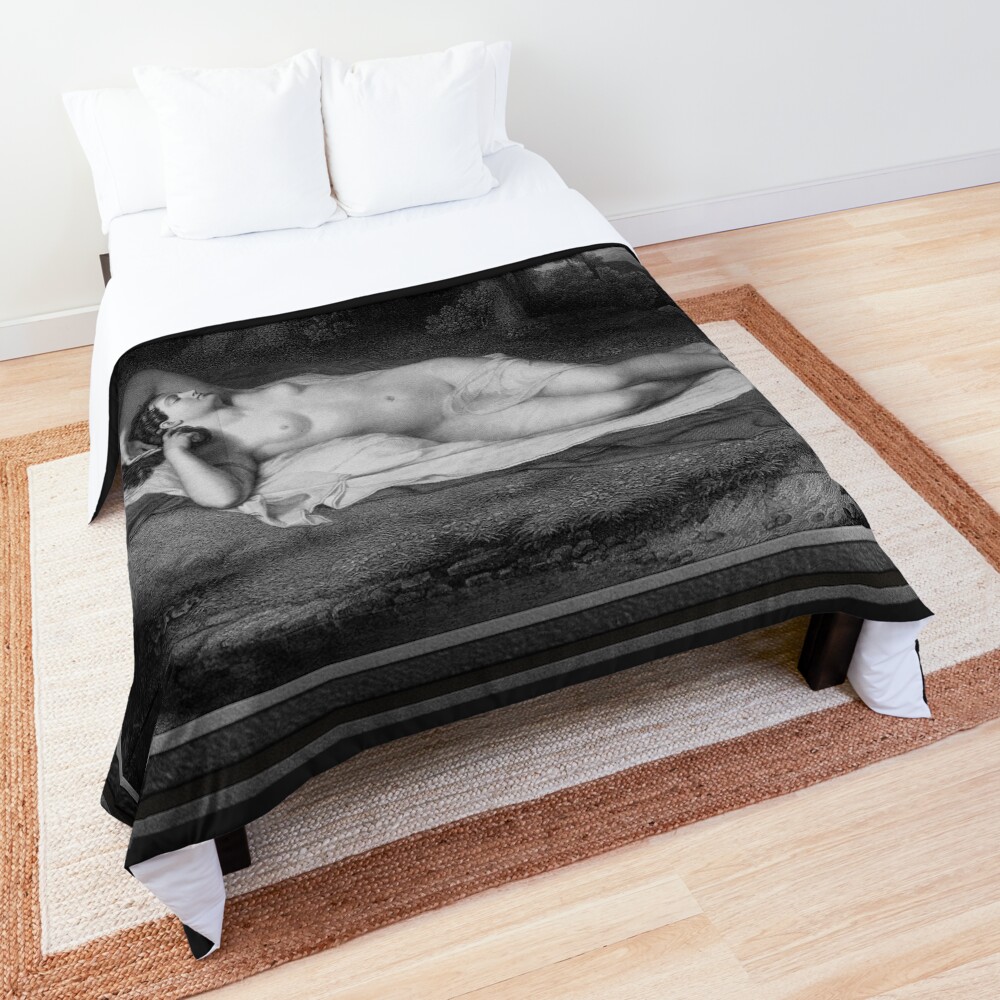
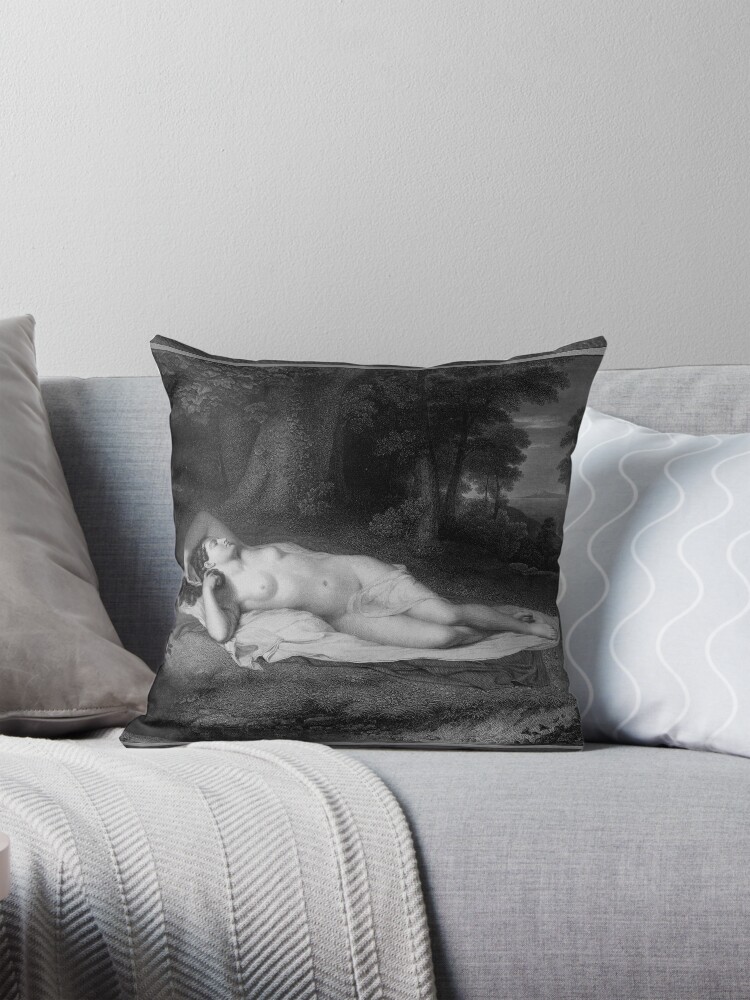
Ariadne Engraving depicts Ariadne laying down in the forest, 그녀의 왼팔은 머리 위로, 오른손은 그녀의 목 뒤 부분에 놓여 있는 머리카락을 움켜쥔 채 스트림 옆에 부분적으로 누드된 옷 묶음 위에.
In the background of the Ariadne Engraving past the trees and the hill she is resting on, we can see a boat on the bank of a lake, and in the far distance we can see what appears to be a large island.
This Ariadne Engraving is a retouched digital art old masters reproduction of a public domain image.
아래 정보 Wikipedia.org
Durand는 메이플우드에서 태어나 결국 사망했습니다., 뉴저지 (제퍼슨 빌리지라고 불리는). 그는 열한 자녀 중 여덟째였다.. Durand의 아버지는 시계공이자 은세공인이었습니다..
Durand는 조각가의 견습생으로 1812 NS 1817 나중에 회사 소유주와 파트너십을 맺었습니다., 찰스 쿠싱 라이트 (1796–1854), 누가 그에게 회사의 뉴욕 사무실을 관리하도록 요청했는지.
그는 존 트럼블을 위해 독립 선언문을 새겼습니다. 1823, 이 나라 최고의 조각사 중 한 명으로 Durand의 명성을 확립했습니다..
Durand는 New York Drawing Association의 조직을 도왔습니다. 1825, 국립 디자인 아카데미가 될 것입니다.; 그는 조직에서 회장으로 봉사할 것입니다. 1845 NS 1861.
지폐에 새겨진 Asher의 조각은 미국 최초의 우표 초상화로 사용되었습니다., 그만큼 1847 시리즈. 그의 형제 Cyrus와 함께 그는 또한 다음의 일부를 새겼습니다. 1851 문제.
그의 주요 관심사는 판화에서 유화로 바뀌었다. 1830 그의 후원자의 격려로, 루만 리드. 동안 1837, 그는 친구 Thomas Cole과 함께 Adirondacks Mountains의 Schroon Lake로 스케치 탐험을 떠났고 얼마 지나지 않아 풍경화에 집중하기 시작했습니다..
그는 Catskills에서 여름을 보냈습니다., 애디론댁, 그리고 뉴햄프셔의 화이트 마운틴, Hudson River School을 정의하는 데 도움이 된 완성 된 아카데미 조각에 나중에 통합 된 수백 개의 그림과 오일 스케치 만들기.
Durand는 특히 그의 상세한 나무 묘사로 기억됩니다., 바위, 그리고 단풍. 그는 최대한 사실적으로 자연에서 직접 그림을 그리는 옹호자였습니다.. 듀랑이 썼다, “허락하다 [아티스트] 뭐든지 냉정하게 받아들인다 [자연] 그가 할 때까지 그를 선물한다, 어느 정도, 그녀의 무한함과 친밀해졌습니다… 결코 그가 고의적으로 진리를 떠나 그녀의 신성함을 욕되게 하지 마십시오.”
다른 Hudson River School 예술가들처럼, Durand는 또한 자연이 신의 형언할 수 없는 현시라고 믿었습니다.. 그는 자신의 에세이에서 이러한 감정과 예술에 대한 일반적인 견해를 표현했습니다. “풍경화에 대한 편지” 크레용에서, 19세기 중반 뉴욕 미술 정기간행물. 듀런드를 썼다, “[NS]그는 조경 예술의 진정한 영역은 보이는 창조물에서 하나님의 작품을 표현하는 것입니다…”
Durand는 그의 1849 Catskills Mountains 풍경에서 동료 Hudson River School 예술가 Thomas Cole과 시인 William Cullen Bryant를 보여주는 Kindred Spirits 그림. 이것은 Cole이 사망했을 때 Cole에게 경의를 표하기 위해 그렸습니다. 1848, 그리고 브라이언트에게 선물로.