

Architects Dream c1840
“Architect’s Dream,” gemaakt in 1840 by American artist Thomas Cole (1801 – 1848), is an awe-inspiring oil painting that invites viewers to contemplate the grandeur of architectural ambition set against the backdrop of a vast, idealized landscape. Cole, known as the founder of the Hudson River School, often infused his works with deep philosophical and spiritual meanings, reflected here through the exploration of man’s drive to create and build monumental structures. This piece, in het bijzonder, addresses themes of progress, the interplay between nature and human endeavor, and the vision of what might be achieved when the natural world and human architecture collide in harmony.
Inhoudsopgave
Hoofdonderwerp: De droom van architectuur
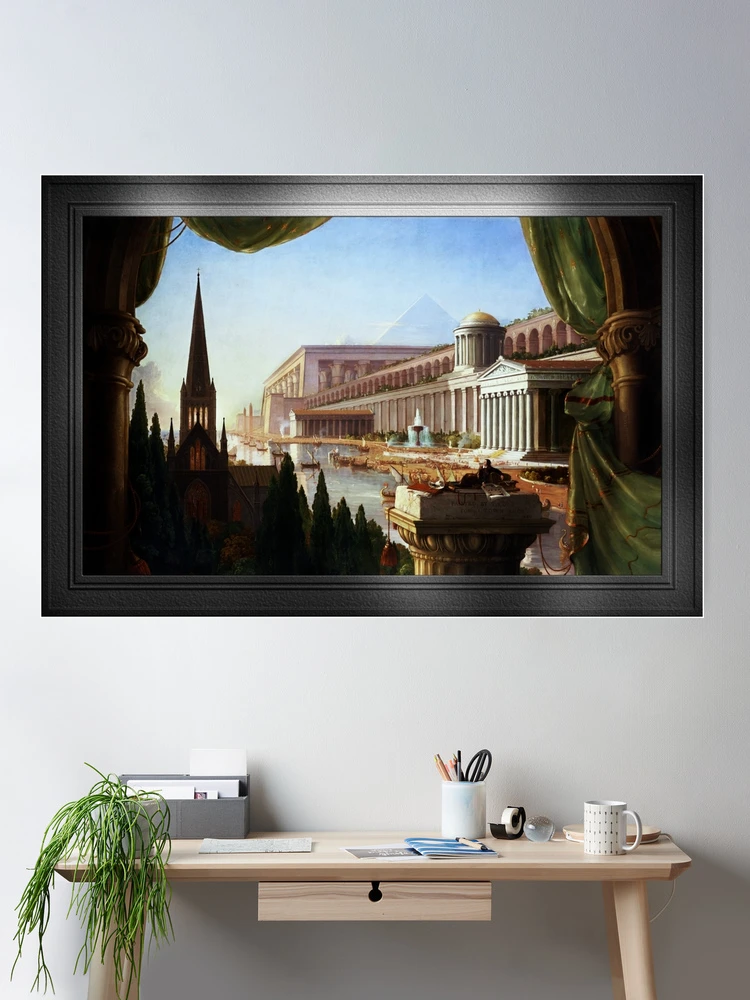
Het schilderij toont een scène waarin de grens tussen het echte en het ingebeelde vervaagt, met een weids uitzicht op een riviervallei met een processie van klassieke gebouwen en monumenten. Centraal staat de figuur van een architect, op de voorgrond geplaatst. Hij staat op een balkon, uitkijkend over het droomlandschap van zijn visioen. De architectuur in dit landschap lijkt zowel geïnspireerd te zijn door als een eerbetoon te zijn aan de grote beschavingen uit de oudheid, specifiek Griekse en Romeinse invloeden, waarbij de structuren monumentale proporties aannemen. De aanwezigheid van de architect in het schilderij vestigt de aandacht op het thema van de menselijke aspiratie en het diepe intellectuele en artistieke streven dat betrokken is bij het creëren van architectuur.
Objecten en terrein
Het terrein binnen “Architect’s Dream” is uitgestrekt en idyllisch. Naar links, de donkere gotische torenspitsen van een kathedraal rijzen omhoog, zinspelend op de invloed van de Europese middeleeuwse architectuur. De gebouwen op het schilderij bevinden zich in een rijk landschap dat in schril contrast staat met de grandeur van de geconstrueerde elementen. Weelderige groene bomen en open velden omringen de verre waterwegen die de warmte reflecteren, gouden licht van de ondergaande zon. Het terrein gaat in de verte over in bergachtige gebieden, wat een perfecte synthese suggereert tussen de schoonheid van de natuur en door de mens gebouwde omgevingen.
In het midden van het schilderij, de rivier stroomt zachtjes door het land, winding between the monumental structures that seem to emerge from the earth. A series of boats dot the river’s surface, with a few visible figures navigating the water, further adding to the sense of scale and movement within the painting. The intricate details of the boats, some drawn by oars and others by sails, suggest that human industry and commerce still play a vital role in this serene but constructed world.
The architecture itself is classical in style, evoking grand temples, colonnades, and public squares, with columns and porticos making up the central designs of the structures. Op de achtergrond, an ancient pyramid looms, its purpose and construction a testament to a civilization long past, and a symbol of human achievement and ambition. The distant cityscape, bathed in the soft light of the horizon, impliceert dat de creatie van dergelijke architectuur tijdloos is, alsof de droom van de beschaving nooit eindigt.
Stijl en techniek
De kenmerkende stijl van Thomas Cole komt duidelijk tot uiting in de ingewikkelde details en emotionele toon van het schilderij. Op de voorgrond zijn de scherpe en realistische weergave van de figuren en de architectonische details te zien. Opvallend is ook zijn beheersing van het licht, vooral door de manier waarop het zowel de architect als de gebouwen op subtiele wijze belicht, waardoor een dynamisch samenspel ontstaat tussen schaduw en licht. In Cole's schilderijen, licht speelt vaak een symbolische rol, die de aanwezigheid van goddelijke inspiratie of de verlichting van intellectuele en artistieke verlichting vertegenwoordigt. De kleuren in het schilderij zijn rijk en warm, met een gouden tint die over de hele scène spoelt, lending an almost ethereal quality to the landscape and structures.
The use of perspective is masterful, as the artist stretches the dimensions of the scene to evoke a sense of grandeur and importance. The distant horizon is dominated by a sky full of soft, fading light, enhancing the reflective and dreamlike quality of the composition. The water in the river mirrors this delicate lighting, reflecting the towering buildings and sky with an uncanny clarity.
Thema: De droom van menselijke prestatie
The title, “Architect’s Dream,” suggests the deep philosophical underpinnings of the painting. It explores the idea that the act of designing and constructing monumental buildings is a deeply imaginative and transcendent endeavor. The artist presents the architect not merely as a builder but as a visionary, dreaming of great works that blend the natural with the human-made. Cole subtly criticizes the potential for human endeavor to become excessive or disconnected from nature, but he also acknowledges the magnificence of human creativity and ambition.
The image can be interpreted as a metaphor for civilization itself, symbolizing both the potential for human greatness and the fleeting nature of all things. The presence of the pyramid in the background could be seen as a symbol of ancient civilization, while the more modern buildings could represent the future. The juxtaposition of nature’s sublime beauty with the engineered environment alludes to the tension between progress and preservation, a recurring theme in Cole’s works. Through this balance, the artist suggests that while architectural dreams may soar to incredible heights, they remain tethered to the earth and ultimately subject to time’s passing.
Stemming en emotionele impact
De stemming van “Architect’s Dream” is contemplative and awe-inspiring. The artist’s use of soft light and gentle colors creates a serene atmosphere, inviting viewers to reflect on the boundless possibilities of human achievement. Nog, this serenity is tinged with a sense of melancholy as the viewer is reminded that such grand visions may be impossible to realize fully. The dreamlike quality of the scene further enhances this sense of timelessness and the fleeting nature of human ambitions.
The presence of the architect in the foreground creates a focal point for this reflection. His gaze directed towards the horizon suggests that he, te, is lost in contemplation, possibly questioning the limits of human imagination or contemplating the intersection of beauty, natuur, en creatie. The architectural dream before him is a vision not just of stone and mortar but of something far grander, an idealized world shaped by human hands, yet rooted in the natural landscape.
Conclusie
“Architect’s Dream” is a deeply philosophical and evocative painting that explores themes of human creativity, the tension between nature and architecture, and the grandeur of human achievement. Through meticulous detail and masterful use of light and perspective, Thomas Cole creates an artwork that serves as both a reflection on the past and a visionary gaze into the future. It is a meditation on the dream of building something lasting, something transcendent, while acknowledging the impermanence of all things.
Architects Dream is een geretoucheerde digitale kunstreproductie van oude meesters van een afbeelding uit het publieke domein.
Bio van kunstenaar afgeleid van Wikipedia.org
Thomas werd geboren in Bolton le Moors, Lancashire Engeland in 1801 en bij 17 jaar met zijn gezin naar de Verenigde Staten emigreerde, vestiging in Steubenville, Ohio in 1818.
In 1823 hij verliet Ohio en verhuisde naar Philadelphia en vandaar naar binnen 1825 verhuisd naar Catskill, New York, waar hij de volgende tijd woonde 23 jaren met zijn vrouw en kinderen.
Thomas begon zijn carrière als graveur en was als schilder vrijwel volledig autodidact, boeken gebruiken om zijn vak te leren en ook het werk van andere kunstenaars bestuderen.
Dan in 1822 Thomas begon te werken als portretschilder en na verloop van tijd verlegde hij zijn focus van portret naar landschaps- en historische schilderkunst.
Thomas wordt beschouwd als een van de prominente 19e-eeuwse Amerikaanse schilders en de grondlegger van de Hudson River School-beweging die werd beïnvloed door het Romantiek-tijdperk van de late 18e eeuw en het midden van de 19e eeuw.
Hoewel Cole in de eerste plaats een landschapsschilder was, hij produceerde ook allegorische kunstwerken; waarvan de bekendste de vijfdelige serie The Course of Empire is; die generaties lang hetzelfde landschap weergeven, van een bijna natuurlijke staat tot de voltooiing van het imperium, en dan verval en verlatenheid.