

Ariadne Engraving
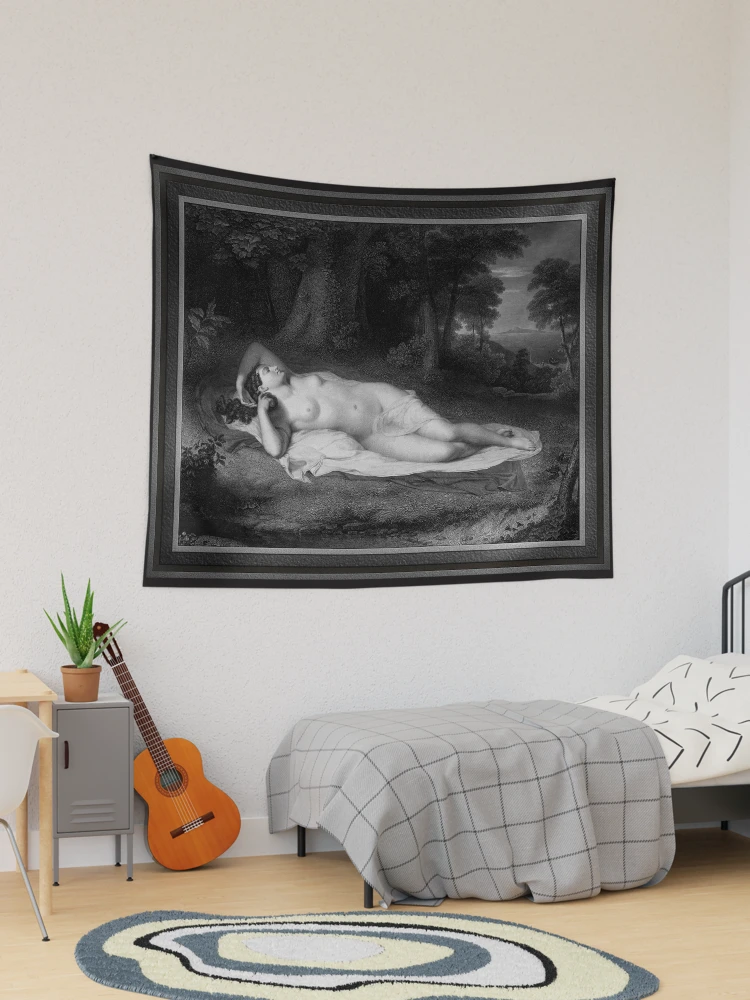
Ariadne Engraving c1835 by American Painter & Graveur Asher Brown Durand (1796 – 1886) wie diel fan 'e Romantyk Keunstbeweging en wie in ôfstudearre oan 'e Hudson River School. Asher syn haadfokus wie op lânskipsskilderijen.
Oersicht
The Ariadne engraving by Asher is from a copy of a painting he made from an original painting by John Vanderlyn (1776 – 1852). Ariadne is the Cretan Princess who was briefly loved by Theseus (de mytyske kening en stifter-held fan Atene), who abandoned her on the island of Naxos.
“Ariadne” is an exquisite engraving created by Asher Brown Durand, one of the prominent American artists and engravers of the 19th century. Dit keunstwurk, completed circa 1835, is a masterful interpretation of classical themes in the Neoclassical style.
The subject of this engraving, Ariadne, is a figure from Greek mythology, whose image has been captured through Durand’s engraving with remarkable sensitivity and depth. The mood and narrative conveyed in this piece are deeply entwined with the themes of abandonment, iensumens, and longing, presenting Ariadne as a symbol of romantic melancholy.
Ynhâldsopjefte
Underwerp en komposysje
At the heart of the composition lies Ariadne, the central figure who is often depicted in ancient myths as the abandoned lover of Theseus. Durand has rendered her lying on the ground, draped in soft, flowing cloths that seem to merge with the natural world around her.
Her posture suggests a sense of relaxation or even resignation, with one arm resting behind her head, while the other lies gracefully on her torso. Har gesicht, serene yet distant, looks toward the horizon as though lost in thought or perhaps anticipating the return of her lover, a theme which resonates with the classical myths of lost love and abandonment.
The depiction of Ariadne in this engraving speaks volumes about Durand’s understanding of the human form, especially in the rendering of the female body. The curves of her limbs, the delicate folding of the fabric, and the naturalistic contours of her face all contribute to the timeless beauty and vulnerability of the figure. Durand’s use of shading and fine details in the engraving enhances the texture of the flesh and the fabric, lending a sense of life to the image despite its static nature.
The Setting and Environment
The background and setting of the engraving contribute significantly to its thematic weight. Ariadne is positioned in a lush, idyllic natural setting—likely an open glade or secluded forest. It terrein, gently sloping and dotted with trees, provides a soft contrast to the hard, chiseled forms of the figure.
A distant view of rolling hills and a river suggest a harmonious integration of human and natural elements. The setting appears to be at the cusp of day and night, as a hazy light filters through the trees, subtly illuminating Ariadne’s form while casting the landscape in a soft, dreamlike glow.
The artist skillfully renders the trees and foliage with intricate lines, creating a sense of depth and dimension. The distant hills add a sense of scale to the composition, further enhancing the naturalistic style that Durand excelled at. The fine linework and delicate shading are characteristic of the engraving medium, a technique that requires patience and precision, both of which Durand applied expertly to bring the landscape into harmonious balance with the figure of Ariadne.
The Medium: Engraving
As an engraving, this piece is executed with meticulous attention to detail. Durand, known for his skill in this medium, uses sharp, clear lines and intricate crosshatching to achieve a wide range of tonal values. The engraving’s fine lines lend it a delicate quality, but the use of contrast and shadow provides a deep, almost three-dimensional sense of volume. Durand’s technique is particularly adept at capturing textures, from the softness of Ariadne’s skin to the rough bark of the trees surrounding her.
The use of engraving as a medium also reflects Durand’s engagement with the tradition of classical art and his desire to produce works that could be widely disseminated, popularizing such mythological themes among American and European audiences. Engraving, being more accessible than original paintings, allowed for greater distribution of this image, making it not only an artistic achievement but also a vehicle for promoting classical ideals.
Themes and Symbolism
The figure of Ariadne in this engraving embodies themes of isolation, abandonment, en it ferrin fan 'e tiid. In Greek mythology, Ariadne helps Theseus escape the Labyrinth, only to be later abandoned by him on the island of Naxos. This image captures her at a moment of quiet reflection, perhaps contemplating her fate or lost love.
The serene expression on her face juxtaposes with the emotional turmoil that her myth entails. The soft folds of her drapery and the calm surroundings may symbolize a fleeting moment of peace before the inevitable sorrow that comes with being left alone.
Oanfoljend, the natural setting of the piece complements these themes. The trees and foliage suggest a timeless, unchanging world, while Ariadne’s figure contrasts with this permanence, hinting at the transient nature of human life and emotion. Her presence in such a setting evokes the tension between humanity and nature, a theme that is deeply ingrained in classical art and literature.
Stimming en sfear
De stimming fan “Ariadne” is deeply melancholic. Durand has chosen to portray the moment of Ariadne’s solitude after her abandonment, and the peaceful yet somber expression on her face enhances this emotional atmosphere. The engraving’s lighting, with its soft contrast between light and shadow, imbues the piece with a quiet, hast etheryske kwaliteit. The trees in the background create a feeling of shelter, yet their distance and the softness of their outlines evoke a sense of isolation, reinforcing the emotional undercurrent of the narrative.
While the scene is bathed in the calm of nature, there is an undercurrent of sadness that is palpable. The solitude of the figure, combined with the longing gaze and the distant landscape, creates an atmosphere that is both tender and tragic. It speaks to the human experience of abandonment and the quiet resignation that often accompanies it.
Konklúzje
Asher Brown Durand’s “Ariadne” stands as a fine example of 19th-century American engraving and a representation of classical themes through a Neoclassical lens. The serene yet poignant depiction of Ariadne, set against a natural backdrop, invites the viewer to contemplate the fragility of human emotion, it ferrin fan de tiid, and the isolation that often accompanies love and loss. The technical mastery and emotional depth of this work, combined with the delicate interplay of light and shadow, make it a timeless piece of art.
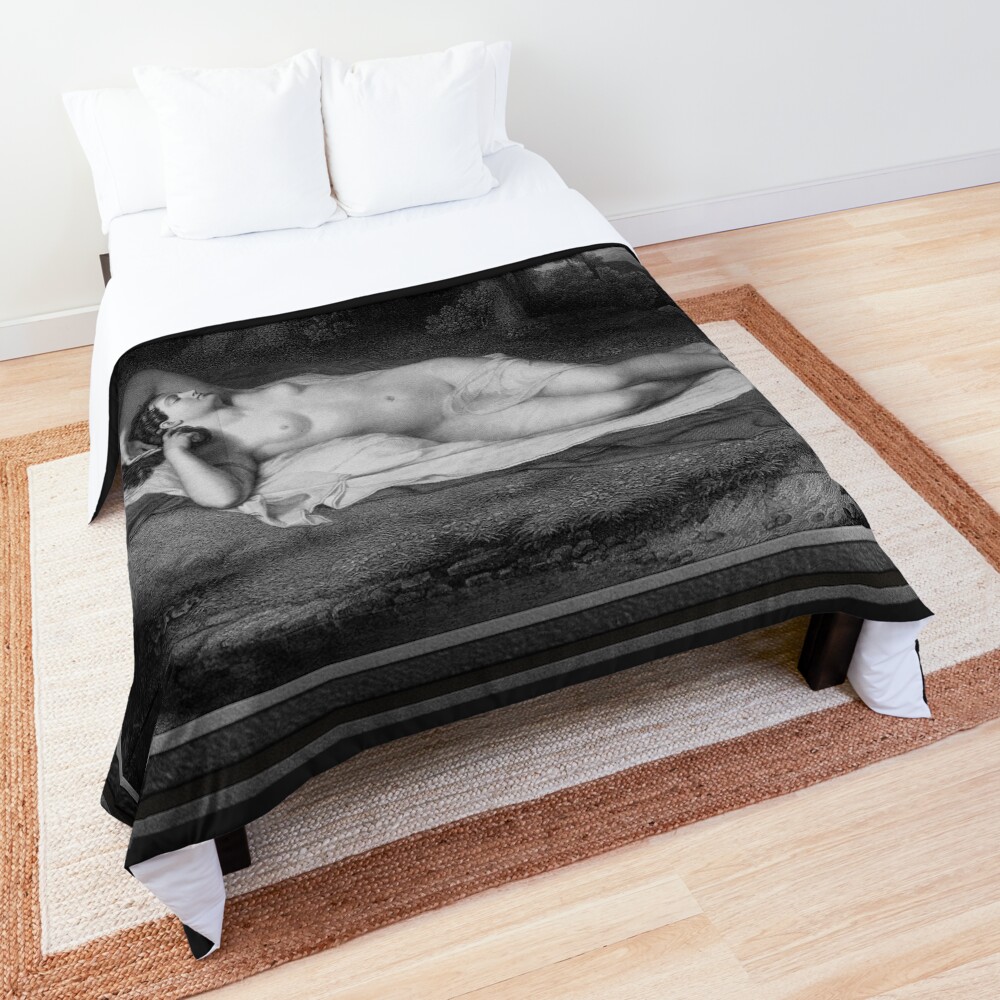
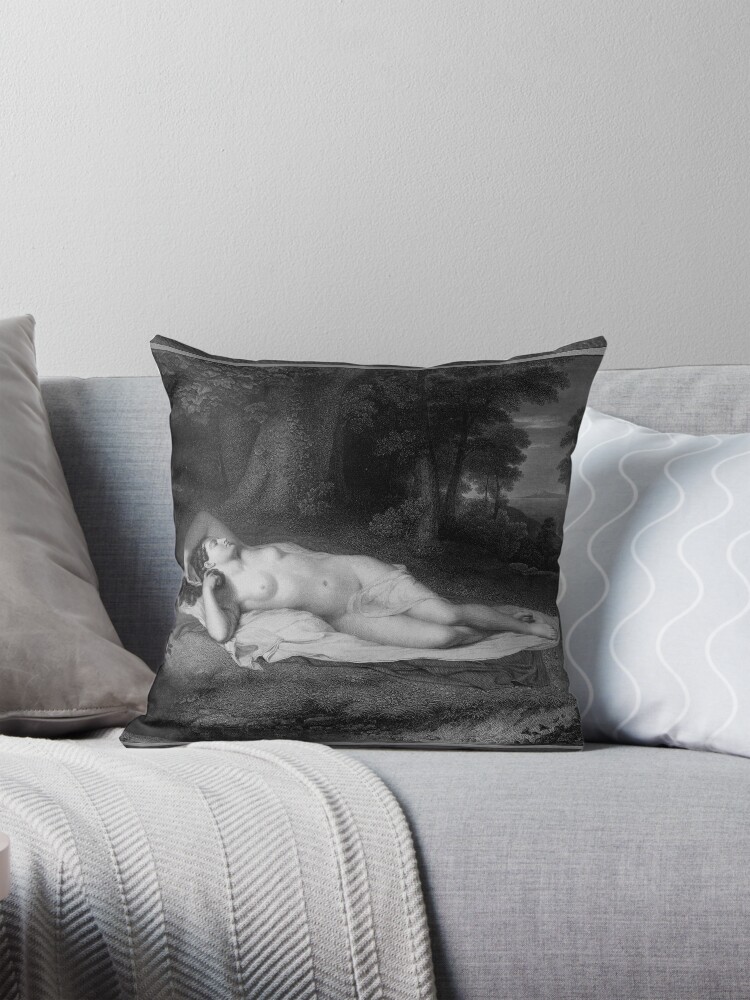
Ariadne Engraving depicts Ariadne laying down in the forest, on top of a bundle of clothing partially nude by a stream with her left arm positioned over her head and her right hand grasping her hair as it rest on the back portion of her neck.
In the background of the Ariadne Engraving past the trees and the hill she is resting on, we can see a boat on the bank of a lake, and in the far distance we can see what appears to be a large island.
This Ariadne Engraving is a retouched digital art old masters reproduction of a public domain image.
Info hjirûnder Fan Wikipedia.org
Durand waard berne yn en stoar úteinlik yn Maplewood, New Jersey (doe neamd Jefferson Village). Hy wie de achtste fan alve bern. Durand syn heit wie in horloazjemakker en in sulversmid.
Durand waard learling oan in graveur út 1812 nei 1817 en letter in gearwurkingsferbân oangien mei de eigner fan it bedriuw, Charles Cushing Wright (1796–1854), dy't him frege om it kantoar fan it bedriuw yn New York te behearjen.
Hy gravearre Ferklearring fan Unôfhinklikens foar John Trumbull tidens 1823, dy't Durand syn reputaasje fêstige as ien fan 'e moaiste graveurs fan it lân.
Durand holp by it organisearjen fan de New York Drawing Association tidens 1825, dy't de National Academy of Design wurde soe; hy soe tsjinje de organisaasje as foarsitter fan 1845 nei 1861.
Asher syn gravueres op bankbiljetten waarden brûkt as de portretten foar Amearika syn earste postsegels, de 1847 searje. Tegearre mei syn broer Cyrus gravearre er ek guon fan 'e opfolgjende 1851 saken.
Syn wichtichste belangstelling feroare fan gravuere nei oaljeferve oer 1830 mei de oanmoediging fan syn beskermhear, Luman Reed. Tidens 1837, hy begeliede syn freon Thomas Cole op in sketsekspedysje nei it Schroon Lake yn 'e Adirondacks Mountains en koart nei't er him begûn te konsintrearjen op lânskipsskilderij.
Hy brocht simmers sketsen yn 'e Catskills, Adirondacks, en de Wite Bergen fan Nij-Hampshire, it meitsjen fan hûnderten tekeningen en oaljesketsen dy't letter waarden ferwurke yn ôfmakke akademystikken dy't holpen om de Hudson River School te definiearjen.
Durand is remembered particularly for his detailed portrayals of trees, rotsen, and foliage. He was an advocate for drawing directly from nature with as much realism as possible. Durand wrote, “Let [the artist] scrupulously accept whatever [natuer] presents him until he shall, in a degree, have become intimate with her infinity…never let him profane her sacredness by a willful departure from truth.”
Like other Hudson River School artists, Durand also believed that nature was an ineffable manifestation of God. He expressed this sentiment and his general opinions on art in his essay “Letters on Landscape Painting” in The Crayon, a mid-19th century New York art periodical. Wrote Durand, “[T]he true province of Landscape Art is the representation of the work of God in the visible creation…”
Durand is noted for his 1849 skilderjen Kindred Spirits dy't kollega Hudson River School-keunstner Thomas Cole en dichter William Cullen Bryant toant yn in lânskip fan Catskills Mountains. Dit waard skildere as earbetoan oan Cole by Cole syn dea tidens 1848, en as in kado oan Bryant.