

Beauty Under The Orange Tree
“Beauty Under The Orange Tree” is a remarkable work of art created by the French painter Emile Vernon yn 1910. Known for his contributions to the Belle Époque period, Vernon was skilled in capturing the elegance of the feminine form with great attention to detail. Dit skilderij, much like many of his other works, showcases a young woman in a serene, nature-filled setting. The subject’s beauty is enhanced by her tranquil pose and the lush surroundings that provide a perfect complement to her natural grace. With a keen focus on light and texture, Vernon creates a harmonious blend of realism and idealized beauty, characteristic of the time.
Ynhâldsopjefte
It haadûnderwerp
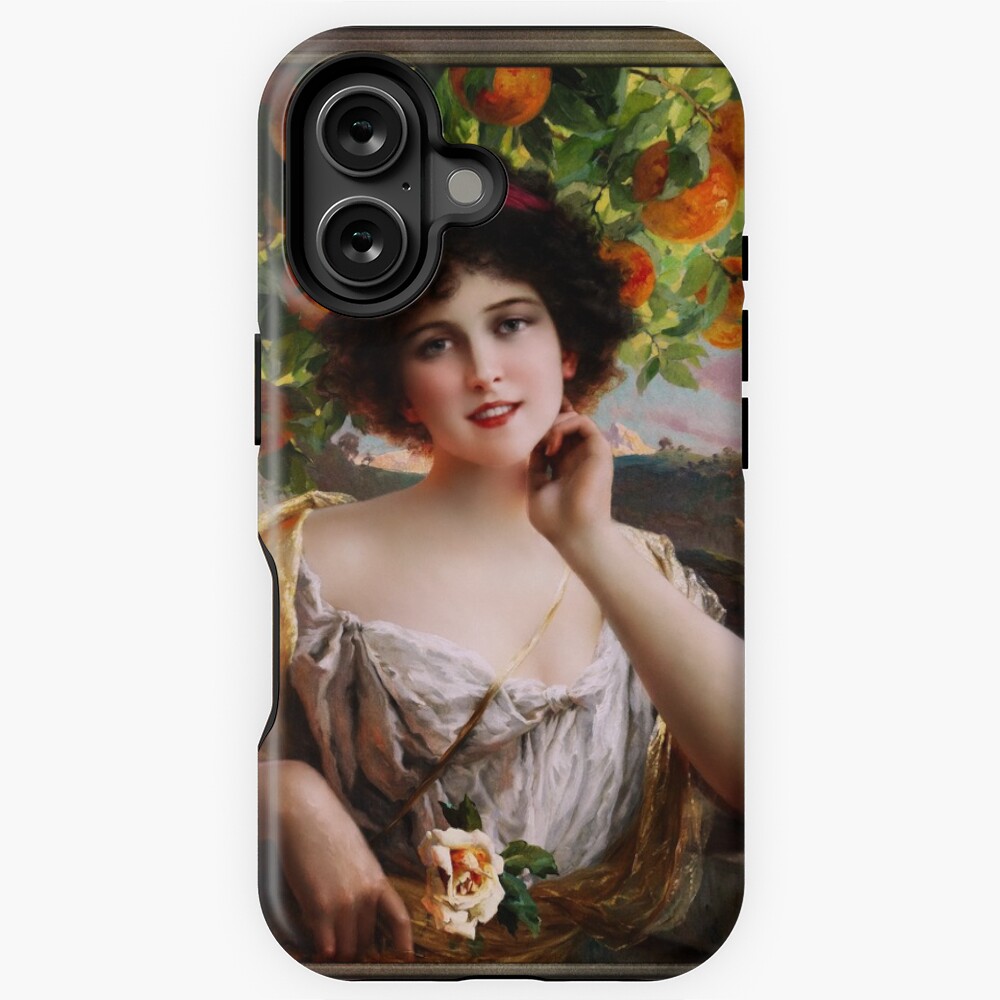
At the heart of the composition stands the young woman, her youthful innocence conveyed through her soft features and serene expression. Her light skin tone contrasts beautifully with the vivid backdrop of orange trees. Har hier, styled in soft curls, is crowned by a deep red ribbon that complements the rich tones of the surrounding scene. The woman’s gaze is directed just slightly off-center, as if lost in thought, evoking a sense of calm and quiet introspection. Her bare shoulders and exposed skin further emphasize the purity and natural beauty that Vernon sought to highlight in his work.
She is dressed in a simple yet elegant gown, made from flowing white fabric that catches the light in soft, radiant folds. A golden sash wrapped around her waist adds a touch of opulence, its gleaming hue echoing the brightness of the oranges hanging from the tree above her. The gown’s soft material contrasts with the vivid oranges in the background, which seem to symbolize abundance and vitality, themes often found in works of this period. The woman’s soft smile and the gentle manner in which she touches her neck contribute to her portrayal as a delicate, almost ethereal figure within this idyllic scene.
The Landscape and Setting
The backdrop of this painting is equally important, setting the tone and mood of the piece. A lush orange tree, heavy with fruit, arches over the woman, framing her in a natural embrace. The leaves of the tree are painted with fine attention to detail, their deep green color providing a striking contrast to the warm oranges, which glow with an almost lifelike intensity. These oranges not only contribute to the painting’s vibrant color palette but also add to the overall sense of calm and bounty that permeates the work. The tree’s canopy seems to provide both shade and shelter, creating a space of peace for the subject.
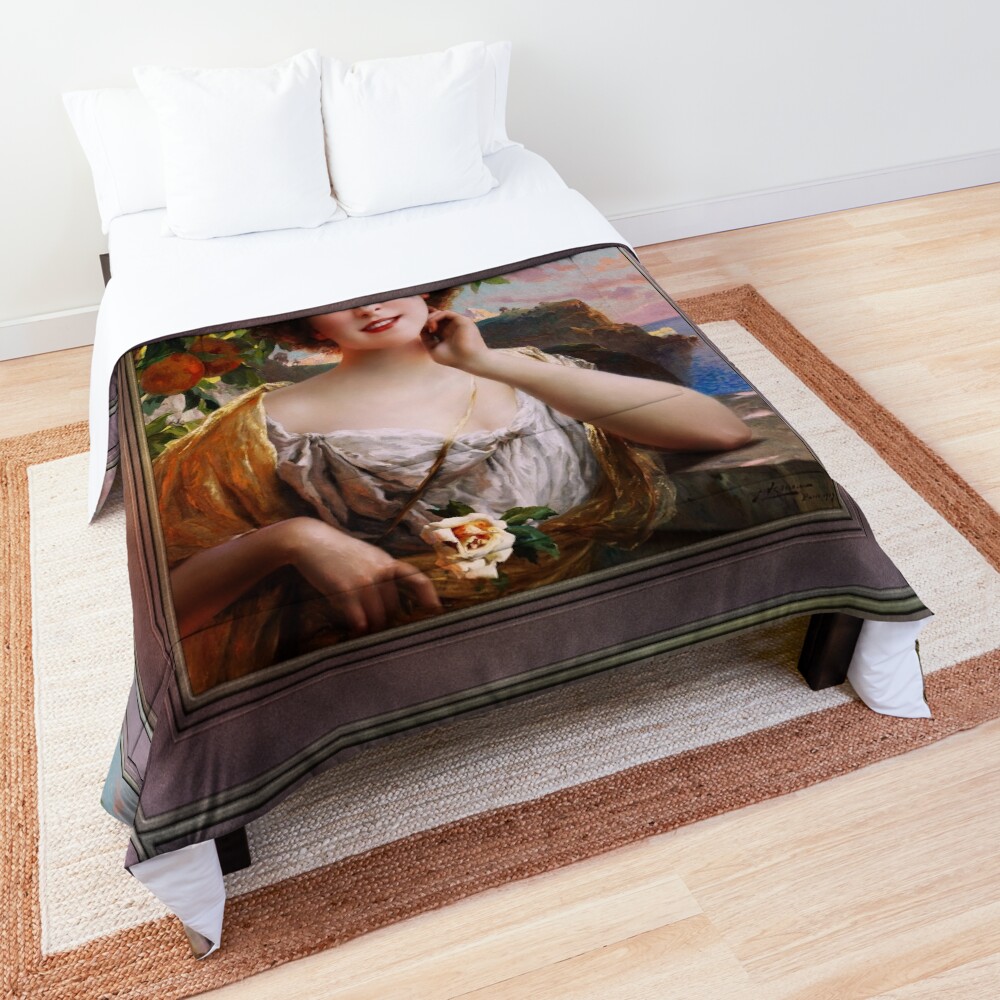
Beyond the tree, the terrain transitions into a soft, rocky landscape leading toward the ocean. The horizon is painted with a subtle gradient of pastel hues, from soft pinks and purples to the cool blues of the distant water. The light from the setting or rising sun casts a warm glow on the scene, lending the entire piece a romantic and peaceful atmosphere. The artist’s masterful use of light not only highlights the subject but also enhances the feeling of tranquility that flows through the work.
The scene is bathed in the soft glow of daylight, which pours through the canopy, casting dappled shadows onto the ground. The artist’s choice to include the seaside in the background adds depth and a sense of vastness to the scene. The water’s calm, almost reflective surface mirrors the stillness of the subject, reinforcing the theme of serenity that dominates the painting.
De stimming en sfear
De stimming fan “Beauty Under The Orange Tree” is one of quiet contemplation and natural beauty. The young woman, at ease in her surroundings, embodies the ideals of femininity that were celebrated during the Belle Époque period. Her pose is relaxed, suggesting that she is both at peace with herself and in harmony with the environment. De sêfte, almost pastel-like colors used throughout the composition further emphasize the peaceful, serene mood. The gentle play of light on the woman’s skin and the natural surroundings invites the viewer to experience a sense of calm and admiration.
This mood is also enhanced by the soft textures used throughout the painting. Vernon’s careful attention to detail in the rendering of the fabrics of the woman’s gown, the leaves of the tree, and the waves of the distant ocean, creates an overall sense of softness and tranquility. The scene evokes a timeless beauty, one that could belong to any period but is uniquely tied to the turn-of-the-century fascination with idealized beauty and harmony with nature.
Artistike styl en technyk
Émile Vernon’s painting exemplifies the style of the late 19th and early 20th centuries, where artists sought to bridge the gap between realism and idealism. His ability to blend these two approaches allows the viewer to experience both the realism of the natural world and the idealized vision of beauty. The fine details of the painting, especially in the portrayal of the woman’s skin, hier, and clothing, demonstrate Vernon’s mastery of texture and light.
Vernon uses rich, saturated colors that give depth to the figures and natural elements in the scene. The oranges of the tree, yn't bysonder, seem to leap from the canvas, bringing a vibrant energy to the otherwise tranquil composition. The soft blending of colors, especially in the sky and water, reflects the artist’s skill in capturing light, creating a harmonious balance between the figure, the tree, and the distant landscape.
The brushwork is subtle yet deliberate, with gentle strokes that form a cohesive whole. The blending of soft, muted tones in the background contrasts with the more defined, radiant forms of the subject and the fruit-laden tree. This contrast further emphasizes the central figure, making her the focal point of the composition.
Konklúzje
“Beauty Under The Orange Tree” by Émile Vernon is a painting that celebrates the natural world, feminine beauty, en rêst. Through his careful use of light, kleur, en tekstuer, Vernon creates a scene that is at once intimate and expansive, inviting the viewer to pause and appreciate the simplicity and peace found within nature. The painting captures an idealized moment of serenity, offering a window into a world where beauty and nature exist in perfect harmony.
This is a retouched digital art old masters reproduction of a public domain image which you can purchase as a canvas print online.
Dizze digitale keunst skepping, lykas mei al it keunstwurk dat te finen is op 'e Xzendor7-webside is online te keap yn in ferskaat oan materiaalformaten, ynklusyf canvasprints, acryl prints, metalen prints, hout prints, framed prints, posters, en as rôlde canvasprints yn in ferskaat oan grutte fan 12 inches oan 72 inch ôfhinklik fan de grutte fan it eigentlike keunstwurk en de print-on-demand winkel wêrfan jo kieze om de keunst te keapjen.
It keunstwurk is ek te krijen op in breed oanbod fan klean foar manlju en froulju, mokken, totes, sjaals, notebooks en tydskriften en in protte home decor produkten.
Oer The Artist
Info hjirûnder Fan Galery Ary Jan
Émile Vernon wie in studint oan de Skoalle foar Byldzjende Keunsten yn Tours dêr't hy de earste priis wûn foar tekenjen yn 1888; neitiid waard er doe begeliede troch William Bouguereau en Auguste Truphème.
Dan yn 1898 hy die mei oan de Tours-útstalling fan Byldzjende Keunsten en Dekorative Keunsten en letter dat jier, yn de Frânske keunstnerstentoanstelling en stelde dêr geregeld hie wurk út 1898 nei 1913; portretten presintearje, lânskippen, sênes út Bretanje, stillibbenboeketten dy't hy yn aquarel skildere, likegoed as froulike figueren, dy't letter waard is spesjaliteit.
Émile útblonk yn syn skilderijen fan sêft ferljochte, adorable figueren fan bern en elegante jonge froulju, mei wa't er faak in húsdier as in kat assosjearre, hûn of fûgel, en fersierde syn bylden mei slingers of boeketten fan blommen, syn hiele karriêre; mar hy wie ek in tige alsidige keunstner dy't mei strangens en krêft skilderje koe lykas yn syn wurken it portret fan Madame Vernon en Sous la Lampe (Under de lampe).