

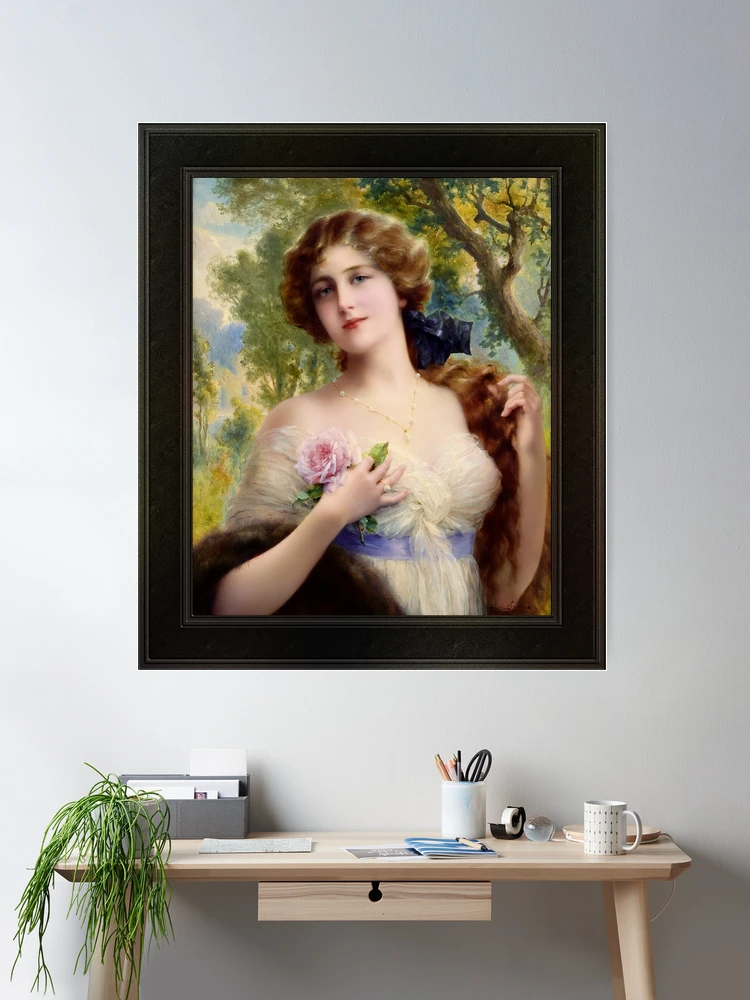
The Young Lady With A Rose c1916
“The Young Lady With A Rose,” oanmakke yn 1916 by the French painter Emile Vernon (1872 – 1919), is a captivating portrayal of feminine beauty set within the context of early 20th-century French art. Vernon, known for his romantic and idealized depictions of women, brings forth a vision of grace and delicacy that stands as a prime example of his work. The painting radiates a sense of peaceful serenity, capturing the subject with a gentle, hast etheryske oanwêzigens. This piece is a testament to Vernon’s mastery of light, weefselstruktuer, and the subtle nuances of emotional expression, drawing viewers into an intimate moment of timeless elegance.
Ynhâldsopjefte
Haadûnderwerp en komposysje
De sintrale figuer fan it skilderij is in jonge frou, elegantly poised, holding a large, sêft rôze roas yn har lofterhân. Se sjocht direkt nei de sjogger mei in lichte, útnoegjend glimke. Har eagen, sêft en sêft, in lucht fan waarmte en sêftens oerbringe, en de sêfte plooien fan har goudbrune hier, tafallich regele, komplementearje har serene útdrukking. De klean fan 'e frou bestiet út in delikate off-white jurk, foar in part drapearre oer har skouders, mei in ljocht lavendelblauwe sjerp dy't in elemint fan kleurkontrast en ferfining tafoeget.
De roas dy't se hâldt is in symboal fan skientme, froulikens, en ferfining. It is grut, sêfte blomblêden lykje hast te triljen fan it libben, fêstlein mei in hast tactile presyzje. De betûfte werjefte fan Vernon fan 'e roas en it byhearrende grien leveret in prachtich kontrast oan' e bleke teint en ljochte jurk fan 'e frou. De blom is natuerlik, sêft roze kleur stiet as in stille ferklearring fan jeugdige skientme, fierder de klam op 'e suverens en genede fan it ûnderwerp.
De ynstelling en eftergrûn
Achter de jonge frou, de eftergrûn lit in serene en weelderige lânskip sjen. In sêfte bosk sêne mei dappled sinneljocht filterjen troch de beammen soarget foar in sêft, hast dreamlike sfear. It blêd is skildere yn rike tinten grien, suggerearret in freedsume plattelân of tún ynstelling, mooglik hingjen op in idyllyske lân retreat. De waarme toanen fan sinneljocht kontrastearje subtyl mei de koele skaden, it ferbetterjen fan de trijediminsjonaliteit fan it ûnderwerp en it toaniel yndrukke mei in lucht fan rêst.
Vernon syn kar fan sa'n natuerlike, freedsume omjouwing komplementearret de jeugdige ûnskuld fan it ûnderwerp. The setting does not dominate the composition but instead supports the overall mood of calm and contemplation. The soft brushwork used to depict the trees and distant landscape further deepens the sense of depth and space within the work.
Styl en technyk
Émile Vernon was influenced by the Symbolist movement, and his works often carried elements of romanticism and realism. “The Young Lady With A Rose” exemplifies his ability to blend these influences into a harmonious and elegant style. His painting technique is marked by a delicate handling of light and color, hokker, in this instance, creates an atmosphere of softness and subtle elegance. Vernon’s expert use of light, particularly the gentle illumination of the young woman’s face and figure, creates a glowing effect, drawing the viewer’s eye to the subject and enhancing the overall ethereal mood of the piece.
The brushwork in the painting is both smooth and detailed, with an emphasis on the textures of the skin, stof, and flowers. Each fold in the woman’s gown is carefully modeled to suggest softness and movement, while her delicate features—especially her eyes and lips—are rendered with precise attention to form, yet with a subtlety that avoids overemphasis. The handling of the rose and its petals is particularly skillful, as Vernon has captured the flower’s delicate structure with a near-photographic quality, lending it an almost tangible presence in the scene.
Tema en stimming
The theme of the painting is centered on youthful beauty and femininity, conveyed through the depiction of the young woman as both a subject of admiration and a symbol of grace. The flower she holds in her hand, with its soft colors, is often associated with themes of love, skientme, and purity, aligning with the serene and delicate expression she carries.
The mood of the artwork is one of quiet contemplation and serenity. The young woman is not portrayed as an object of desire, but as a figure that embodies gentleness and a sense of inner peace. Her expression and posture suggest an intimate moment of grace, evoking a sense of tranquility and timelessness. De waarme, gouden ljocht, paired with the natural beauty of the surroundings, contributes to an atmosphere that feels both nostalgic and enduring. The gentle, harmonious palette further enhances the overall calm and peaceful tone of the piece.
Materials and Surface
“The Young Lady With A Rose” is painted using traditional oil on canvas. The surface is smooth yet textured in places, such as in the fabric of the woman’s gown and the detailed rendering of the rose. Vernon’s precise use of oils allows for the creation of soft gradients of color that are integral to the mood of the painting. It skilderij is ryk oan detail, yet retains a fluidity that makes the work feel effortless, emphasizing the natural beauty of the subject and her environment.
The overall presentation of the painting, from the subject’s soft skin to the details in the foliage, reflects the high level of skill and attention to detail that Vernon applied throughout his career. De materialen, technyk, and color choices all work together to create a work of art that remains timeless and evocative.
Konklúzje
Yn “The Young Lady With A Rose,” Émile Vernon has created an artwork that combines romance, sierlikens, and serenity in a single frame. The soft palette, the graceful depiction of the young woman, and the serene landscape combine to create a work that speaks of beauty and calm, making it a quintessential example of Vernon’s style. The rose, a central motif, serves as both a literal and symbolic reminder of the delicate nature of femininity, while the painting as a whole speaks to the enduring power of beauty, captured in a moment of peace.
Dit is in retouchearre reproduksje fan âlde masters fan digitale keunst fan in ôfbylding yn it iepenbier domein.
Artist Bio
Info hjirûnder Fan Galery Ary Jan
Émile Vernon wie in studint oan de Skoalle foar Byldzjende Keunsten yn Tours dêr't hy de earste priis wûn foar tekenjen yn 1888; neitiid waard er doe begeliede troch William Bouguereau en Auguste Truphème.
Dan yn 1898 hy die mei oan de Tours-útstalling fan Byldzjende Keunsten en Dekorative Keunsten en letter dat jier, yn de Frânske keunstnerstentoanstelling en stelde dêr geregeld hie wurk út 1898 nei 1913; portretten presintearje, lânskippen, sênes út Bretanje, stillibbenboeketten dy't hy yn aquarel skildere, likegoed as froulike figueren, dy't letter waard is spesjaliteit.
Émile útblonk yn syn skilderijen fan sêft ferljochte, adorable figueren fan bern en elegante jonge froulju, mei wa't er faak in húsdier as in kat assosjearre, hûn of fûgel, en fersierde syn bylden mei slingers of boeketten fan blommen, syn hiele karriêre; mar hy wie ek in tige alsidige keunstner dy't mei strangens en krêft skilderje koe lykas yn syn wurken it portret fan Madame Vernon en Sous la Lampe (Under de lampe).