

Brigue au large de la côte du Maine
“Brigue au large de la côte du Maine,” peint en 1851 by Fitz Hugh Lane (1804 – 1865), is a remarkable maritime work that captures the majesty of the sea and the intricate interplay of light, vent, and water. Lane, an American painter known for his detailed seascapes, invites the viewer into a world where the natural beauty of the Maine coast is juxtaposed with the raw, untamed energy of the ocean. This painting showcases Lane’s skill in rendering the expansive vistas of the sea, using a refined technique that emphasizes both realism and the ethereal qualities of the environment. The painting is both a celebration of maritime life and an exploration of the profound relationship between humans and nature during the 19th century.
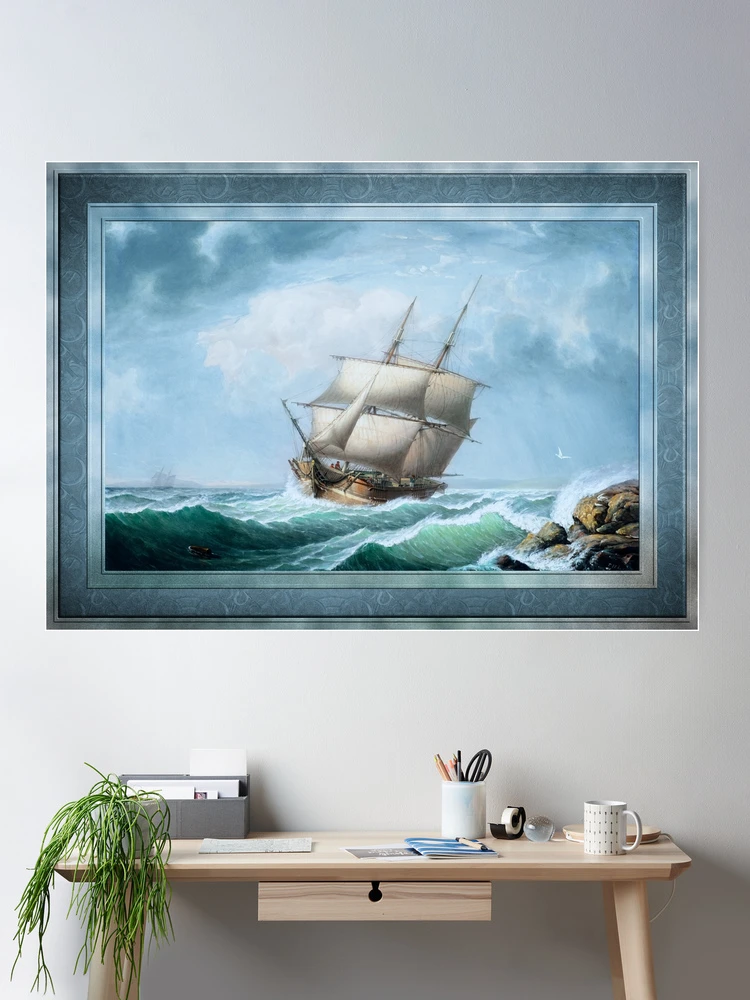
Table des matières
Le sujet principal: The Brig and Its Journey
At the heart of the artwork is a brig, an elegantly proportioned two-masted ship, navigating the choppy, turbulent waters off the coast of Maine. The ship appears to be actively engaged in its journey, with its sails filled by the brisk wind. The brig is not the only subject; plutôt, it is the focal point within a broader scene where the interplay between the ship and its surrounding natural environment takes precedence.
The ship’s sturdy hull is painted with meticulous care, reflecting the artist’s ability to capture fine details of wood, rigging, and canvas. This conveys a sense of strength and resilience, embodying the spirit of adventure and commerce that was common for ships of that era.
Lane presents the brig with sails billowing, its course determined by both the wind and the skill of its crew. La lumière, white sails contrast with the deep hues of the ocean, their pristine fabric offering a stark visual contrast to the wild, rough water below. The slight tilt of the ship hints at its struggle against the natural forces of the sea, which is one of the predominant themes in Lane’s seascapes, humankind’s perpetual battle with the vastness and power of the natural world.
Terrain and Landscape: A Majestic, Untamed Coastline
The backdrop of the painting offers a sweeping view of the rugged Maine coastline, marked by jagged rocks and steep cliffs that rise from the turbulent waters. The landscape is typical of the Maine coast, wild, pristine, and untamed. The coastline’s rocky outcrops are detailed, with uneven textures that speak to the harshness of the environment, and the waves crashing against them emphasize the constant erosion by the ocean’s unyielding motion.
Au loin, the horizon stretches out, giving the viewer a sense of endless space. There are hints of other ships, likely distant or out of focus, suggesting the vibrancy of maritime activity that pervaded the region. These ships are part of a wider maritime world, where fishing, commerce, and exploration played critical roles in the economy of Maine and the broader Northeastern United States during the 19th century.
The ocean itself dominates the scene, with its dark green and blue hues suggesting both calmness and violence. The waves curl, their foam catching the light in white streaks, while the undulating movement of the water conveys a sense of dynamism. The brushstrokes are soft yet deliberate, capturing the texture of the waves and their powerful interaction with the brig. À travers, Lane allows the ocean to become an active participant in the narrative, mirroring the struggles faced by sailors and explorers navigating its vastness.
Light and Atmosphere: The Changing Mood
One of the most striking aspects of “Brigue au large de la côte du Maine” is the artist’s treatment of light. Lane uses a diffuse, natural light that bathes the scene in a soft glow, particularly noticeable on the ship’s sails and the cresting waves. The sunlight appears to filter through the clouds, creating a shimmering effect that contrasts with the darker, shadowed areas of the painting. This light helps to imbue the scene with an atmospheric quality, where the sky and sea are not mere backdrops but integral parts of the composition.
The sky above is dynamic, with swirling clouds that range from billowy whites to more somber grays. The vastness of the sky mirrors the expanse of the sea, and the transition between them is seamless, blurring the line between water and air. This contributes to a mood of transition, as though the viewer is suspended in a moment of time, witnessing the brig navigating the vast unknown. Lane captures the mood of uncertainty, where nature’s unpredictability reigns, yet there is a quiet sense of peace in the balance between the ship and its environment.
Les matériaux et les techniques: A Blend of Realism and Romanticism
Lane’s technique in this painting is characteristic of his style, blending the precision of realism with the romanticism of the 19th-century maritime tradition. His use of oil paints allows for smooth transitions between light and shadow, as well as the nuanced rendering of textures—whether the smoothness of the ship’s wood or the rough, frothy sea. The colors are rich yet restrained, with the deeper tones of the ocean and rocks providing a contrast to the lighter shades of the sky and sails.
Lane’s attention to detail is evident in his careful depiction of the ship’s rigging and sails, as well as the individual waves. The texture of the water is rendered with delicate precision, evoking the feeling of wind and water colliding in an endless dance. The clouds above, while dramatic in their composition, are painted with a soft touch that gives them an almost ethereal quality. Through these materials, Lane captures both the reality of the maritime world and the more philosophical sense of the sea as a powerful and unpredictable force.
Le thème et l'ambiance: A Sense of Adventure and Struggle
Le thème général de “Brigue au large de la côte du Maine” is one of adventure, lutte, and the ever-present tension between human endeavor and the unpredictable forces of nature. The mood is one of awe, where the viewer is invited to reflect on the vastness of the ocean and the challenges faced by those who sailed upon it. En même temps, there is a sense of calm that comes with the stability of the brig as it glides across the waves. The ship’s steadiness in the face of the tumultuous waters evokes a quiet resilience, as though the journey itself is a part of a greater, timeless struggle.
This duality—the fierce power of the sea versus the calm, controlled strength of the ship—reflects Lane’s own fascination with the maritime world, where human beings seek mastery over nature, even as they acknowledge its vastness and unpredictability. The painting serves not only as a historical record of the 19th-century maritime world but also as a meditation on humanity’s relationship with the natural world.
Il s'agit d'une reproduction de maîtres anciens d'art numérique retouchée d'une image du domaine public.
Cette création d'art numérique, comme toutes les œuvres d'art disponibles sur le site Web Xzendor7, elles sont disponibles à l'achat en ligne dans une variété de formats de matériaux, y compris des impressions sur toile., impressions acryliques, impressions métalliques, gravures sur bois, impressions encadrées, affiches, et sous forme d'impressions sur toile roulées dans une variété de tailles de 12 pouces à 72 pouces en fonction de la taille de l'œuvre d'art réelle et de la boutique d'impression à la demande auprès de laquelle vous choisissez d'acheter l'art.
L’œuvre d’art est également disponible sur une large gamme de vêtements pour hommes et femmes., tasses, fourre-tout, écharpes, cahiers et journaux et de nombreux produits de décoration intérieure.
Biographie de l'artiste
Informations ci-dessous dérivées de Wikipedia.org
Fitz est né à Gloucester, Massachusetts en décembre 19, 1804 à Jonathan Dennison Lane, un voilier, et a été baptisé Nathaniel Rogers Lane en mars 17, 1805.
En décembre 26, 1831 a fait une demande officielle à l'État du Massachusetts pour changer son nom de Nathaniel Rogers Lane à Fitz Henry Lane; et à l'âge de 27 en mars 13, 1832 l'État du Massachusetts lui a accordé le changement de nom.
Pendant une brève période de sa jeunesse, Fitz travaillait comme fabricant de chaussures; mais après avoir reconnu qu'il pouvait dessiner bien mieux que fabriquer des chaussures, déménagé à Boston, Massachusetts pour prendre des cours de dessin et de peinture et entamer une carrière de peintre de marine.
Fitz a acquis ses leçons artistiques grâce à son emploi à l'atelier de lithographie Pendleton à Boston de 1832 à 1847; et grâce à cette expérience et aux compétences qu'il a acquises, il a pu produire des peintures marines de haute qualité..
Fitz est reconnu pour avoir créé le style connu sous le nom de Luminisme (un style caractérisé par des effets de lumière dans le paysage, grâce à l'utilisation de la perspective aérienne et à la dissimulation des coups de pinceau visibles – https://en.wikipedia.org/wiki/Luminism_(style_art_américain))
Dans 1848 Fitz est retourné à Gloucester, et s'y installe définitivement; et en 1849 a commencé à superviser la construction d'une combinaison de maison et de studio de sa propre conception à Cuncan's Point; qui restera sa résidence principale pour le reste de sa vie.