

Brünettes Pinup-Girl mit blauen Blumen auf dem Kopf vom peruanischen Künstler Alberto Vargas (1896 – 1982)
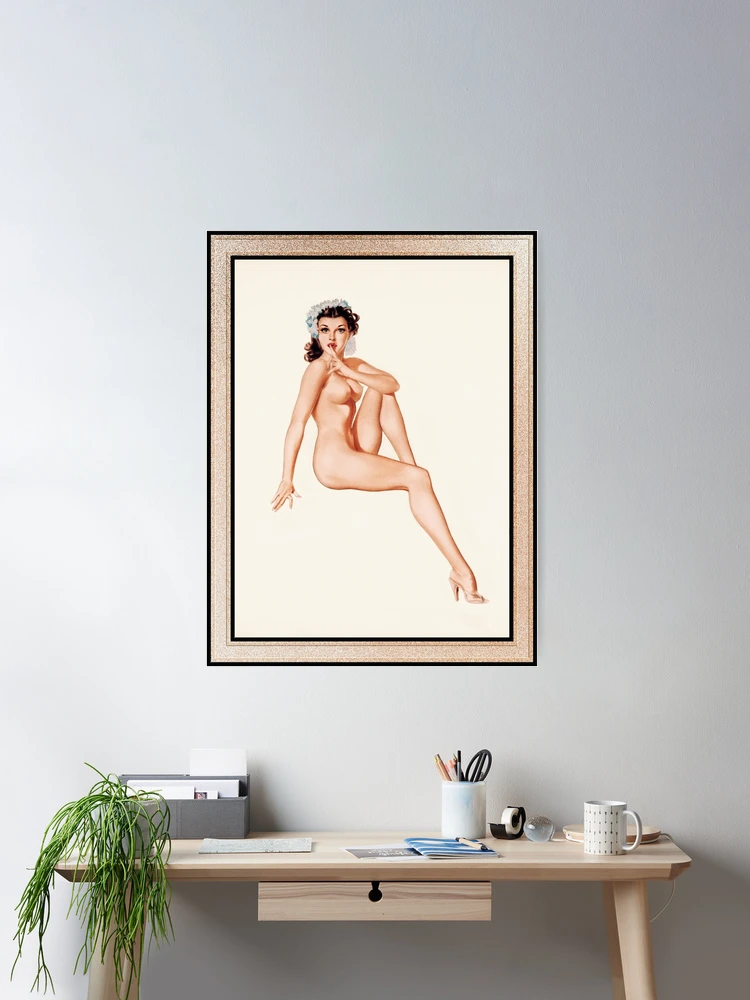
Brünettes Pinup-Girl mit blauen Blumen auf dem Kopf von Alberto Vargas (1896 – 1982), a renowned Peruvian artist famous for his contributions to pin-up art, captures a moment of alluring beauty in this painting. Das Stück, which exemplifies the pin-up genre that became iconic in mid-20th century American art and advertising, features a sultry and captivating portrayal of a nude brunette pinup girl with dark brown hair adorned with blue flowers, in a pose that exudes both playfulness and confidence. Alberto Vargas’s expertise in capturing feminine allure through soft, yet assertive portrayals of women is evident here, with his precise attention to detail, vibrant color palette, and his signature ability to instill life into his subjects.
This particular artwork is representative of the golden age of pin-up art, and Vargas’s influence in shaping that era cannot be overstated. His mastery of color and his meticulous rendering of human form give the figure of the woman a sense of life and personality. The model in the piece is seated gracefully, her hand placed gently across her lips as if to shush the viewer, adding an element of intimacy and mystery to her character. The model’s gaze, though inviting, also maintains a sense of secrecy, further enhanced by the placement of her finger to her lips, alluding to an unspoken narrative between artist and observer.
Inhaltsverzeichnis
Hauptthema: Das Pinup-Girl
The central figure of the artwork is a stunning brunette woman, painted in soft, elegant tones that highlight the curves of her body and the subtle contours of her facial features. She is depicted in a seated pose, the posture both relaxed and seductive. Her bare skin, rendered in light peach and tan tones, contrasts beautifully against the background’s pale, almost empty space, bringing the viewer’s attention squarely on her form.
Ihre Haare, a rich chestnut brown, is styled in loose curls, a style typical of the pin-up genre. The delicate addition of small blue flowers woven into her hair creates a visual focal point, drawing attention to her face while also softening her otherwise bold and confident pose. These blue flowers serve as a significant contrast to her warm-toned complexion and further emphasize her femininity. The flowers evoke a sense of purity, Unschuld, and youth, which contrasts with the otherwise sensual expression of the model, creating an interesting juxtaposition in the overall tone of the painting.
Her body is depicted with a soft, flowing grace, emphasizing the rounded shape of her hips and legs while maintaining an air of modesty despite her nude form. The pose is both intimate and confident, as though she is aware of her beauty but not overtly flaunting it. The artist’s ability to capture a balance between suggestiveness and subtlety is one of the defining characteristics of Vargas’s pin-up art, und dieses Gemälde ist keine Ausnahme.
Mood and Style
The mood of the artwork can be described as both serene and provocative. The subject’s facial expression, along with her finger placed to her lips, suggests a quiet moment of contemplation or secrecy, inviting the viewer into a moment of stillness. jedoch, the soft contours of her body and the vulnerability suggested by her pose give the piece an undertone of seduction and allure. The viewer is drawn into the painting, engaging with the model’s direct gaze and the implied mystery surrounding her gesture.
Vargas’s use of color is another integral aspect of the work. Das Weiche, pastel-like tones of her skin contrast with the vibrant pop of blue flowers, creating a balanced and pleasing visual experience. The overall lack of background detail helps maintain the focus on the woman herself, allowing her presence to fill the space. This minimalist approach also serves to amplify the emotional intensity of the work, as there are no external distractions from the model’s form and expression.
As for the style, “Brunette Pinup Girl With Blue Flowers On Her Head” is unmistakably in line with the classic pin-up aesthetic of the mid-20th century. Vargas was known for his ability to infuse glamour and sensuality into his pin-up illustrations, creating women who were simultaneously idealized and relatable. His mastery of lighting and shadow lends the figure a sculptural quality, enhancing the three-dimensionality of the subject. The technique is smooth and polished, emphasizing the model’s flawless beauty and the painter’s precision in capturing delicate details, such as the texture of her hair, the curvature of her arms, and the slight play of light on her skin.
Objekte und Materialien
The artwork itself is framed in a classic, ornate frame that complements the overall vintage aesthetic of the pin-up genre. The golden, textured border adds an additional layer of opulence to the piece, evoking the glamour and prestige of the time period in which the pin-up art style flourished. The simple background, devoid of any extraneous objects or scenery, allows the model to remain the focal point of the composition.
Platzhalterbild für Alberto Vargas, a master of creating portraits of women, relies on his exceptional talent in illustrating human figures, using a combination of traditional materials to bring his vision to life. Der glatte, almost airbrushed quality of the work suggests that Vargas employed techniques that allowed for precise blending of tones and textures, adding a soft and ethereal quality to the figure while still maintaining a sense of realism. His attention to detail in the model’s expression, ihre Haare, and even the soft folds of her limbs underscores his technical prowess as a painter.
Abschluss
“Brunette Pinup Girl With Blue Flowers On Her Head” by Alberto Vargas is a quintessential piece of mid-century pin-up art, offering both a visual feast and an emotional connection to the viewer. The painting exemplifies Vargas’s trademark skill in capturing the female form with grace and sensuality while maintaining an air of mystery and elegance. The serene mood coupled with the subject’s confident allure speaks to Vargas’s mastery of evoking both beauty and subtle narrative. This artwork remains a timeless example of Vargas’s lasting influence on the pin-up genre and its place in American culture.
Brünettes Pinup-Girl mit blauen Blumen auf dem Kopf vom peruanischen Künstler Alberto Vargas (1896 – 1982); für seine verführerische und exquisite Pin-Up-Girl-Kunst und gilt als der berühmteste des Pin-Up-Künstler-Genres.
Ein sitzender Nacktes brünettes Pinup-Girl Mit blauen Blumen auf dem Kopf, die offene Fersen- und Zehenabendschuhe tragen, gestikuliert dem Betrachter pssst, während sie ihre beste Pose für das Porträt gibt
Brunette Pinup Girl ist eine retuschierte Reproduktion der digitalen Kunst alter Meister eines gemeinfreien Bildes.
Info unten von Wikipedia.org
Geboren in Arequipa, Peru, er war der Sohn des bekannten peruanischen Fotografen Max T. Vargas. Alberto Vargas zog in die Vereinigten Staaten in 1916 nach dem Kunststudium in Europa, Zürich, und Genf vor dem Ersten Weltkrieg.
Während seines Aufenthalts in Europa stieß er auf die französische Zeitschrift La Vie Parisienne, mit einem Cover von Raphael Kirchner, was, wie er sagte, einen großen Einfluss auf seine Arbeit hatte.
Seine frühe Karriere in New York umfasste Arbeiten als Künstler für die Ziegfeld Follies und für viele Hollywood-Studios. Ziegfeld hat sein Gemälde von Olive Thomas im Theater aufgehängt, und sie galt als eine der frühesten Vargas Girls.
Vargas’ berühmteste filmarbeit war für das poster des 1933 Film Die Sünde von Nora Moran, die eine fast nackte Zita Johann in einer Pose der Verzweiflung zeigt. Das Poster wird häufig als eines der besten Filmplakate aller Zeiten bezeichnet.
Er wurde in den 1940er Jahren als Schöpfer der ikonischen Pin-ups aus der Zeit des Zweiten Weltkriegs für das Esquire-Magazin bekannt als “Vargas-Mädchen.” Zwischen 1940 und 1946 Vargas produziert 180 Bilder für das Magazin.
Die Nasenkunst vieler amerikanischer und alliierter Flugzeuge aus dem Zweiten Weltkrieg wurde von diesen Esquire-Pin-ups inspiriert und angepasst, sowie die von George Petty, und andere Künstler.