

Venus auf den Wellen
Venus auf den Wellen: A Rococo Dreamscape
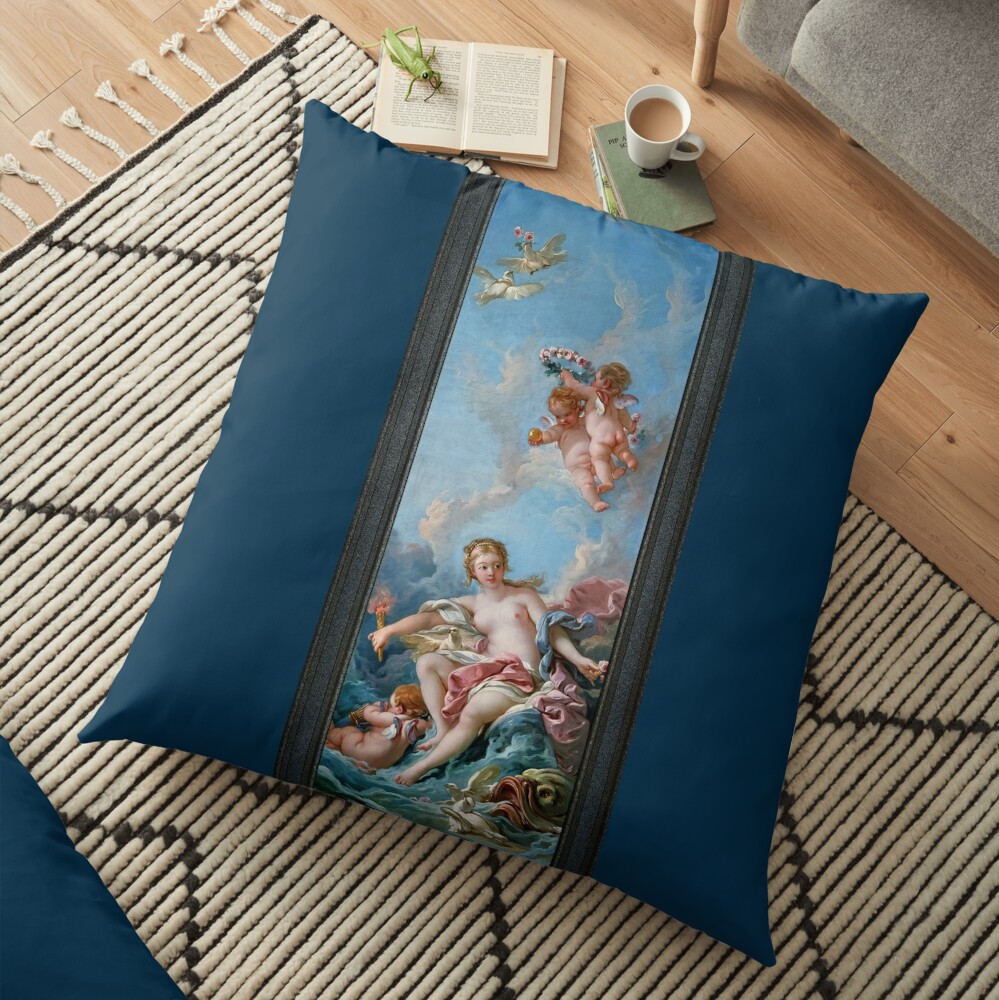
Francois Boucher'S (1703 – 1770) “Venus on the Waves,”Herumgemalt 1769, exemplifies the quintessential Rococo style that flourished in France during the mid-18th century. This vertical format painting, a testament to Boucher’s mastery of color and composition, depicts the Roman goddess Venus, or Aphrodite as she is known in Greek mythology, emerging from the sea amidst a swirling panorama of clouds, Putten, and marine motifs. The work was commissioned by Madame de Pompadour, Louis XV’s influential mistress, reflecting the era’s taste for mythological subjects rendered with elegance and sensuality.
Inhaltsverzeichnis
Kompositionselemente & Narrative Absence
Die Komposition ist vertikal ausgerichtet, drawing the viewer’s eye upwards from the turbulent sea towards the celestial realm above. Venus occupies a central position, seated upon a shell-like structure that rises from the waves. She appears serene and composed, her gaze directed slightly downwards, as if acknowledging the surrounding spectacle but not actively participating in it. The lower portion of the painting is dominated by the churning ocean, rendered with a palette of blues and greens, punctuated by whitecaps suggesting movement and energy. Above Venus, a swirling sky filled with clouds provides a backdrop for several cherubic figures engaged in playful activities.
Cherubs & Symbolische Details
Several cherubs populate the scene, each contributing to the overall atmosphere of lightness and grace. One cherub floats above Venus, scattering rose petals – a traditional symbol of love and beauty associated with the goddess. Another group of cherubs is depicted weaving a garland, adding a touch of pastoral charm to the composition. A winged putto flies overhead carrying a bouquet of flowers, further reinforcing the theme of affection and celebration. The shell upon which Venus sits isn’t merely decorative; it’s a symbolic representation of her birth from the sea foam – a foundational myth in classical mythology.
Boucher’s Rococo Style: Farbe & Technik
Boucher’s artistic style is immediately recognizable through his use of soft, pastel colors and delicate brushstrokes. The painting lacks sharp lines or dramatic contrasts; stattdessen, it relies on subtle gradations of color to create a sense of ethereal beauty. His technique emphasizes fluidity and movement, particularly evident in the depiction of the waves and clouds. Boucher’s mastery of light is also apparent – Venus appears bathed in a soft, diffused glow that enhances her luminous quality. The overall effect is one of dreamy tranquility, characteristic of Rococo art’s pursuit of pleasure and escapism.
Kontext & Historical Significance
“Venus on the Waves” was created during a period when mythological subjects were highly fashionable among the French aristocracy. Boucher’s interpretation of Venus departs from earlier depictions that emphasized her power or authority; stattdessen, he presents her as an embodiment of beauty, Anmut, and sensuality – qualities prized by the court of Louis XV. The painting reflects the Rococo era’s shift away from the grandeur of the Baroque towards a more intimate and decorative style. It served not only as a work of art but also as a symbol of refined taste and aristocratic patronage.
Examination of Venus’s Pose & Ausdruck
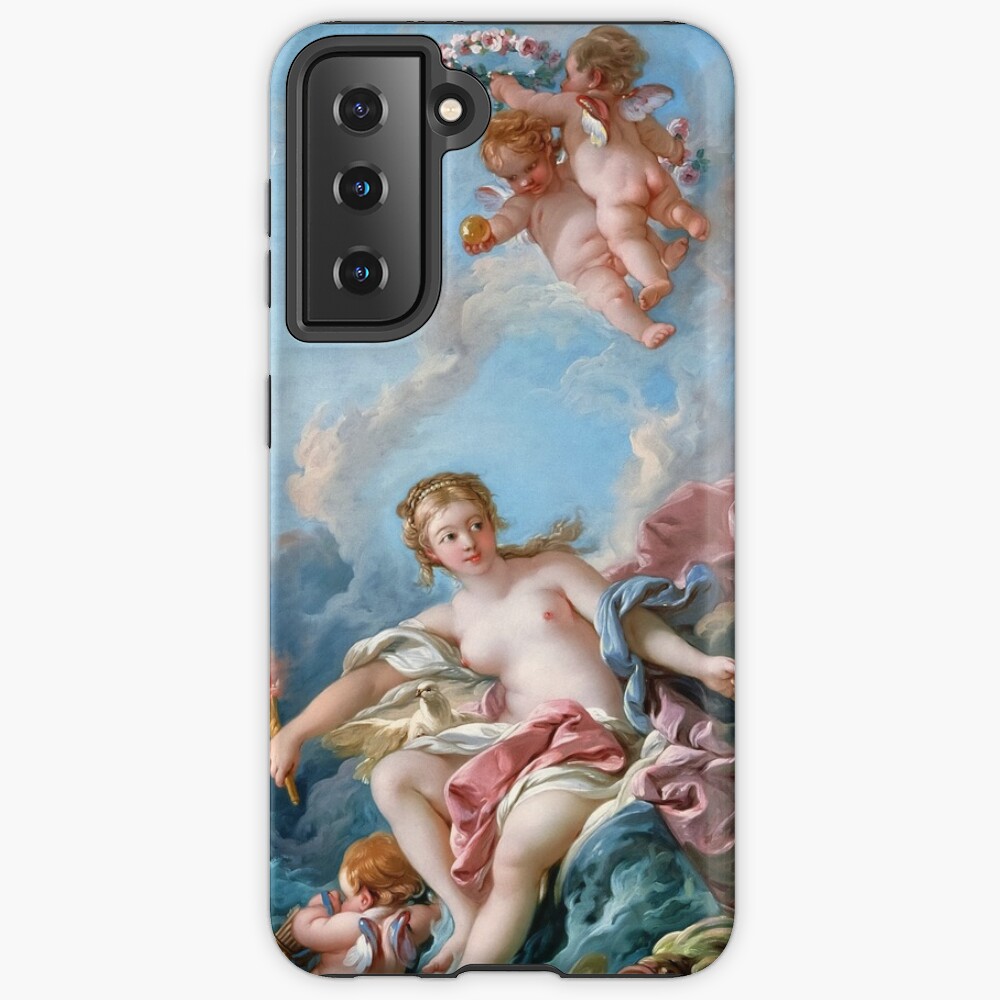
Venus is depicted in a relaxed, almost languid pose. Her body curves gently, suggesting both softness and vitality. She holds a single torch aloft, its flame casting a warm glow on her face and hands. The torch itself carries symbolic weight; it represents the divine spark of love and beauty that Venus embodies. Her expression is serene and contemplative, conveying a sense of inner peace and detachment from the surrounding activity. This lack of overt emotion contributes to the painting’s overall atmosphere of tranquility and grace.
Farbpalette & Atmospheric Effects
The color palette in “Venus on the Waves” is dominated by soft blues, Rosa, Grüns, und Gold. These colors contribute to the painting’s ethereal quality and evoke a sense of warmth and light. Boucher skillfully uses atmospheric perspective – rendering distant objects with less detail and paler colors – to create a sense of depth and space within the composition. The swirling clouds and turbulent waves add dynamism to the scene, while the soft lighting enhances the overall feeling of dreamlike beauty.
Künstlerische Einflüsse & Vermächtnis
Boucher’s work was influenced by earlier masters such as Peter Paul Rubens and Jean-Antoine Watteau, both renowned for their depictions of mythological subjects and their mastery of color and composition. jedoch, Boucher developed his own unique style that became synonymous with the Rococo movement. “Venus on the Waves” is considered one of his most iconic works and has had a lasting impact on Western art, inspiring countless artists to emulate its elegance and sensuality. The painting remains an important example of Rococo aesthetics and a testament to Boucher’s artistic genius.
Künstler Bio abgeleitet von Wikipedia.org
Ein gebürtiger Pariser, Boucher war der Sohn eines weniger bekannten Malers Nicolas Boucher, wer gab ihm seine erste künstlerische Ausbildung. Im Alter von siebzehn Jahren, Ein Gemälde von Boucher wurde vom Maler François Lemoyne bewundert. Lemoyne ernannte später Boucher zu seinem Lehrling, aber nach nur drei Monaten, Er arbeitete für den Kupferstecher Jean-François Cars.
Im 1720, Er gewann den Elite Grand Prix de Rome für Malerei, nutzte aber erst fünf Jahre später die Gelegenheit, in Italien zu studieren, aufgrund finanzieller Probleme an der Royal Academy of Painting and Sculpture.[1] Nach seiner Rückkehr vom Studium in Italien wurde er in die neu gegründete Académie de Peinture et de Sculpture am aufgenommen 24 November 1731. Sein Empfangsstück (Empfangsstück) war sein Rinaldo und Armida von 1734.
Boucher heiratete Marie-Jeanne Buzeau in 1733. Das Paar hatte drei Kinder zusammen. Boucher wurde Fakultätsmitglied in 1734 und seine Karriere beschleunigte sich von diesem Punkt an, als er zum Professor und dann zum Rektor der Akademie befördert wurde, Inspektor der Royal Gobelins Manufaktur und schließlich Premier Peintre du Roi (Erster Maler des Königs) im 1765. Porträt von Marie-Louise O’Murphy c. 1752
Boucher starb am 30 Kann 1770 in seiner Heimat Paris. Sein Name, zusammen mit dem seiner Patronin Madame de Pompadour, war zum Synonym für den französischen Rokoko-Stil geworden, die Goncourt-Brüder zum Schreiben führen: “Boucher ist einer jener Männer, die den Geschmack eines Jahrhunderts repräsentieren, die ausdrücken, personifizieren und verkörpern es.”
Boucher ist berühmt dafür, dass die Natur es ist “zu grün und schlecht beleuchtet” (zu grün und schlecht beleuchtet).
Boucher war mit dem Edelsteinstecher Jacques Guay verbunden, wen er lehrte zu zeichnen. Er betreute auch den mährisch-österreichischen Maler Martin Ferdinand Quadal sowie den neoklassizistischen Maler Jacques-Louis David in 1767.[4] Später, Boucher fertigte eine Reihe von Zeichnungen von Werken Guays an, die Madame de Pompadour dann gravierte und als hübsch gebundenen Band an bevorzugte Höflinge verteilte
Venus On The Waves is a retouched digital art reproduction of a public domain image that is available as a gerollter Druck online.