

Exposition universelle de Chicago – Un siècle de progrès, 1833 – 1933
Exposition universelle de Chicago – Un siècle de progrès, 1833 – 1933 – 27 mai au 1er novembre Affiche d'art vintage Art Déco
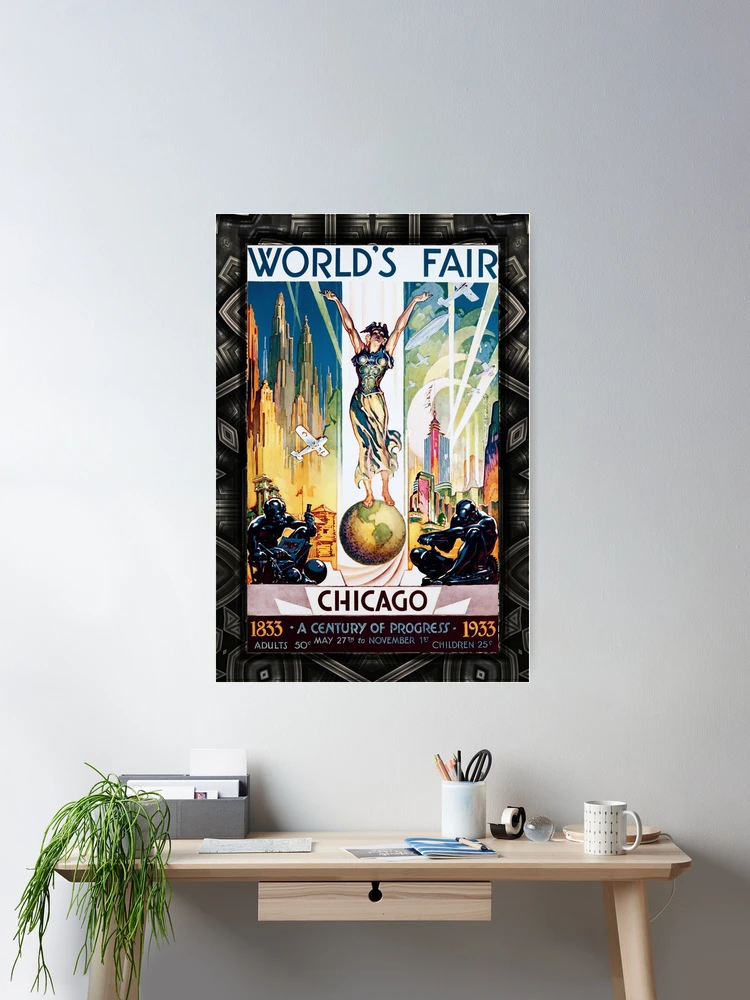
Table des matières
Cette œuvre d'art saisissante est une représentation emblématique de la 1933 Chicago Exposition universelle, connu sous le nom “Un siècle de progrès.” Cet événement, qui a eu lieu à Chicago pour marquer le 100e anniversaire de la fondation de la ville, était une grande célébration de l'innovation technologique, modernité, et des progrès. Le design de l'affiche lui-même est un exemple magistral du style Art déco qui dominait le début du 20e siècle., alliant futurisme, élégance et grandeur.
Sujet principal: La figure centrale
Au cœur de la composition se trouve une figure féminine allégorique plus grande que nature., qui symbolise le progrès et l'innovation. Elle est représentée triomphalement au sommet du monde., avec ses bras tendus vers le haut dans un geste d'autonomisation, une pose saisissante qui transmet force et vision. The female figure, embodying the spirit of the fair, wears a futuristic, metallic, almost armor-like attire, reflecting the era’s fascination with technology and modernity. Her pose is both heroic and graceful, a visual metaphor for humanity’s progress in both culture and technology.
Objets et symbolisme
Flanking the central figure, two figures in black, symbolic of man and machine, represent the contrasting forces of the industrial age. Ces chiffres, depicted in a stylized and geometric manner typical of Art Deco, are looking up at the central figure, perhaps as a sign of reverence or aspiration. The figures are in poses of thoughtfulness and contemplation, suggesting that human effort and technological advancement go hand-in-hand in shaping the future.
To the left and right of the woman, planes and futuristic, streamlined vehicles float in the air, further enhancing the theme of progress and innovation. The airplanes symbolize the advancements in aviation technology, which were groundbreaking during this era. These elements contribute to a sense of forward movement and the breaking of boundaries, with both terrestrial and aerial vehicles pointing toward a bright future. The planes also imply a sense of global interconnectedness, as technology continues to shrink the distances between nations.
Le terrain et le paysage urbain
The background of the poster is dominated by a stylized, almost dreamlike cityscape, a blend of towering skyscrapers and gleaming modern structures. These buildings represent the marvels of urbanization and modern architecture that were a hallmark of the 1930s. The city is presented in a way that blends realism with artistic abstraction, emphasizing the awe-inspiring scope of modern engineering. The cityscape’s sharp, angular lines and geometric shapes are typical of the Art Deco style, which is known for its emphasis on symmetry and clean lines.
In contrast to the futuristic buildings, the ground is depicted as a rocky and uneven sphere—the Earth—on which the central female figure stands. This globe of the Earth is not only symbolic of the fair’s theme of global progress but also suggests humanity’s continuing efforts to conquer and improve the world in which they live.
Matériaux et techniques
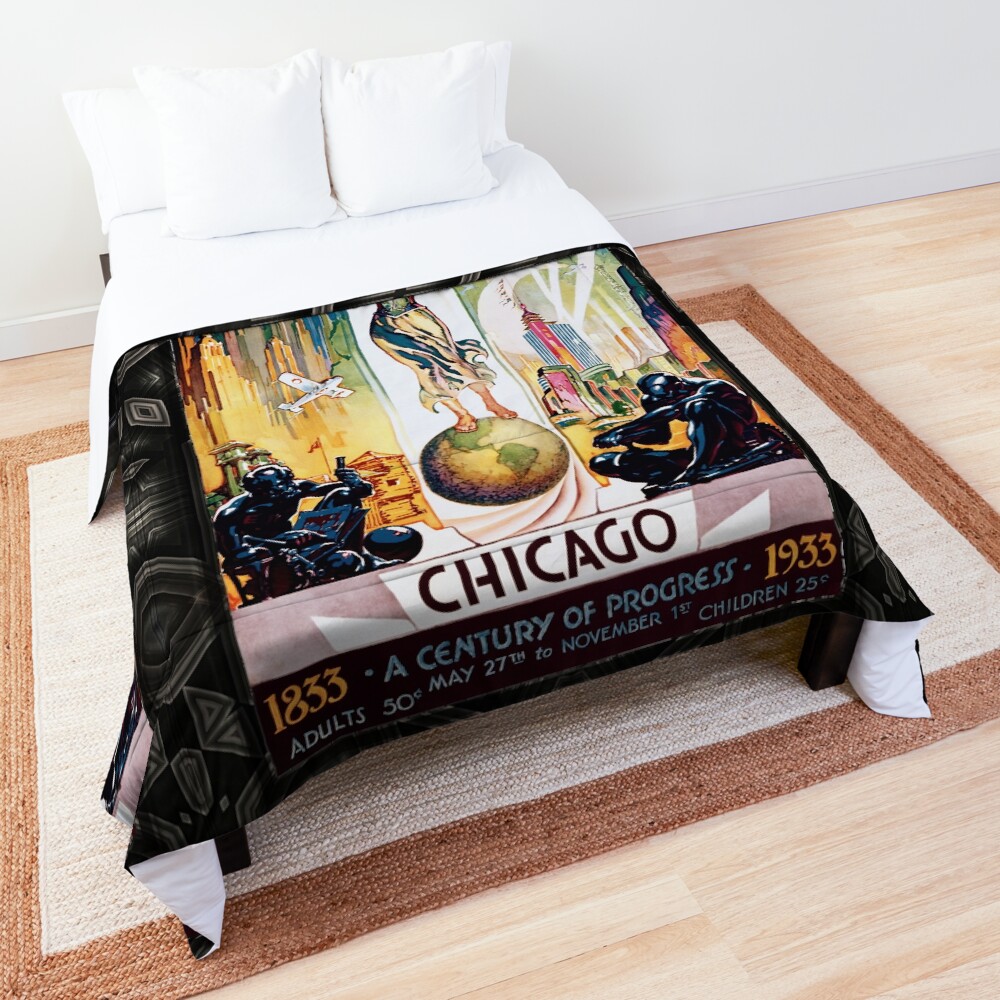
The artist’s use of color and contrast is noteworthy, with a vibrant color palette that ranges from the deep, bold blues and greens of the sky to the warm yellows and oranges of the Earth. The colors are rich and saturated, enhancing the sense of vitality and energy that defines the period. The female figure herself is painted in a luminous gold, symbolizing both divinity and enlightenment, while the sleek, black figures of man and machine stand in stark contrast to the brighter hues, representing the mechanization of humanity.
The use of geometric shapes and the streamlined design of the buildings, planes, and figures contribute to the overall sense of movement and dynamism. The lines are sharp and clean, almost mechanical, which aligns with the futuristic themes of the fair and the Art Deco movement’s emphasis on progress, vitesse, et modernité.
Style, Thème, et humeur
This artwork is quintessentially Art Deco, un style caractérisé par des formes géométriques audacieuses, symétrie, et un accent sur le luxe, charme, et le progrès technologique. L'Art Déco cherchait à refléter l'optimisme et l'innovation de l'époque, et cette affiche est une synthèse parfaite de cette philosophie. Le thème de la foire, “Un siècle de progrès,” est clairement communiqué à la fois par le design et le symbolisme de l'œuvre d'art.. L'imagerie d'une femme debout sur le monde, la ville futuriste, et les figures mécaniques travaillent toutes ensemble pour transmettre un message d'espoir, pouvoir, et un potentiel illimité.
L'ambiance de l'œuvre d'art est celle de l'optimisme et de l'anticipation.. Il y a un sentiment d'excitation et d'émerveillement, comme si le monde était à l'aube d'une nouvelle ère, une ère définie par la technologie, architecture moderne, et la promesse d'un avenir meilleur. Ce n'est pas une pièce sombre ou réfléchissante, but one that exudes confidence and the belief that progress is both inevitable and desirable.
Conclusion
En somme, this 1933 Chicago World’s Fair poster is a striking example of the Art Deco style, blending symbolism, futurisme, and bold visual elements to communicate the fair’s theme of progress. Through its use of a central allegorical figure, dynamic cityscapes, and futuristic imagery, it presents a vision of a world on the cusp of transformation. The artwork’s energetic colors, formes géométriques, and focus on technological advancements capture the optimism and excitement of the era, making it an enduring symbol of the 1933 World’s Fair and a testament to the enduring spirit of human progress.
Il s'agit d'une reproduction de maîtres anciens d'art numérique retouchée d'une image du domaine public.