

Christ in the Storm on the Sea of Galilee
L'opera intitolata “Christ in the Storm on the Sea of Galilee”, creato in 1695 by the German-Dutch painter Ludolf Backhuysen (1630 – 1708), powerfully conveys a dramatic moment of biblical history. Backhuysen, known for his skillful mastery of maritime landscapes, utilizes his expertise to depict both the ferocity of nature and the calm authority of Christ amidst a violent storm. This painting is part of a broader tradition of maritime paintings during the Dutch Golden Age, with a specific focus on the themes of human struggle against nature, intervento divino, and the Christian narrative.
Sommario
Soggetto e narrativa principale
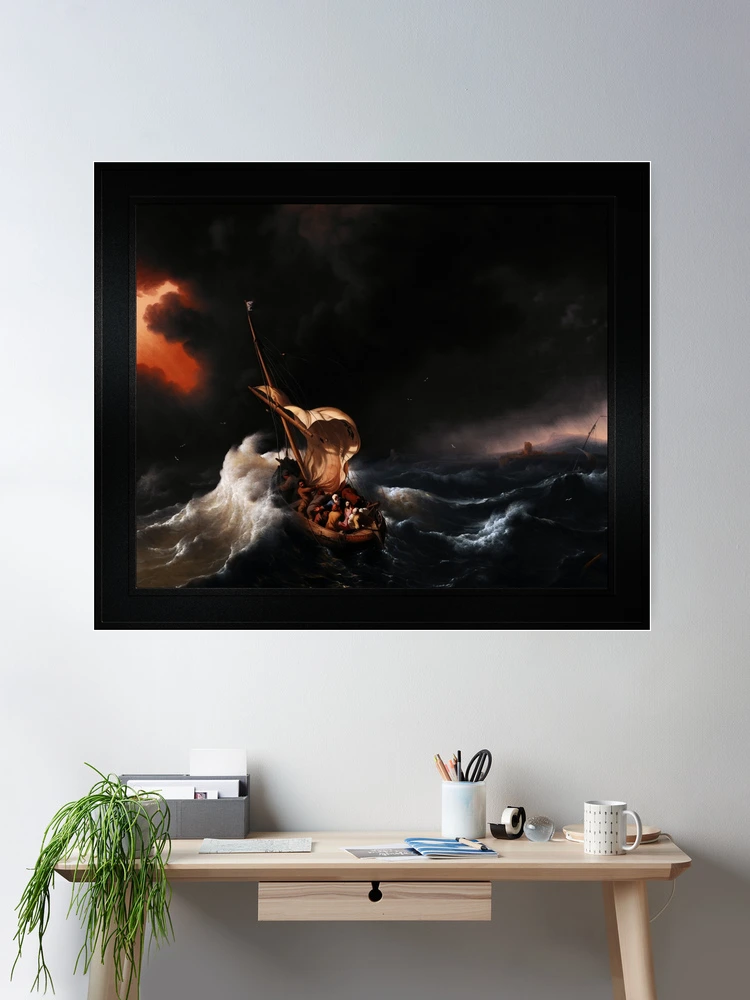
The primary subject of the painting is the biblical story from the Gospel of Matthew, where Jesus Christ calms the storm on the Sea of Galilee. Backhuysen chooses to focus on the intense moment of chaos aboard the boat, capturing the panic of the disciples and the calm demeanor of Christ. In primo piano, the viewer sees a group of men, likely disciples, struggling against the wind and waves. Their expressions reveal fear and desperation as the storm rages around them. The turbulent sea, dark clouds, and relentless waves all serve to heighten the sense of danger that envelops the boat.
Amidst the turmoil, Christ remains serene and composed, the central figure of the composition. His presence is both reassuring and commanding, symbolizing divine authority over nature and the human condition. The artist uses the contrast between the violent sea and the peaceful figure of Christ to underscore the miraculous nature of the event. Christ’s stillness contrasts with the frenetic energy of the storm, making His divine role clear.
Oggetti e simbolismo
The boat itself is a critical object in this piece, representing both the literal vessel in the biblical story and the symbolic “ship” of the Christian church navigating through the turbulent waters of the world. The ship is crafted with great detail, and the artist’s ability to render the movement of the water around it adds a sense of realism. The storm is not just a natural occurrence, but also a visual metaphor for the trials and tribulations of life, which are often beyond human control.
The figures in the boat are also symbolic. The disciples, depicted in various stages of panic and struggle, reflect the human response to overwhelming challenges. One figure leans over the edge of the boat, possibly to throw up, while another clutches the mast, his face twisted in fear. These expressions of human vulnerability are contrasted by Christ’s calmness, suggesting faith and the belief that divine intervention will provide salvation.
Inoltre, the elements of the storm—raging waves, dark clouds, and flashes of lightning—add to the intensity of the scene. The dark sky, with its dramatic lighting, represents the chaotic forces of nature and, metaphorically, the trials of life. Yet the light breaking through the clouds hints at hope and the divine presence that promises peace and guidance.
Terreno e materiale
The scene unfolds on the turbulent waters of the Sea of Galilee, Quale, in Backhuysen’s portrayal, are dark, foamy, and churning. The waves are masterfully painted, showing a range of textures from the frothy white caps to the deep, threatening blue and green depths. The artist’s command of light is particularly notable in the way it reflects off the surface of the water and highlights the contours of the figures, lending a sense of realism to the otherwise supernatural scene.
Il cielo, a striking backdrop to the action, is filled with ominous dark clouds, their heavy masses suggesting the sheer power and chaos of the storm. The dramatic interplay of light and dark contributes to the overall mood of the painting, amplifying the tension in the narrative. A small area of light appears through a break in the clouds, potentially indicating the divine presence, adding an aura of hope amidst the turmoil.
Stile, Tema, e umore
Ludolf Backhuysen’s style is one of the defining characteristics of the Dutch Golden Age. Known for his ability to capture the mood and texture of the sea, Backhuysen demonstrates an extraordinary talent for conveying motion and emotion. The turbulence of the water, the billowing sails, and the energy of the storm all exhibit a mastery of the seascape genre.
The theme of the painting merges the natural with the divine, showing human struggle against the overpowering forces of nature, only to be saved through divine intervention. The mood is one of awe and reverence, evoking a sense of the sublime in the viewer. The dynamic clash between the forces of the storm and the calm figure of Christ is a powerful visual metaphor for faith, trust, and divine power.
La tavolozza dei colori, while dominated by darker hues of stormy skies and deep ocean blues, also contains areas of lighter tones that reflect the divine light shining through the chaos. The contrast between light and dark creates a dramatic tension in the composition, emphasizing the miracle at the heart of the scene.
In terms of technique, Backhuysen uses fine brushwork to create a vivid depiction of the storm, with each wave and cloud rendered in intricate detail. The fluidity of the water and the dramatic effects of the sky demonstrate Backhuysen’s technical prowess and his ability to transport the viewer into the heart of the storm.
Conclusione
“Christ in the Storm on the Sea of Galilee” by Ludolf Backhuysen stands as a testament to both the artistic skill of the artist and the theological depth of the subject matter. The painting is a dramatic visualization of the biblical narrative, combining natural and divine elements in a way that speaks to the viewer on both an emotional and spiritual level. The intensity of the storm, the vulnerability of the disciples, and the calm authority of Christ all combine to create a powerful visual experience, offering a meditation on faith, divine protection, and human endurance.
A Back Story Of The Artwork
This appears to be a work that was copied from Rembrandt van Rijn (1606 – 1669) piece, “Il Storm on the Sea of Galilee c1633″.
While the original version created by Rembrandt is up close with the entire focus being on the boat with Jesus and his 12 disciples in the boat with him; this version takes a much wider view.
This version shows Jesus in the sailboat with an additional 8 uomini, as it is slammed on its side by a large wave; and off to the right of the scene we see a part of a mast sticking out of the water and farther back another sailboat caught in the sea storm.
In the distance we can see two structures several miles apart on the shore, some mountains behind one of the structures as well as large dark storm clouds with a small clearing in the clouds that is orange in color due to the sun; while the boat is being illuminated by a bright white light.
Christ in the Storm on the Sea of Galilee is a remastered digital art old masters reproduction of a public domain image that is available as a stampa su tela in linea.
Questa creazione di arte digitale, come tutte le opere d'arte che si possono trovare sul sito Web di Xzendor7 è disponibile per l'acquisto online in una varietà di formati di materiali, comprese le stampe su tela, stampe acriliche, stampe in metallo, stampe su legno, stampe incorniciate, manifesti, e come stampe su tela arrotolata in una varietà di formati da 12 pollici a 72 pollici a seconda delle dimensioni dell'opera d'arte effettiva e del negozio di stampa su richiesta da cui scegli di acquistare l'arte.
L'opera d'arte è disponibile anche su un'ampia gamma di abbigliamento da uomo e da donna, tazze, borse, sciarpe, quaderni e diari e tanti prodotti per l'arredamento della casa.
Biografia dell'artista
Informazioni di seguito derivate da Wikipedia.org
Ludolf was born in Emden, Frisia orientale, a lower region in Lower Saxony Germany in 1630 e all'età di circa 20 went to Amsterdam, Netherlands and gained employment as a Calligrapher and Merchant’s Clerk.
It was during this time that discovered that he had a great talent for painting, and so devoted his time to this endeavor, leaving his current employment; initially doing pen drawings and also studying under the eminent Dutch Golden Age Painters Allaert van Everdingen (1621 – 1675), un pittore, printmaker and etcher as well as Hendrick Dubbels (1621 – 1707), a marine and winter landscape painter.
As a student of nature Ludolf would often go out to sea in an open boat to study the nature of the waves during storm events; as his main focus was on marine art, with an emphasis of scenes with stormy ocean waves.