

Cressida
Introduction et aperçu Le portrait oeuvre d'art “Cressida” du peintre britannique Edward John Poynter (1836 – 1919), peint au 19ème siècle, met en valeur l'expertise de l'artiste dans la capture de figures de la mythologie classique et du drame shakespearien avec les techniques raffinées de la tradition académique. Cette pièce représente la figure tragique de Cressida du roman de Shakespeare. Troïlus et Cressida, un personnage dont la beauté et la complexité émotionnelle ont fasciné de nombreux artistes. Le rendu d'elle par Poynter, baigné de lumière douce et de teintes délicates, invite le spectateur à entrer dans un moment de réflexion tranquille, capturer sa vulnérabilité et sa profondeur émotionnelle. La peinture, exécuté avec précision et un niveau de détail presque photographique, s'inspire de thèmes classiques, alliant réalisme et allégorie.
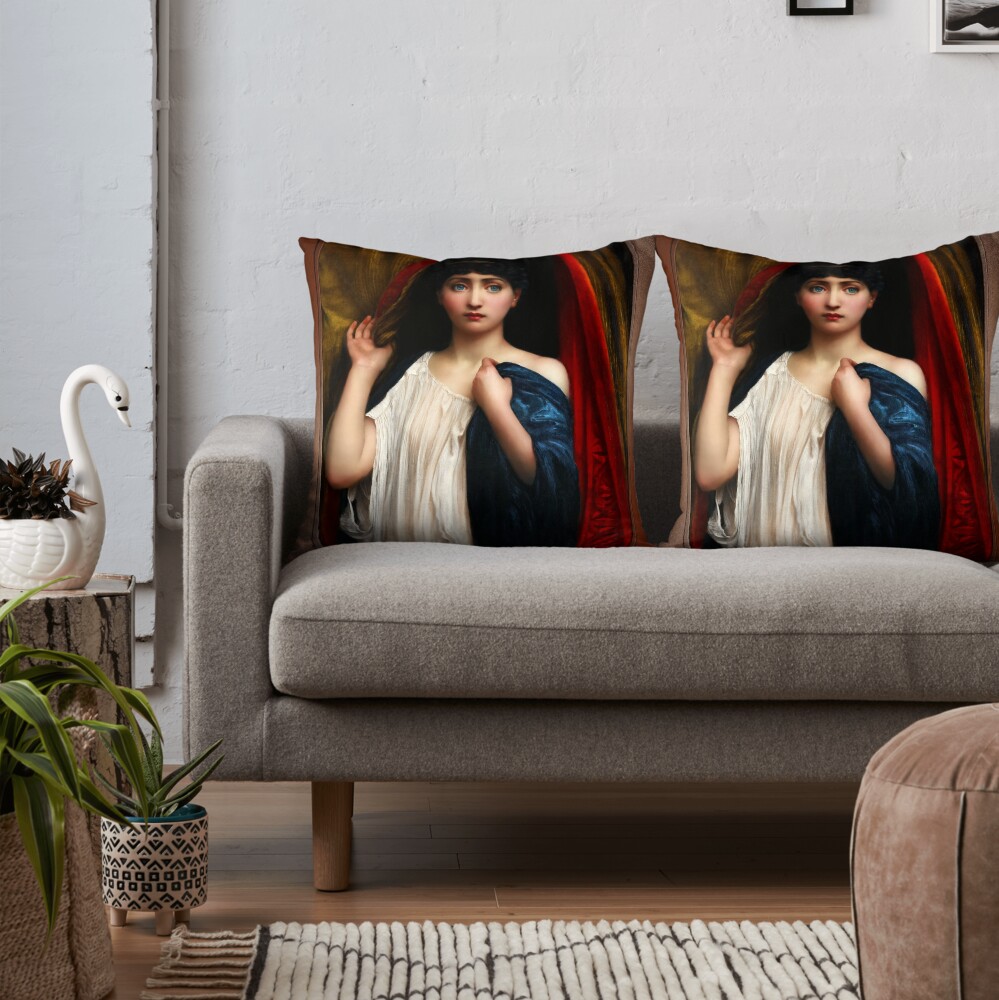
Table des matières
Le sujet principal: Cressida
Au cœur de la composition se trouve Cressida elle-même, une jeune femme aux yeux d’un bleu profond qui semble regarder directement dans l’âme du spectateur, évoquant un sentiment de mélancolie. Son expression est pensive, presque mélancolique, faisant allusion à ses troubles intérieurs et aux émotions conflictuelles qu'elle endure dans la pièce. Cressida se tient en équilibre, position gracieuse, sa silhouette drapée d'un délicat, vêtement blanc qui épouse ses formes, suggérant à la fois sa vulnérabilité et sa beauté. Le tissu est méticuleusement peint, capturer chaque pli et chaque texture avec un réalisme remarquable. Sur son épaule, un riche, une cape d'un bleu profond tombe en cascade, ajoutant un contraste saisissant aux tons pâles de sa tenue vestimentaire.
Sa main droite touche doucement le tissu de la cape près de son épaule., tandis que sa main gauche repose légèrement contre un rideau de teintes rouge foncé et dorées. Ce placement de ses mains crée un sentiment de calme, comme si elle était à la fois à l'aise et pourtant prise émotionnellement dans un moment de contemplation privée. Les matériaux luxueux, soie et velours, jouer un rôle important dans l’amélioration de la richesse visuelle du tableau, ajouter de la profondeur et un sentiment d'opulence à la scène. L'attention de l'artiste au tissu et à la façon dont il interagit avec la forme humaine révèle sa maîtrise de la texture et de la matière..
Le contexte et le cadre
Le fond du tableau est composé de couleurs sombres, rideaux drapés de rouges profonds et d'or, qui encadrent le sujet. Ces riches, les couleurs chaudes rehaussent non seulement la silhouette de Cressida mais transmettent également un sentiment d'intimité et de drame, créer un décor scénique qui fait écho aux thèmes de la pièce. La draperie est rendue de manière à mettre en valeur à la fois son poids et sa douceur., suggérant presque la présence d'un espace théâtral. Le choix de tons si vifs derrière Cressida agit comme une métaphore visuelle des émotions passionnées et souvent tragiques qu'elle éprouve tout au long de la pièce..
Le réglage, bien que quelque peu indéfini au-delà de la draperie, contribue à l'ambiance générale du tableau. Le lourd, les tissus somptueux suggèrent que Cressida existe dans un monde d'aristocratie et d'intrigues courtoises, un royaume d'opulence et de complexité morale. Cette toile de fond, bien que simple, améliore la profondeur psychologique de la scène, suggérant un moment privé d'introspection dans un monde autrement tumultueux.
Technique, Matériels, et style
L’approche de Poynter en matière de peinture “Cressida” reflète la précision et les détails typiques du style académique. Sa technique, souvent caractérisé par des surfaces très polies et une attention presque photographique aux détails, est évident dans tous les aspects de la pièce. Le rendu minutieux des textures, de l'éclat délicat du vêtement de Cressida à la douceur, les plis volumineux de son manteau, témoigne de la compréhension profonde de l’artiste des matériaux et de sa capacité à les traduire sur toile avec une fidélité remarquable.
La lumière du tableau est douce et diffuse, mettre en valeur les traits du sujet de manière naturaliste. Poynter utilise un équilibre minutieux entre la lumière et l'ombre, créant une impression de tridimensionnalité et de profondeur qui attire l'œil du spectateur sur le visage et la posture du sujet. L’utilisation de la lumière pour accentuer les traits du visage de Cressida, surtout ses yeux, intensifie encore la résonance émotionnelle de la pièce, permettre au spectateur de ressentir sa vulnérabilité et le poids de son état émotionnel.
En termes de palette de couleurs, Les choix de Poynter sont à la fois sophistiqués et évocateurs. Les tons froids de la robe de Cressida et les teintes chaudes contrastées de la toile de fond créent une harmonie visuelle qui renforce l'impact émotionnel du tableau.. L’utilisation par l’artiste du vif, les couleurs saturées ajoutent un effet dramatique, tandis que les transitions subtiles entre la lumière et l’obscurité traduisent l’interaction complexe des émotions qui définissent le personnage de Cressida dans la pièce de Shakespeare..
Thème et humeur
Le thème principal de la peinture est celui de la complexité émotionnelle et de la vulnérabilité.. Poynter “Cressida” n'est pas simplement le portrait d'une femme dans un décor opulent; c'est l'étude d'un personnage pris entre l'amour, loyauté, et trahison. Les yeux de Cressida, large et rempli d'une tristesse presque innocente, reflect her inner conflict and emotional turmoil. Sa posture, composed yet delicate, suggests a woman who is in the midst of a private struggle, uncertain of her place in the world around her.
The mood of the painting is somber and reflective, underscored by the warm, dark tones of the background and the soft, diffused light that envelops Cressida. The emotional weight of her expression, coupled with the luxurious materials of her attire, suggests a tension between her outer beauty and the inner turmoil she faces. This duality is at the heart of the painting, as Poynter captures not only the physical beauty of his subject but also the emotional depth that lies beneath the surface.
Conclusion
“Cressida” by Edward John Poynter is a masterful depiction of one of Shakespeare’s most complex and tragic female characters. L’utilisation habile de la couleur par l’artiste, lumière, et la texture crée une expérience visuelle riche qui reflète la profondeur émotionnelle du sujet. Le tableau sert non seulement de prouesse technique mais aussi d'exploration de la condition humaine., capturer un moment d'introspection et de vulnérabilité émotionnelle. Grâce à ce travail, Poynter invite le spectateur à interagir avec le monde intérieur de Cressida, proposant une méditation poignante sur l'amour, trahison, et les complexités du cœur humain.
Il s'agit d'une reproduction de maîtres anciens d'art numérique remasterisée d'une image du domaine public qui est disponible en tant que impression sur toile.
Biographie de l'artiste dérivée de Wikipedia.org
Edouard est né à Paris, France à British Architect et fondateur de l'Institute of British Architects (c1834) Ambroise Poynter (1796 – 1886) et Emma Forster (? – 1848); et peu après sa naissance, ses parents retournèrent en Grande-Bretagne.
Edward est allé au Brighton College et à l'école d'Ipswich, mais a été contraint de partir tôt en raison d'une mauvaise santé; ce qui l'a amené à passer ses hivers à Madère, Portugal et à Rome, Italie.
Quand il était 17 ans, à Rome, il rencontre le peintre britannique Frederick Leighton, et cette réunion a fait une forte impression sur; de sorte qu'à son retour à Londres, il s'inscrit à la Leigh's Academy, qui a été fondée par James Mathews Leigh (1808 – 1860) et deviendrait finalement la Heatherley School of Fine Art aujourd'hui; et il étudierait également à la Royal Academy Schools.
De là, il se rendit à Paris pour étudier à l'atelier du peintre classique suisse Marc Gabriel Charles Gleyre. (1806 – 1874).
Au cours de sa carrière, Edward a occupé un certain nombre de postes officiels, dont celui de professeur Slade à l'University College de Londres. (1871 – 1875), directeur de l'École nationale supérieure de formation artistique (1875 – 1881) et directeur de la National Gallery (1894 – 1904); supervisant l'ouverture de la Tate Gallery.
Edward a été noté comme un peintre de grandes peintures historiques tout au long de sa carrière, avec des œuvres comme Israël en Egypte c1867, suivi de St George pour l'Angleterre c1869, représentant St George et le Dragon et culminant peut-être avec la visite de la reine de Saba au roi Salomon c1884-90.