

Dame Mit Margeritenstrauß c1940
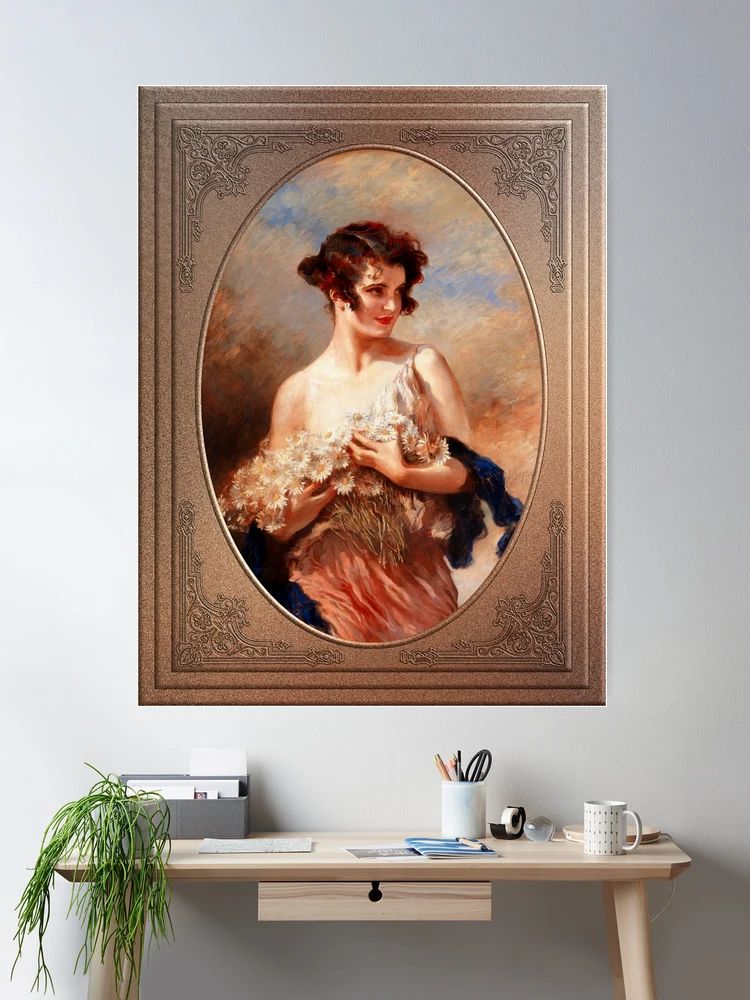
An dealbh leis an tiotal Dame Mit Margeritenstrauß, air a chruthachadh timcheall air 1940 by the renowned German artist Leopold Schmutzler (1864 – 1940), captures an exquisite dealbh de bhoireannach adorned with a bouquet of daisies. Schmutzler, known for his delicate depictions of women, frequently explored themes of femininity, gràs, agus bòidhchead nàdarra. Anns an obair seo, the artist uses his signature soft brushwork and skillful handling of light to create a composition that is both tranquil and refined, inviting the viewer into an intimate moment of serenity.
Clàr-innse
Subject and Expression
The central figure of the painting is a young woman, elegantly posed and bathed in soft light. She gazes to the side, her expression gentle and contemplative, le gàire beag a tha a 'nochdadh an dà chuid blàths agus sàmhchair, fois sàmhach. A falt donn, air a stialladh ann an tonnan bog, a’ cur ris na feartan fìnealta aice, agus tha corra fhuilt a' tuiteam gu fuasgailte mu a h-aodann, a’ cur ris a’ mhothachadh air bòidhchead nàdair. Tha bouquet mòr de neòinean-nòin aice na gàirdeanan, cha mhòr nach robh na flùraichean geala a' sreap a-mach às a broilleach. Tha na neòinean-nòin eadar-dhealaichte ri tònaichean blàth a craiceann, agus tha suathadh bog nan flùraichean a’ cur cuideam air cho fìnealta, nàdar ath-leasaichte a’ chuspair. Am measgachadh de a giùlan, a ghruagaich, agus tha na blàthan a' toirt sealladh air òigeachd agus air suaimhneas.
Clothing and Materials
Tha am boireannach air a sgeadachadh ann an gùn a tha a’ sruthadh, a h-aodach a’ sìneadh gu grinn thairis air a gualainn. Tha an aodach sìmplidh ach eireachdail, air a thoirt seachad ann an tònaichean bog de dhhathan pastel aotrom. Chan eil an gùn a’ cur cus cumhachd air an ìomhaigh ach an àite sin a’ cur ri gràs nàdarra a cruth. Saise fìnealta, a dh’ fhaodadh a bhith air a dhèanamh de satain no stuth coltach ris, gu socair a' cuairteachadh a mheadhon, a’ cur cuideam air a dealbh caol. Tha inneach an dreasa gu math eadar-dhealaichte leis a’ bhog, inneach organach nam flùraichean na gàirdeanan. Feartan an dealbh, gu sònraichte an obair bhruis bhog, leig le eadar-ghluasadan seòlta ann am pasgain an aodach, a tha coltach cha mhòr faicsinneach, mar gu'm b'urrainn neach ruigheachd air agus suathadh riu. Tha aire mhionaideach Schmutzler gu mion-fhiosrachadh a’ cur doimhneachd agus reul-eòlas ri a coltas, a’ toirt air an neach-coimhead a bhith a’ faireachdainn gu bheil iad a’ faicinn àm sàmhach na beatha.
Cùl-fhiosrachadh agus suidheachadh
Tha cùl-raon an deilbh bog, nighe dath cha mhòr ethereal a bhios gu socair a’ seargadh air falbh. The tones of the background are muted, consisting of warm beiges, blues aotrom, and soft earth tones. The lack of a distinct, concrete setting places more emphasis on the subject herself, removing any distractions that might divert attention away from her serene expression and posture. Schmutzler intentionally leaves out any detailed landscape or environment, instead focusing on the harmonious balance between the figure and the natural beauty of the bouquet she holds.
Am bog, blurred background enhances the sense of intimacy in the piece. It transports the viewer into a quiet moment where the subject is enveloped in a peaceful atmosphere. There are no overt symbols or props that detract from the central theme of femininity and grace. The choice of flowers, which are likely daisies, is also significant, as they symbolize purity and innocence. These symbolic elements resonate with the overall mood of the painting, reinforcing the sense of calm and timeless beauty that Schmutzler captures so well.

Stoidhle is innleachd ealanta
Leopold Schmutzler’s approach to painting in Dame Mit Margeritenstrauß demonstrates his mastery of classical portraiture, with a focus on realism and a sensitivity to light and texture. The brushstrokes are fine and controlled, yet there is an effortless quality to the way he captures the delicate nuances of the subject’s expression and clothing. The painting’s tone is warm and inviting, le beartach, soft hues that evoke a sense of calm and elegance.
The technique Schmutzler employs gives the portrait an almost soft-focus effect, blurring the boundaries between realism and romanticism. The background is hazy and indistinct, yet it provides a beautiful contrast to the sharply focused details of the subject’s face and flowers. This technique reinforces the theme of ethereal beauty and quiet grace. The light that bathes the woman’s figure is soft, highlighting the contours of her face and body, while also casting gentle shadows that add depth to the portrait.
Mood agus mìneachadh
The mood of the painting is one of calm introspection, far a bheil e coltach gu bheil ùine a 'seasamh fhathast. There is no hurry in this moment; it is a pause in the midst of daily life, a fleeting instance where the subject exists in harmony with her surroundings. The softness of the color palette and the absence of dramatic contrasts contribute to the overall sense of serenity and quiet beauty. Schmutzler does not impose any grandiose narrative on the viewer but instead invites one to share in this quiet, peaceful moment with the subject.
The flowers she holds—daisies—are emblematic of purity, sìmplidheachd, agus neo-chiontachd. They may represent a connection to nature or the untouched beauty of the subject herself. The juxtaposition of the soft, delicate flowers against her graceful posture and gentle expression creates a sense of harmony, suggesting a narrative of timeless beauty that transcends the ordinary.
Co-dhùnadh
Ann an Dame Mit Margeritenstrauß, Leopold Schmutzler masterfully captures the essence of feminine grace, bòidhchead nàdair, agus suaimhneas. The artist’s delicate rendering of the subject’s expression, èideadh, and flowers, air a shuidheachadh an aghaidh cùl-raon bog agus ethereal, a’ cruthachadh faireachdainn gun ùine a bheir cuireadh don neach-coimhead stad a chuir air agus meòrachadh air bòidhchead ciùin na h-ùine. Tha an obair seo na theisteanas air sgil Schmutzler ann a bhith a’ taisbeanadh gach cuid taobhan corporra agus faireachail nan cuspairean aige., ga dhèanamh na dheagh phìos de dhealbhan-camara clasaigeach bho thràth san 20mh linn.
A' bhean-uasal le bouquet neòinean-nòin mu c1940 leis a' pheantair Gearmailteach Leopold Fehller (1864 – 1940); sealladh gnè stoidhle Rococo, dealbhadair agus dealbhadair figear boireann.
Is e seo ath-riochdachadh seann mhaighstirean ealain didseatach ath-leasaichte de ìomhaigh raon poblach a tha ri fhaighinn mar rolla, meatailt, acrylic agus clò-bhualadh canabhas air-loidhne.
Neach-ealain Bio
Fiosrachadh gu h-ìosal a thàinig bho Wikipedia.org
Rugadh Leopold Mies, baile ann an Sgìre Tachov ann an Roinn Plzeň ann am Poblachd nan Seiceach.
B' e taigh-seinnse agus dìollaidear a bh' ann an athair agus thug e a' chiad leasanan tarraing dha mhac, an uair sin bho 1880 gu 1882 rinn e sgrùdadh aig Acadamaidh Ealain Fine Vienna còmhla ris a’ pheantair Gearmailteach Christian Griepenkerl (1839 – 1916); agus an dèidh sin aig Acadamaidh Fine Arts Munich, ag ionnsachadh fo Otto Seitz (1846 – 1912).
Às deidh dha ceumnachadh bho Acadamaidh Ealain Fine Munich ann an 1885 chuir e roimhe tuineachadh ann am Munich, agus mu thoiseach na linne bha e air fàs gu bhith mar aon den luchd-ealain dhealbhan as mòr-chòrdte ann am Munich; cruthachadh ealain airson teaghlach rìoghail Bhabhàiria,, luchd-ciùil agus dannsairean mòr-chòrdte, gabhail a-steach dealbh den bhana-chleasaiche Lili Marberg (1876 – 1962) ann an dreuchd Salome.