

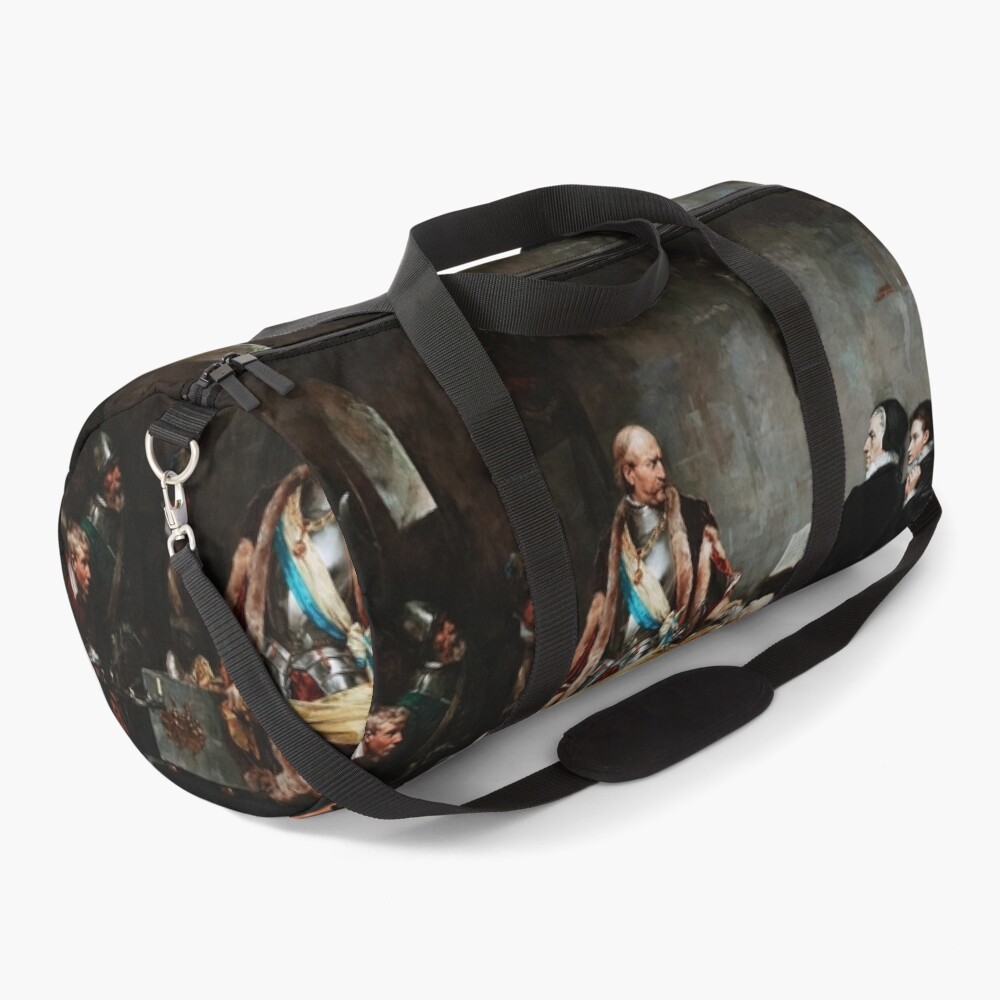
Duke Karl Insulting the Corpse of Klaus Fleming
Diùc Karl a’ dèanamh tàir air corp Klaus Fleming c1878 leis a’ pheantair às an Fhionnlainn Albert Edelfelt (1854 – 1905); noted for his natural and realist approach to painting historical scenes and portraits.
This captivating classical work of art depicts a harsh scene with Duke Charles IX of Sweden (1550 – 1611) who reigned as King of Sweden from 1604 gu 1611; even though he was Sweden’s virtual ruler from 1599 gu 1604.
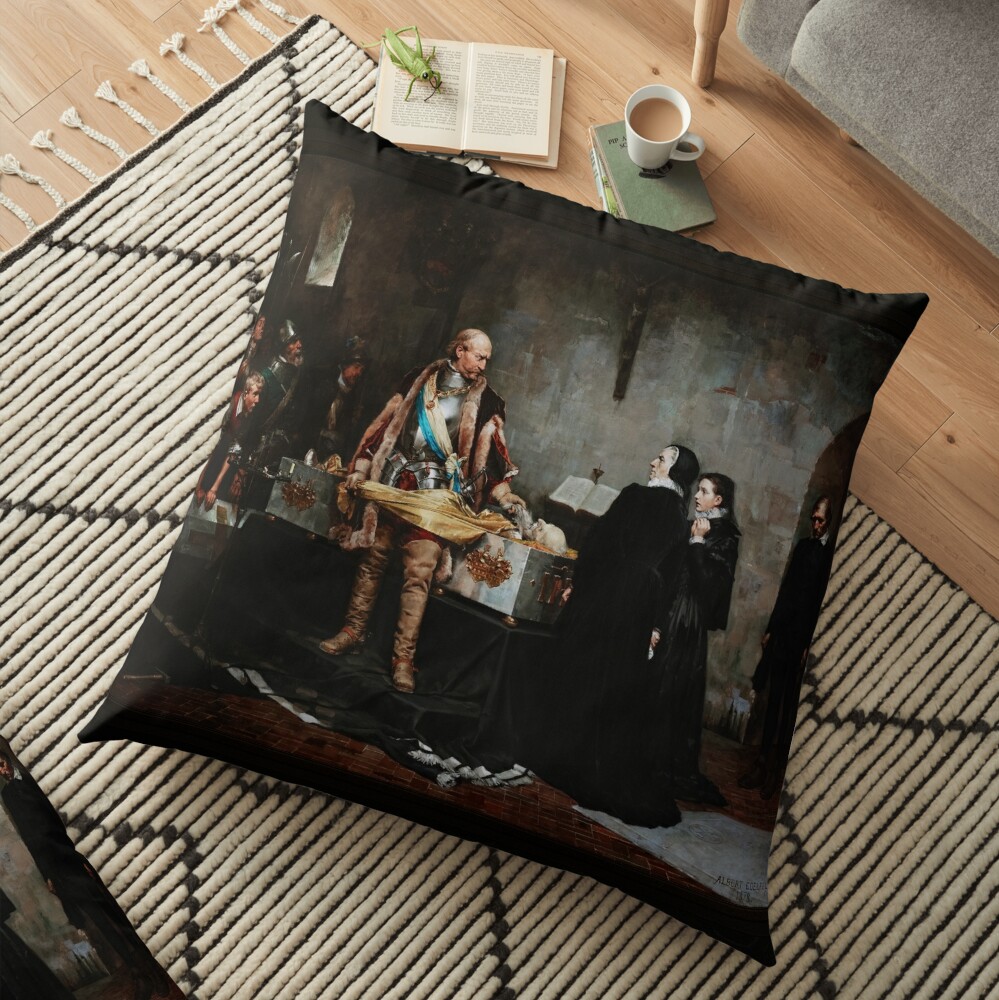
The Duke is pulling on the beard of the dead Klaus Fleming (1535 – 1597); a Finnish born member of the Swedish nobility, admiral and a trustee of King John III (1537 – 1592) and King Sigismund Vasa (1566 – 1632); while he lays in his coffin.
Standing at the head of the coffin while this disrespectful act takes places is the wife and daughter of Klaus Fleming, with his wife giving the Duke a negative stare and his daughter is taken aback.
To the side of the wife and daughter appears to be the caretaker, and at the foot of the coffin is a young man holding the lid of the coffin, while soldiers in uniform and armament stand behind him.
Is e seo ath-riochdachadh seann mhaighstirean ealain didseatach ath-leasaichte de ìomhaigh fearann poblach a tha ri fhaighinn mar chlò-bhualadh canabhas air-loidhne.
Fiosrachadh gu h-ìosal a thàinig bho Wikipedia.org
Albert was born to the Swedish architect Carl Albert Edelfelt (1818 – 1869); who lived in Finland and Alexandra Brandt (1833–1901) air an Iuchar 21, 1854 in Finland.
He began his artistic studies when he was 15 bliadhna dh'aois, at the Drawing School of the Finnish Art Society in Helsinki, Finland and continued as a student of Finnish Genre Painter Adolf von Becker (1831 – 1909) bho 1871 gu 1873.
Afterwards he received an art scholarship from the Finnish Government to study history painting at the Royal Academy of Fine Arts in Antwerp, A' Bheilg; where he studied under Belgian Historical and Portrait Painter Nicaise de Keyser (1813 – 1887) bho 1873 gu 1874, which led to him winning an award of excellence for the deathbed painting of Alexander the Great.
Then from 1874 gu 1878 he studied in Paris, France under the French Painter Jean-Léon Gérôme (1824 – 1904) at the École Nationale des Beaux-Arts.
Ann an 1878 his work Duke Charles IX of Sweden insulting the corpse of his enemy Klaus Fleming enjoyed great success in Finland though it did not get much attention in Paris; but a year later he had his first Paris Salon success, with his piece The Burnt Village; which portrayed a scene of the Finnish peasant revolt of 1596.
During the 1880s Albert began to include some of the characteristics of the Impressionist movement into his natural outdoor painting settings, but stayed well within the realist movement, concentrating on the precise details and complex color palate.
As an accomplished portrait painter Albert painted my famous individuals including that of the French chemist Louis Pasteur (1822 – 1895) and Finnish Soprano Opera Singer Aino Ackté (1876 – 1944), without posing his subjects; but capturing them in their natural everyday environment.