

Mother with her Young Daughter
Mother with her Young Daughter by Flemish (A' Bheilg) Peantair Gustave Leonard de Jonghe (1829 – 1893); ainmeil airson a chuid eachdraidheil, religious and glamorous portraits of women in richly decorated interiors.
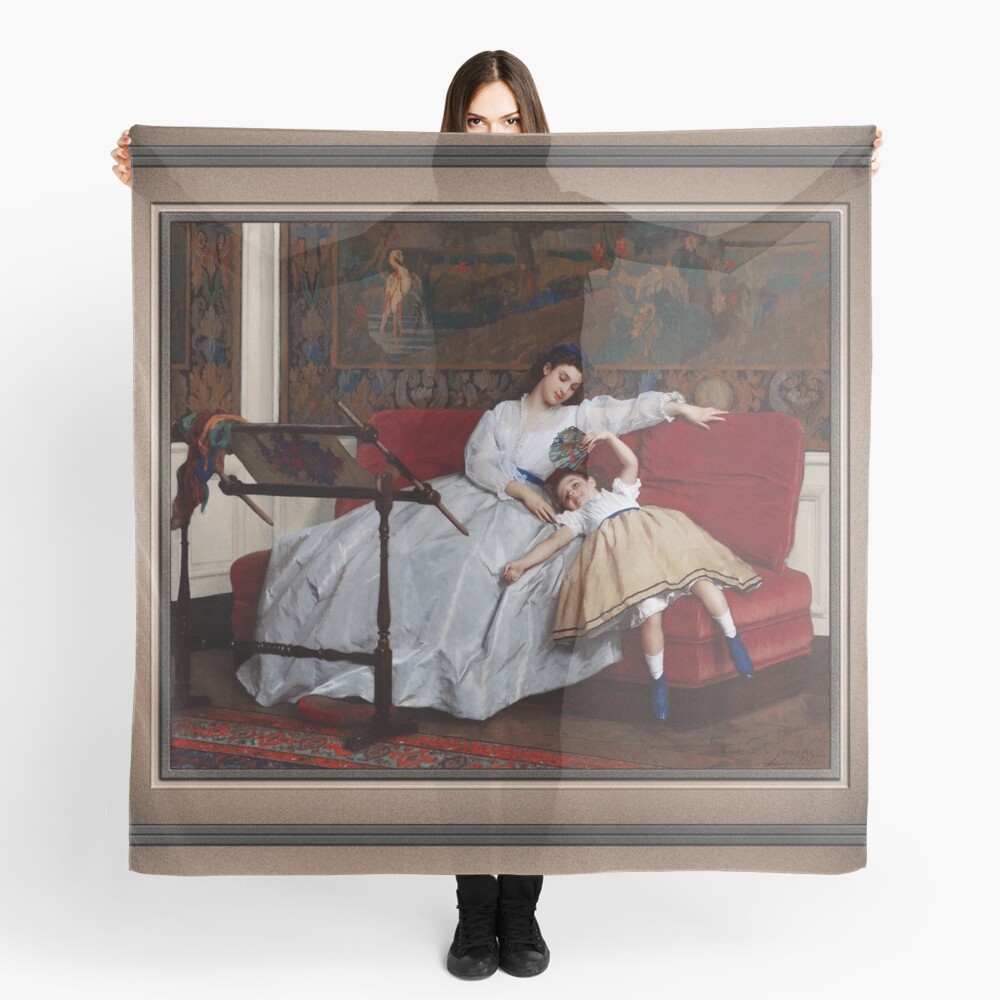
This is a wonder gnè scene of a mother and her young daughter enjoying each others company in the drawing room their home.

The mother is seated on a red couch dressed in a white bell shaped dress with a linen top, under which she is wearing a white blouse, with blue sash around her waist the matches the blue ribbon tied around her hair.
Her daughter that is partially lying on the couch is wearing a white blouse, a tan skirt, white socks and blue shoes and is fanning herself with a small collapsible hand fan.
In front of them is a wooden embroidery stand with a stretched canvas that has a work in progress on it, along with blue, orains, teal and brown yarn on the top of the instrument.
The room has a decorative rug on it and a small yarn basket on the floor; which the walls are inlaid with large frescoes on each side.
Is e seo ath-riochdachadh seann mhaighstirean ealain didseatach ath-leasaichte de ìomhaigh fearann poblach a tha ri fhaighinn mar chlò-bhualadh canabhas air-loidhne.
Fiosrachadh gu h-ìosal a thàinig bho Wikipedia.org
Gustave was born to the well known Belgian landscape painter Jan Baptiste de Jonghe (1785 – 1844) air a' Ghearran 4, 1829 in Kortrijk, A' Bheilg; from whom he received his early art lessons.
He then continued is art studies at the Académie Royale des Beaux-Arts in Brussels, A' Bheilg, where one of his teachers, François-Joseph Navez (1787 – 1869) was the leading Belgian painter of the time.
He was also mentored mentored by the prominent Belgian historical portrait painter Louis Gallait (1810 – 1887), with whom he was friend.
Ann an 1844 when Gustave was 15, hi father passed away, at which time his native city granted him a scholarship to continue his studies; agus aig aois 19, a-steach 1848 he exhibited his work at the Brussels Salon.
Then sometime in the 1850s Gustave, moved to Paris, France where he began exhibiting at the Paris Salons; becoming well known for his depiction of elegant women and group portraits of the Bourgeoisie.
Gustave artistic career gradually came to an end after suffering from a cerebral hemorrhage that led to the onset of blindness, marking the end of a brilliant career.