

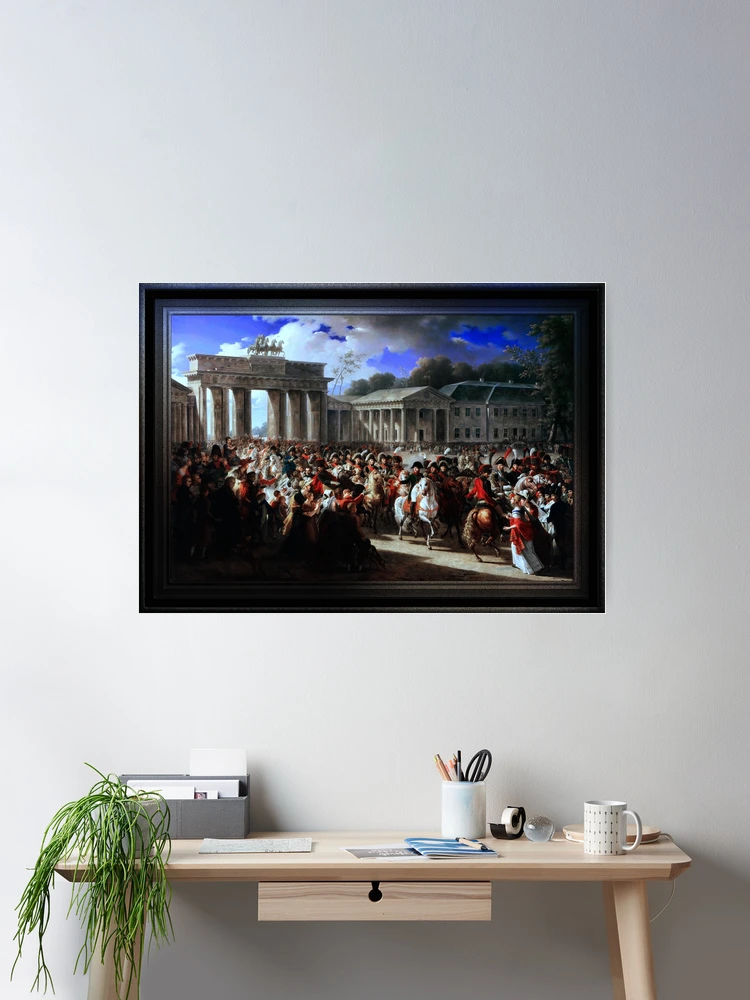
Napoleon I: n tulo Berliiniin, lokakuu, 27th 1806 is a masterpiece by the French painter Charles Meynier (1763 tai 68 – 1832), luotu ympäri 1810. This monumental work captures the historical moment of Napoleon Bonaparte’s entry into Berlin, following the victory at the Battle of Jena-Auerstedt during the Napoleonic Wars. Maalaus, executed in the neoclassical style, is a grand depiction of Napoleon’s triumph and the power he wielded at the height of his empire. The artwork is rich in both narrative and visual grandeur, combining elements of military spectacle with a portrayal of the dramatic atmosphere of the time.
Sisällysluettelo
Pääaihe ja kokoonpano
At the heart of the composition is the figure of Napoleon himself, mounted on a white horse and positioned at the forefront of the scene. He is flanked by his generals and soldiers, who all share the same air of triumph and discipline. The emperor is portrayed with a commanding presence, his gaze fixed and his posture upright, exuding authority and confidence. He is dressed in a grand military uniform, featuring the iconic red coat and golden epaulettes, symbolizing his imperial status. His face, while slightly softened, remains a testament to his power and resolve.
The crowd surrounding Napoleon is varied and dynamic, composed of soldiers, civilians, ja aatelisto, all observing his entry into Berlin. The diverse array of figures, their facial expressions ranging from admiration to awe, provides a sense of the widespread reverence for the emperor. Among the crowd, many figures stand at attention, saluting their emperor, while others gather in groups, forming a living mass that surrounds the procession. The interaction between the figures is well-executed, showcasing Meynier’s talent for rendering human emotion in a collective context.
Architecture and Terrain
The backdrop of the painting features the architectural grandeur of Berlin, with notable buildings and structures representing the city’s 18th-century neoclassical architecture. The Brandenburg Gate – Preussin kuninkaan tilauksesta rakennettu 1700 -luvun uusklassinen muistomerkki Frederick William II, tammikuun Batavian vallankumouksen aikana tapahtuneen väliaikaisen järjestyksen palauttamisen jälkeen 18, 1795, is iconic in its design. Is seen towering in the distance, symbolizing Berlin’s importance as a capital city and Napoleon’s military dominance over it. The columns of the gate rise with a sense of formality and monumental scale, echoing the strength and power of Napoleon’s army.
Etualalla, the terrain is bustling with activity, with soldiers on horseback, infantrymen, and civilians filling the wide avenue that leads into the city. The sweeping motion of the crowd and the movement of the horses convey a sense of dynamism, as if the viewer is witnessing the event in real-time. The ground appears dusty and trampled underfoot, indicative of the many soldiers that had passed through this route before. The street’s wide expanse allows for a clear view of the emperor and his entourage, making them the undeniable focal point of the composition.
Materials and Style
Meynier’s choice of materials and technique demonstrates his mastery of neoclassical painting. The artist uses oil paints to achieve a rich, vivid representation of the scene, employing both light and shadow to enhance the dramatic effect of the moment. The contrast between the dark sky and the illuminated figures in the foreground creates a stark division that emphasizes Napoleon’s central role in the composition. The lighting effect suggests both the grandeur of the event and the imminent shift in European power.
The use of light plays a central role in setting the mood of the painting. The figures of Napoleon and his generals are bathed in bright, almost ethereal light, while the darker shadows cast on the crowd suggest a sense of distance and subjugation. The contrast highlights Napoleon’s central role in the scene, while the surrounding figures appear as mere onlookers in awe of his power.
The neoclassical style of the painting is characterized by its attention to detail, realismi, and idealization of the figures. The precision in the depiction of clothing, hevosia, and architecture all point to Meynier’s rigorous training and adherence to classical ideals. His use of space and form, as well as his ability to convey movement, creates a harmonious balance within the composition. Maalaus, while rooted in historical realism, also embodies a sense of grandeur and heroism, characteristic of the Romantic period that would soon follow.
Mieliala ja ilmapiiri
The mood of the painting is one of triumph, reverence, ja kunnioitusta. The crowd’s overwhelming focus on Napoleon, coupled with the formal, almost ceremonial procession, suggests the emperor’s absolute control over the moment. The scene is imbued with a sense of monumental importance, as the viewer is invited to contemplate the historical significance of the event.
Samaan aikaan, there is a palpable tension in the air. While the soldiers and civilians show deference to Napoleon, the shadow of war and conquest lingers in the background. The stark contrast between the bright light surrounding Napoleon and the darkening skies hints at the fleeting nature of his empire, as well as the impending changes that would soon unfold across Europe. Maalaus, siksi, captures both the glory of Napoleon’s reign and the weight of the forces that would eventually lead to his downfall.
Johtopäätös
Charles Meynier’s “Napoleon I: n tulo Berliiniin” is a powerful historical narrative rendered in exquisite detail. Through his mastery of composition, valaistus, ja muoto, Meynier encapsulates the moment of Napoleon’s triumph while also hinting at the complexities of his reign. The painting stands as a testament to the neoclassical ideals of the time, celebrating the heroism and grandeur of one of history’s most controversial figures.
Charles Meynier on retusoitu digitaalisen taiteen vanhojen mestarien kopio julkisesta kuvasta.
Tämä digitaalisen taiteen luomus, Kuten kaikki taideteokset, jotka löytyvät Xzendor7-verkkosivustolta, ovat ostettavissa verkosta useissa eri materiaalimuodoissa, mukaan lukien kanvasvedokset, akryyliprintit, metalliprintit, puu tulosteita, kehystetyt printit, julisteita, ja kuten rullatut kanvasprintit eri kokoja alkaen 12 tuumaa 72 tuumaa riippuen todellisen taideteoksen koosta ja tilauspainatusliikkeestä, josta haluat ostaa taiteen.
Taideteoksia on saatavana myös laajassa valikoimassa miesten ja naisten vaatteita, mukeja, totes, huivit, muistikirjat ja päiväkirjat sekä monet kodin sisustustuotteet.
Tietoja Taiteilijasta
Alla olevat tiedot ovat peräisin Wikipedia.org
Meynier oli räätälin poika; ja nuorena osoitti lahjakkuutta taiteeseen, ja aloitti koulutuksensa ranskalaisen luonnostelijan ja kaivertajan Pierre-Philippe Choffardin ohjaamana *1731 – 1809).
Opiskelijana ranskalainen uusklassinen ja historiallinen taidemaalari François-André Vincent (1746 – 1816), Meynier voitti toisen palkinnon 1789 Prix de Rome -kilpailu; Anne-Louis Girodet de Roussy-Trioson voitti ensimmäisen palkinnon. Neljä vuotta myöhemmin 1793 Meynier palasi Pariisiin.
Sisään 1815 Meynieristä tuli Académie de France à Rooman jäsen; ja välillä 1819 että 1822, hän loi louvren katon suuren koristeen; sekä luoda lukuisia teoksia, jotka kunnioittivat Napoleonin legendaa, joka on suurimmaksi osaksi Château de Versailles.
Hän teki myös malleja bareljeefeille ja patsaille Arc de Triomphe du Carrouselilla ja Pariisin pörssillä. Alkaen 1816 eteenpäin, Meynier oli Académie des Beaux-Artsin jäsen; ja sisään 1819 hänet nimitettiin opettajaksi École des Beaux-Artsissa.