

Feeding Time
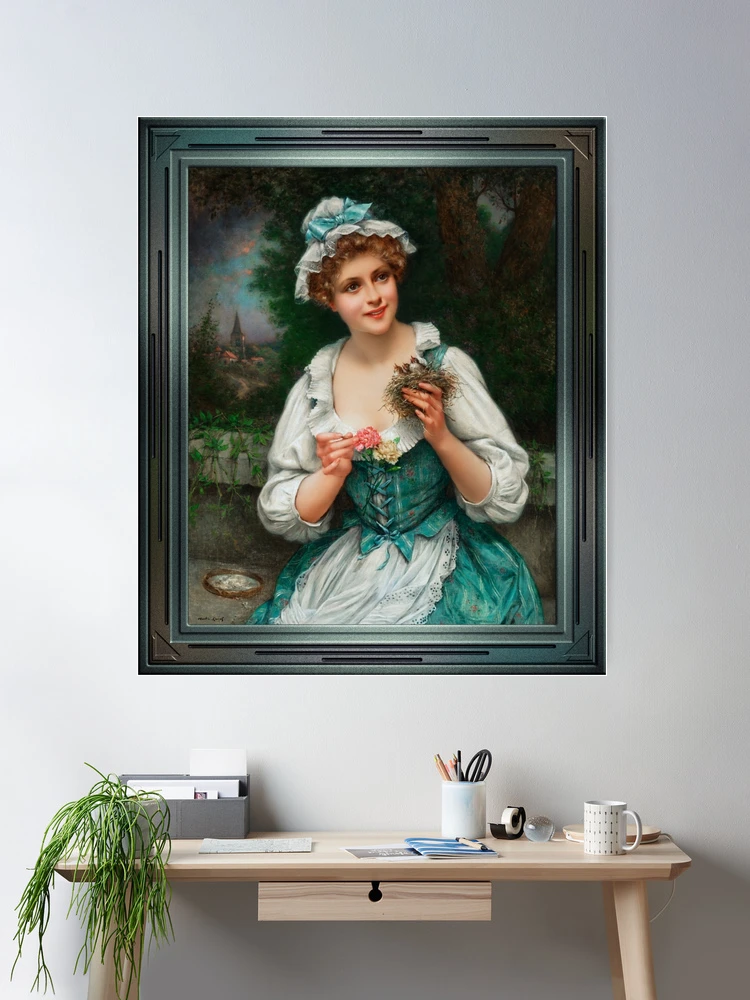
“Feeding Time,” painted in the late 19th century by the renowned French artist François Martin-Kavel (1861 – 1931), is a captivating and serene scene that masterfully blends elements of realism with the softness of romanticism. Martin-Kavel’s work frequently explores themes of youth, Natur, and domestic life, und dieses Stück ist keine Ausnahme. The painting portrays a young woman in a pastoral setting, standing in a lush garden or field, gently holding a nest with small birds. The artist captures her tender interaction with nature, evoking a mood of peacefulness, Unschuld, and harmony between humankind and the environment.
Inhaltsverzeichnis
Hauptthema: The Woman and Her Connection to Nature
Die zentrale Figur in “Feeding Time” is a young woman, dressed in a period-specific, delicate ensemble. She wears a light turquoise gown, adorned with lace trimmings and a satin ribbon, which adds texture and a sense of femininity. Her white blouse with ruffled sleeves contrasts beautifully with the soft, muted colors of the gown. The details of the dress reveal the artist’s careful attention to fabric texture, creating a sense of realism in the way the light interacts with the fabric. Auf ihrem Kopf, she wears a white lace bonnet, which is elegantly tied with a soft blue ribbon, further enhancing her gentle appearance.
In ihren Händen, the woman cradles a small bird’s nest, a significant object within the composition. The nest, filled with small birds, symbolizes new life, Unschuld, and nurturing. Es ist ein kraftvolles Symbol für die zyklische Natur des Lebens und die Verbindung zwischen der natürlichen Welt und der Menschheit. Ihre zarten Berührungen, während sie das Nest hält, zeugen von tiefem Respekt und Fürsorge für die Tiere, die sie pflegt. Die Vögel, wenn auch nicht im Mittelpunkt, sind fester Bestandteil der Szene, Betonung der Zärtlichkeit des Augenblicks und der thematischen Auseinandersetzung des Künstlers mit der menschlichen Interaktion mit der Natur.
Objekte: The Nest, Blumen, and Additional Symbols
Das Nest ist nicht nur eine Requisite im Kunstwerk, sondern ein zentrales Symbol für Leben und Fürsorge. Die kleinen Vögel im Inneren scheinen von der Frau gefüttert zu werden, unterstreicht die fürsorgliche Rolle der weiblichen Figur. Das Nest wird an ihre Brust gelegt, wo es fast wie ein Kind gewiegt zu sein scheint. Dieser Akt der Fürsorge und Ernährung spiegelt sich auch in der anderen Hand der Frau wider, which gently holds a pink flower, possibly a rose or carnation. The flower adds a touch of color to the scene and reinforces the motif of life, Schönheit, and nurturing. It suggests a subtle connection to nature, with the woman herself acting as a bridge between the natural and human worlds.
The background of the painting includes a glimpse of a distant landscape, possibly a garden or meadow, shrouded in a soft, muted haze. The figures in the distance could be indicative of a nearby town or village, though they are not the main focus. This distant view adds depth and perspective to the painting, grounding the more intimate scene in a broader natural setting. The juxtaposition of the small-scale, delicate interaction in the foreground against the larger, Eine ausgedehntere Naturlandschaft verstärkt die Vorstellung, dass die Harmonie der menschlichen Welt untrennbar mit der Natur verbunden ist.
Terrain: A Quiet Garden or Pastoral Setting
Die Szene spielt im Freien, möglicherweise in einem Garten oder einer üppigen, grüne Weide, Dies wird durch das lebhafte Laubwerk und die sanfte Bewegung der Landschaft im Hintergrund deutlich. Der Garten ist wahrscheinlich ein Symbol für Ruhe und Schönheit, Bereitstellung einer natürlichen, friedliche Umgebung, in der sich die Hauptfigur mit der Natur auseinandersetzen kann. Das Licht, das durch die Blätter der Bäume im Hintergrund dringt, taucht die Szene in einen warmen Glanz, die Gelassenheit und Ruhe des Augenblicks weiter verstärken. Der Künstler verwendet subtile, Natürliches Licht, um die Schlüsselelemente der Komposition hervorzuheben, verleiht dem Gemälde eine ätherische Qualität.
Das Gelände ist reich an Farben, mit grünen Farbtönen, die den Hintergrund und das umgebende Laub dominieren. Das Spiel von Licht und Schatten erzeugt eine sanfte Atmosphäre, fast traumhafte Atmosphäre, Sie laden den Betrachter ein, sich in diesem Frieden vorzustellen, idyllische Umgebung. Die Szene ruft ein Gefühl der Zeitlosigkeit hervor, was darauf hindeutet, dass Momente wie diese, wo die Menschheit im Einklang mit der Natur ist, sind universell und unveränderlich.
Stil, Thema, und Stimmung des Kunstwerks
François Martin-Kavels Stil in “Feeding Time” ist im Realismus verwurzelt, mit einem Hauch von Romantik, der der Szene eine idealisierte Schönheit verleiht. Die sorgfältige Verarbeitung von Stoff, Licht, und Texturen demonstrieren die Fähigkeit des Künstlers, die komplizierten Details seiner Motive einzufangen. Das Weiche, fast unscharfe Darstellung des Hintergrunds, mit der sanften Darstellung der jungen Frau, schafft einen Kontrast, der die Klarheit und Fokussierung auf die zentrale Figur verstärkt.
The theme of the painting revolves around nurturing, Unschuld, and the close relationship between humans and nature. The young woman’s caring interaction with the nest of birds signifies an idealized version of femininity and motherhood, which was often celebrated in the art of the time. The scene is not just a representation of a woman’s role in nature, but also a reflection of an era where the connection between humanity and the environment was revered. This harmonious relationship is what sets the mood of the painting—calm, heiter, and gently idealized.
The mood is undeniably peaceful and joyful, conveying a sense of happiness derived from simple, natural acts. The woman’s expression is serene and content, and her posture suggests both gentleness and strength. She is not merely a passive figure in this scene; she actively engages with the birds, suggesting that she is a part of the natural cycle, fostering life and growth.
Abschluss
“Feeding Time” by François Martin-Kavel is a stunning example of 19th-century French realism blended with romantic elements. The painting captures a serene and intimate moment of human interaction with nature, highlighting themes of nurturing, Weiblichkeit, and the beauty of the natural world. Through meticulous attention to detail and a masterful use of light and texture, Martin-Kavel evokes a timeless mood that invites the viewer to pause and reflect on the delicate balance between humanity and nature.
Dies ist eine retuschierte Reproduktion eines gemeinfreien Bildes durch digitale Meister alter Meister.
Künstler Bio abgeleitet von Artnet.com
François Martin-Kavel war ein französischer Genremaler, der vor allem für seine idealisierten Porträts schöner junger Frauen bekannt ist, die er oft in exotischen Kostümen oder in prickelnden Entkleidungszuständen darstellte.
Martin-Kavel malte seine Frauenporträts besonders oft in zentrierten Kompositionen, die von dunklen Stoffhintergründen umgeben waren, und theatralisch beleuchtet wie von einem Scheinwerferlicht auf das Modell.
Auch wenn François für seine beliebten weiblichen Figurenportraits bekannt ist, er war auch bekannt für seine Blumenstillleben und Landschaftsbilder; und war regelmäßiger Aussteller beim Salon des Artistes Français.
Als Mitglied des Salons, er wurde für seine künstlerischen Verdienste mit einer Medaille ausgezeichnet 1881.