

Flaming Arrow
Flaming Arrow c1936 by American Painter Edward Mason Eggleston (1882 – 1941), an who specialized in fashionable and fantasy women’s calendar portraits. He was also known as a commercial illustrator doing work for such firms as the Pennsylvania Railroad, the Fisk Tire Company, and the Great Lakes Exposition.
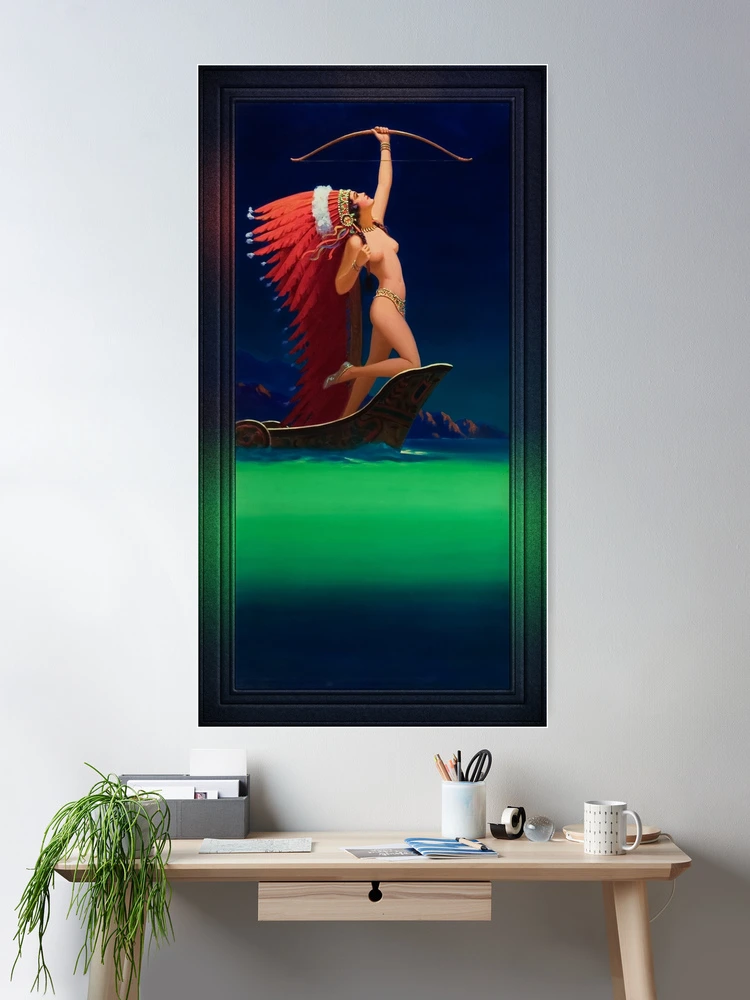
Edward Eggleston was a skilled American artist whose work spanned various genres, from portraiture to landscapes. One of his most iconic pieces, Flaming Arrow, pintat al voltant 1936, encapsulates the early 20th-century fascination with Native American themes and heroic imagery. Aquesta obra d'art, rich in both visual allure and historical resonance, és un testimoni de l'habilitat d'Eggleston per combinar tant el realisme com l'abstracció simbòlica..
L'escena representada a Flaming Arrow és una representació evocadora d'una dona nativa americana preparada com a guerrera, un arquetip de força i valentia. Es col·loca en un vaixell semblant a una canoa, dibuixant una fletxa del seu arc amb un sentit d'intensitat i propòsit. El seu braç està totalment estès, la corda de l'arc tensa que indica l'alliberament imminent de la fletxa, que sembla com si pogués esclatar en un brillant, arc de foc.
Aquesta acció es veu augmentada per la poderosa postura de la dona: l'esquena arquejada amb el pit avançat en perfecta harmonia amb l'energia del moment.. El llarg tocat de plomes que porta, vibrant i en tons rics de carmesí i blanc, sembla volar darrere d'ella com una extensió de la seva determinació i poder. La seva vestimenta, mínim i compost per una sèrie d'adorns tribals, afegeix la sensació primordial i elemental de l'obra d'art, fonamentant-la en la immensitat de la natura i en la recerca èpica que simbolitza.
El vaixell sobre el qual es troba és allargat, estructura esvelta, recorda les antigues canoes natives americanes que s'utilitzaven sovint per navegar per rius o llacs. La tonalitat fosca del vaixell contrasta amb els elements vibrants que l'envolten, i la seva curvatura suggereix un flux gairebé orgànic, com si fos part del paisatge més gran, les aigües de les quals recorren suaument a la seva base.
L'aigua en si es presenta en verds i blaus suaus, la seva superfície sembla tranquil·la i d'un altre món. malgrat això, hi ha un corrent subjacent de poder i potencial, as if the water is part of a larger, untold story that connects the heroine to the unknown. The colors of the water subtly reflect the colors of the sky, reinforcing the symbiosis between the woman and her environment.

The background of the piece is dominated by deep, rich tones of night. The mountains in the distance, visible but faint, rise up out of the mist, their peaks sharp and unyielding. These dark silhouettes provide a stark contrast to the vibrant reds of the woman’s headdress and the warm golds of her body jewelry.
The shadows in the painting are not merely absent light but are infused with texture, hinting at the mysteries and challenges the figure is poised to face. Al cel, one can sense the approach of something monumental, perhaps the impending release of the flaming arrow itself, a symbol of action, el destí, or impending conquest. The dramatic use of shadows in the painting underscores the sense of anticipation that envelops the scene.
Eggleston’s style in Flaming Arrow adheres to the principles of realism, yet with a flair for heightened drama. The forms are precise and the colors are rich, allowing the viewer to appreciate the texture and detail of the woman’s attire and the surrounding environment.
The artist’s use of light and shadow is particularly masterful; the illumination of the woman’s form against the darker backdrop of the night sky highlights her strength and central importance within the composition. The light seems to originate from an unseen source, casting a soft glow that subtly emphasizes her lithe and athletic physique.
The mood of the painting is one of solemnity and quiet power, but also one of impending action. The scene is frozen in time just before the release of the arrow, a moment ripe with potential. The viewer is drawn into this moment of pause, where the tension of the woman’s poised archery and the stillness of the surroundings come together in a breathtaking harmony. The mood feels like one of anticipation, and the woman stands as a figure who is prepared to unleash something far greater than herself.
The color palette Eggleston uses in Flaming Arrow is one of contrast and symbolism. The deep reds, ors, and earthy tones suggest a primal connection to the land and the elements, while the cooler blues and greens of the water and the sky convey serenity and mysticism.

The juxtaposition of these colors not only adds to the aesthetic beauty of the work but also enhances its narrative depth, evoking the complexity of the Native American experience and their historical relationship with nature, survival, and honor.
The painting’s theme could be interpreted as one of strength, resiliència, and the eternal connection between the warrior and the natural world. La dona, with her poised stance, no és només una figura de la història sinó una representació simbòlica de les qualitats atemporals del coratge i la fortalesa. La fletxa encesa que dibuixa significa no només una eina de guerra sinó també la idea d'un camí cap endavant, una elecció, o un moment de transformació personal.
Pel que fa als materials, L'ús de la pintura a l'oli per part d'Eggleston és evident en la riquesa textural i la profunditat del color que caracteritza la peça.. Les pinzellades són visibles en zones com el tocat amb plomes i l'aigua, creant una sensació de moviment i textura dinàmica.
La rendició de l'aigua, en particular, destaca per la seva translucidència i el joc de llum que li atorga una qualitat quasi eteri. El contrast entre la suavitat de l'aigua i la textura del cos de la dona i la canoa afegeix una capa de contrast que emfatitza encara més la figura central.
En conclusió, Flaming Arrow d'Edward Mason Eggleston és una obra d'art poderosa i captivadora. Combina realisme amb imatges simbòliques, creant una narració que ressoni amb temes de força, honor, i la connexió amb el món natural.
El domini de la llum per part de l'artista, color, i la forma atrau l'espectador a un món on el temps s'atura, i un moment singular de potencial penja en la balança. La pintura no és només una representació històrica sinó com una representació atemporal de l'esperit guerrer.
Informació a continuació de Wikipedia.org
Edward Mason Eggleston (22 de novembre 1882 – 14 Gener 1941) va ser un pintor nord-americà especialitzat en retrats de calendari de dones, de moda i fantàstic.
He was also a well known commercial illustrator doing work for companies such as the Fisk Tire Company, the Pennsylvania Railroad, and the Great Lakes Exposition.
He attended the Columbus Art School in Columbus, Ohio and moved to New York about 1915, where he worked to illustrate magazine covers, travel posters, advertisements and calendars.
He worked primarily with oil paints on canvas, and also with pastels, water colors, and gouache.
Eggleston tapped into an American trend toward escapist fantasy during the Great Depression years of the 1930s.
Described as “storytelling,” his calendar works focused on women in stylish and fashionable dresses and hats, swimwear, or costumed as Native-American women, “Egyptian Goddesses,” pirate girls, and women in the character of Peter Pan