

Flores de primavera – Flowers Of Spring
Introducción a la obra de arte
Flores de primavera (“Flowers of Spring”) is an exquisite work painted in 1878 by the renowned French artist William-Adolphe Bouguereau (1825 – 1905). Known for his mastery in rendering human figures with astonishing realism, Bouguereau’s “Flores de primavera” epitomizes his prowess in depicting delicate details and soft textures, capturing the purity of youth and the vibrancy of springtime. This painting is a perfect example of Bouguereau’s signature style, showcasing his ability to merge portraiture with the natural world, offering an intimate glimpse into the innocence of childhood and the richness of nature.
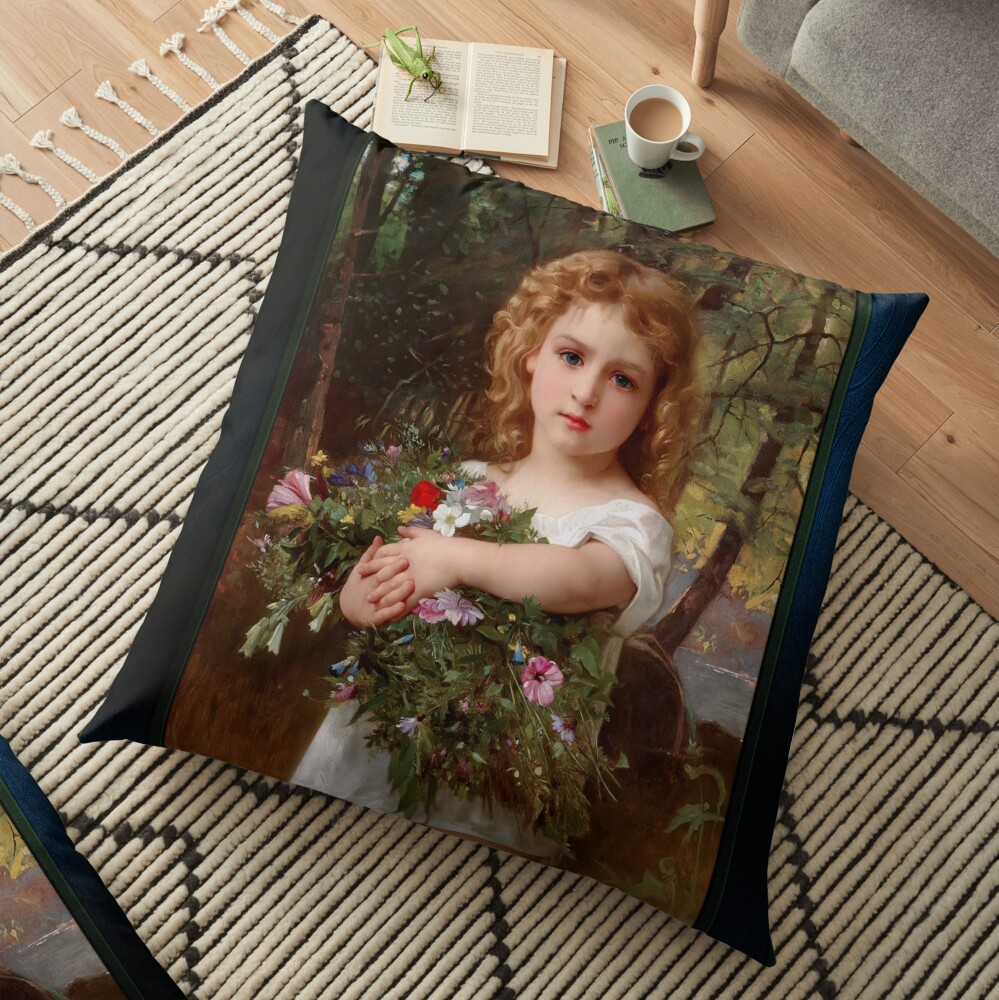
Tabla de contenido
El sujeto
At the heart of the composition is a joven, delicately posed as if she were an embodiment of spring itself. She is dressed in a simple white gown, her bare feet standing on the soft, earthy ground as she cradles an abundant bouquet of wildflowers against her chest. The floral arrangement she holds is a mixture of vibrant colors—deep purples, rosa, ropa blanca, and reds, evoking the fresh blossoms of the season. Her golden curls tumble down around her shoulders, contrasting against the pure whiteness of her garment. The girl gazes softly at the viewer with a subtle, almost shy expression, her features marked by a youthful innocence and purity that evoke a sense of nostalgia and tranquility.
The girl’s portrayal exudes the timeless theme of childhood innocence, yet it is also a nod to the floral symbolism of spring—a time of renewal, crecimiento, y fertilidad. The flowers are as much a part of her as she is a part of them, suggesting a harmonious connection between human and nature.
El escenario
El contexto de “Flores de primavera” is equally significant, as it sets the stage for the narrative of the young girl. The artist has chosen a wooded, paisaje iluminado, with trees partially obscured by a soft mist of morning dew. This ethereal backdrop suggests a tranquil rural setting, possibly near a forest or meadow, and reflects the peaceful serenity of nature. The earthy tones of the surrounding trees, foliage, and ground create a contrast with the purity and brightness of the girl’s figure. The light filters through the foliage, casting dappled shadows on the earth, which enhances the sense of a serene and harmonious relationship between the figure and the environment.
Bouguereau’s attention to detail in the landscape—each leaf, each flower, and each blade of grass—is striking, further elevating the realism of the work. The natural surroundings appear to frame the girl, subtly emphasizing her as the focal point while also suggesting her belonging to the world around her.
El estilo y la técnica
William-Adolphe Bouguereau was a master of the academic style, which was rooted in the traditions of realism and fine detail. His technique in “Flores de primavera” showcases the soft, almost ethereal quality of light and texture that defined his work. Bouguereau’s use of light is exceptional, with the interplay of soft sunlight across the girl’s face and the flowers accentuating the contours of her delicate features. The fine brushwork creates a smooth surface, almost velvety in appearance, making the girl’s skin seem radiant and lifelike.
The precise modeling of the face and hands is characteristic of Bouguereau’s meticulous approach to human anatomy. The tender folds of the gown, the gentle curve of the child’s arms, and the weightlessness of her pose all reflect a sophisticated understanding of human form. This technique not only gives a sense of realism but also imbues the figure with a sense of inner life, as though the viewer is encountering a moment of real beauty rather than a mere representation.
The flowers themselves are rendered with an almost botanical accuracy. Bouguereau was particularly adept at painting flora and fauna, and the bouquet in this painting is a testament to his skill in capturing the intricate textures and colors of nature. The flowers appear fresh and vibrant, as if plucked from the ground just moments before.
El estado de ánimo y el tema
El estado de ánimo de “Flores de primavera” es sereno y contemplativo, evoking a sense of nostalgia for a simpler, more innocent time. The young girl’s gaze, aunque suave, carries a depth of emotion that invites the viewer to reflect on themes of purity, juventud, y la naturaleza fugaz del tiempo. The softness of the figure, the gentle curvature of her body, and the expression on her face all suggest a sense of vulnerability, yet also an inherent strength. The connection to the natural world further amplifies these emotions, symbolizing life’s transient beauty, much like the blooming of flowers in spring that are destined to wither, only to be replaced by new growth.
The flowers themselves play a symbolic role in this painting. Traditionally, flowers represent the cycle of life, crecimiento, y muerte, and here, they symbolize the innocence and vitality of youth. In spring, the flowers’ bloom mirrors the girl’s own youthful energy and unspoiled beauty. Bouguereau’s careful juxtaposition of the girl’s purity with the vibrant spring flowers suggests an inevitable passage of time, a theme that resonates deeply in the art of the 19th century.
Conclusión
“Flores de primavera” is a quintessential example of William-Adolphe Bouguereau’s mastery in blending realism with emotional depth. The artwork encapsulates the beauty of the natural world and the fragility of youth, themes that were deeply significant to the artist and his contemporaries. Bouguereau’s attention to detail, his gentle rendering of the human form, and his understanding of light and shadow combine to create a painting that is not only visually stunning but also rich with emotional resonance. This work continues to be a testament to Bouguereau’s legacy as one of the finest painters of the 19th century.
Acerca de la obra de arte
Fleurs De Printemps es otra versión de la pieza de William Bouguereau Little Girl With Flowers c1878; con un fondo completo.
Mientras que la otra versión de esta pieza estaba recortada justo debajo de las rodillas y tenía un fondo negro.; esta versión tiene una configuración de bosque.
Me vi obligado a modificar la pieza ya que el fondo de esta versión estaba hecho un desastre, la mayor parte del fondo del bosque había sido borrado y las partes que eran visibles estaban casi completamente negras..
Para remediar esto, dé a la obra de arte una nueva apariencia., Decidí reemplazar el fondo con la pieza de paisaje Kahnpartie im Spreewald c1910 del pintor alemán Edward Theodore Compton (1849 – 1921).
Esta modificación produce un fondo de árboles y plantas que combina muy bien con la niña y la hierba alta detrás de ella.; y agrega una fuente de luz adicional y un río en el extremo derecho.
Luego fui a reparar los cortes., grietas, abandonos y suciedad de la pintura; además de difuminar el suelo que había perdido pintura y se veía mal, para que se mezclara con el resto de la escena.
El resultado final es el de una adorable niña encantadora de pies descalzos., con cabello castaño claro dorado vestido con una túnica blanca, con una mirada angelical para ella; que está de pie en un camino forestal que lleva en sus brazos y cerca de su cuerpo, una gran variedad de flores y plantas silvestres que ha recolectado durante su excursión al bosque.
Fleurs De Printemps es una reproducción de maestros antiguos de arte digital remasterizada de una imagen de dominio público que está disponible como lienzo enrollado, acrílico, grabados en metal y madera.
Sobre el artista
Información a continuación derivada de Wikipedia.org
William-Adolphe Bouguereau nació en La Rochelle, Francia, en 30 noviembre 1825, en una familia de comerciantes de vino y aceite de oliva. Hijo de padres católicos Théodore Bouguereau b1800 y Marie Bonnin b1804, conocida como Adeline.
Tenía un hermano mayor, Alfredo, y una hermana menor, Marie (conocido como Hanna), que murió a la edad de siete años. La familia se mudó a Saint-Martin-de-Ré en 1832. Otro hermano nació en 1834, gatito.
A la edad de 12, Bouguereau fue a Mortagne para quedarse con su tío Eugène, sacerdote y desarrolló un amor por la naturaleza, religión y literatura. En 1839, fue enviado a estudiar para el sacerdocio en un colegio católico en Pons.
En el Catholic College, Louis Sage le enseñó a dibujar y pintar., que había estudiado con Ingres. Bouguereau abandonó a regañadientes sus estudios para volver con su familia, ahora residiendo en Burdeos. Mientras esté en Burdeos en noviembre 1841 conoció a un artista local, Charles Marionneau, y continuó sus estudios artísticos en la Escuela Municipal de Dibujo y Pintura.
Bouguereau también trabajó como dependienta, colorear litografías a mano y realizar pequeñas pinturas que fueron reproducidas mediante cromolitografía. Pronto fue el mejor alumno de su clase., y decidió convertirse en artista en París. Para financiar la mudanza, Él vendió 33 retratos al óleo sin firmar en tres meses; y con el dinero ganado, llegó a París a la edad de 20 en marzo 1846.
Después de llegar a París, Bouguereau se convirtió en estudiante en la École des Beaux-Arts.; y para complementar su formación formal en dibujo., asistió a disecciones anatómicas y estudió vestuario histórico y arqueología. En 1848 creó Igualdad antes de la muerte (Igualdad antes de la muerte), su primer cuadro de Bmajor.
Posteriormente obtuvo un puesto en el estudio de François-Édouard Picot, donde estudió pintura al estilo académico; produciendo Dante y Virgilio en el infierno c1850, que es un ejemplo temprano de su obra de arte neoclásica.
Durante su vida, Bouguereau disfrutó de una gran popularidad en Francia y Estados Unidos., y recibió numerosos honores oficiales, mientras disfruta de que le paguen el mejor precio por su obra de arte. Como el pintor de salón por excelencia de su generación, fue vilipendiado por la vanguardia impresionista.
A lo largo de su vida, Bouguereau ejecutado 822 pinturas terminadas conocidas, aunque aún se desconoce el paradero de muchos.