

El soñador
“El soñador” es una pintura creada por el artista francés Louis Marie de Schryver, un reconocido pintor de finales del siglo XIX y principios del XX. Completado a finales del siglo XIX o principios del XX., Esta obra maestra ejemplifica la exquisita maestría de De Schryver para capturar la forma femenina., así como su delicadeza a la hora de transmitir emociones a través de delicadas paletas de colores y pinceladas.. El artista, nació en 1862 y pasando 1942, especializado en retratar mujeres hermosas con suaves, cualidades etéreas, a menudo envueltos en entornos lujosos. En este trabajo en particular, de Schryver imbuye un ambiente sereno pero íntimo a través del retrato de una mujer joven, que mira suavemente hacia afuera, envuelto en un estado casi de ensueño.
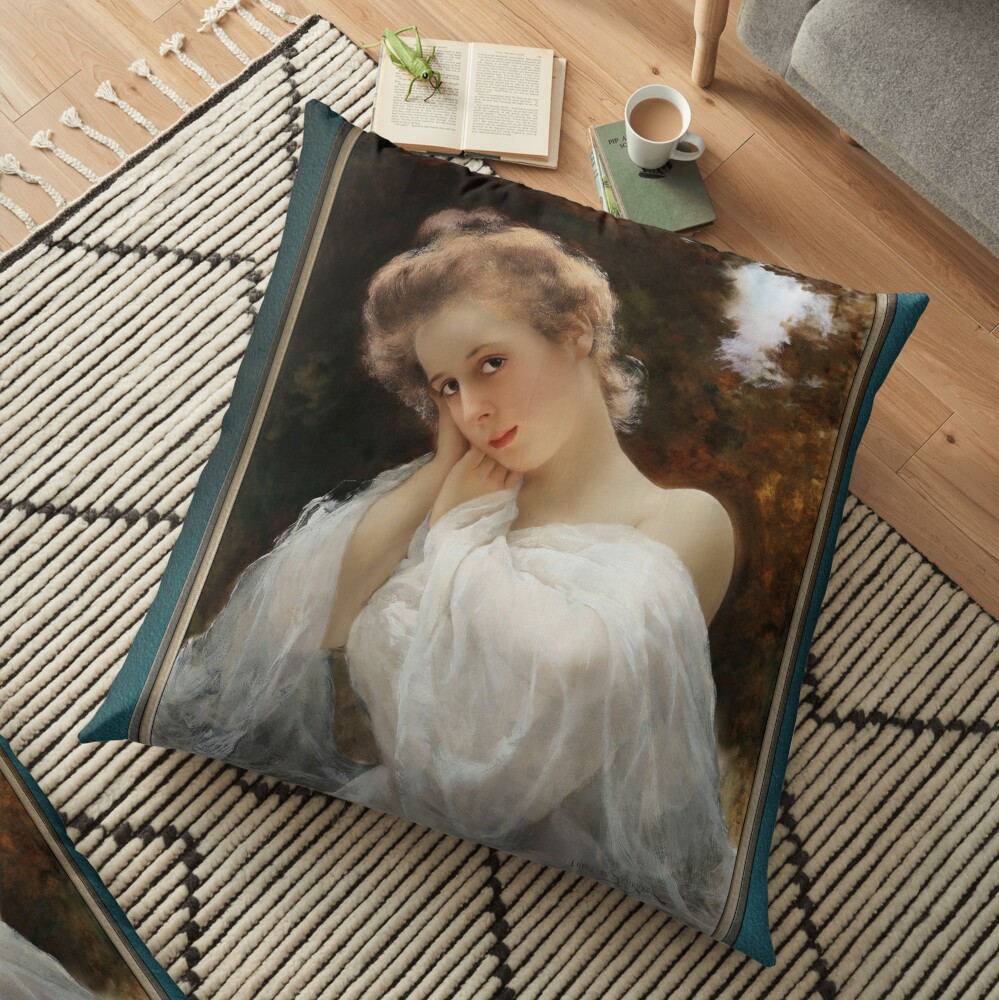
Tabla de contenido
El sujeto: El soñador
En el corazón de la composición se encuentra el tema de “El soñador,” un gracioso mujer joven exudando una tranquila sensación de ensueño. Su expresión es suave y contemplativa., como perdido en un momento de introspección personal o de ensueño. La pose que asume es elegante., con una mano colocada pensativamente cerca de su mejilla, que acentúa sus delicados rasgos. la mirada, mientras se dirige ligeramente hacia un lado, parece distante, Casi como si la figura estuviera absorta en sus propios pensamientos.. ella despeinada, pelo suave, con sus suaves olas, es luminoso y aireado, contribuyendo al suave aura de inocencia y feminidad que el artista construye cuidadosamente.
El sujeto está vestido con una prenda blanca fluida que se mezcla con los tonos suaves que la rodean., casi como si ella fuera parte del paisaje etéreo. La tela transparente parece casi translúcida., Captar la luz de maneras que revelan la habilidad del artista para representar texturas delicadas y profundidad.. Las opciones de color realzan la calidad onírica de la pieza., ya que la tela blanca contrasta con los tonos más oscuros del fondo, que permanece suave, pero distante. La sencillez de su atuendo y su expresión serena dirige la atención del espectador únicamente hacia ella., crear una conexión poderosa entre el sujeto y la audiencia.
Antecedentes y terreno
El fondo de la pintura es sutil pero integral al estado de ánimo general.. Tonos oscuros de marrón y ocre se lavan en las esquinas superiores., enmarcando la figura. La gradación de colores crea una sensación de profundidad., guiando los ojos del espectador hacia el soñador. Pequeños toques de mechero, aspectos destacados casi etéreos sugieren un paisaje vago, tal vez un jardín indistinto o un entorno natural, pero el foco sigue estando en la figura más que en el entorno. Estos detalles evocan un ambiente que parece suspendido en el tiempo: desconocido pero reconfortante..
La suave combinación de colores del fondo refleja la suavidad y la atemporalidad que De Schryver a menudo infundía en sus obras.. Hay una sensación de quietud en la escena., donde los elementos naturales parecen desvanecerse en una atmósfera de otro mundo. Evitando distintos terrenos u objetos., el artista aísla la figura, permitiendo que el soñador siga siendo el foco central de la composición, no afectado por ningún entorno externo.
Materiales y estilo
El enfoque de Louis Marie de Schryver hacia los materiales es evidente en la textura y fluidez de su trabajo.. Conocido por su dominio de la pintura al óleo., de Schryver utiliza capas de pigmento para crear una apariencia suave y rica, mostrando su meticulosa atención al detalle. Las pinceladas en “El soñador” son suaves y refinados, Característica del estilo del artista que pretendía imitar la elegancia y la naturaleza delicada de la forma humana.. Lo suave, La aplicación casi aterciopelada de pintura se suma a la ilusión de ligereza y ligereza que impregna la pieza..
El estilo en sí se basa en el realismo académico de finales del siglo XIX., pero está imbuido de un sentido de romanticismo. De Schryver no se limita a representar a una mujer, sino que la presenta como una visión idealizada de la belleza femenina.. Este enfoque está en consonancia con los ideales de la tradición pictórica del Salón Francés., donde la belleza, gracia, y el refinamiento eran primordiales. Todavía, También hay una sutil abstracción en la obra que permite al espectador proyectar sus propias interpretaciones., hacer que la obra de arte trascienda cualquier período o estilo específico.
La elección de utilizar predominantemente tonos suaves: el beige., ropa blanca, y dorados apagados, contra el fondo oscuro crea un suave contraste que enfatiza la ligereza de la figura mientras mantiene la suavidad de la escena.. La capacidad de De Schryver para crear fluidez entre el sujeto y su entorno es evidente., mientras la figura y el fondo se fusionan perfectamente, sugiriendo la calidad onírica de la pintura.
El tema y el estado de ánimo de la obra de arte.
El tema de “El soñador” es uno de introspección, feminidad, y delicada belleza. La pintura parece invitar al espectador a un momento de ensoñación tranquila., donde los límites entre la realidad y el sueño se desdibujan. El sujeto, envuelto en suave, telas ligeras, podría representar una visión idealizada de la feminidad o simplemente la tranquila introspección que el artista deseaba transmitir. El aire de delicadeza y fragilidad en la composición habla de la vulnerabilidad del sujeto., basándose en temas de juventud y pureza.
El ambiente general de la pintura es de tranquila serenidad.. No hay ninguna emoción manifiesta en la expresión del sujeto., pero la sutileza de su comportamiento sugiere una contemplación pacífica, una calma que impregna toda la composición. Lo suave, Los tonos apagados, combinados con la gracia de la figura, dotan a la pieza de una elegancia atemporal.. La quietud de la pose de la mujer contrasta con el movimiento fluido de la tela., Creando una tensión armoniosa entre los elementos estáticos y dinámicos..
La cualidad onírica de esta pieza sugiere la visión romántica de la feminidad del artista., Presentar a la mujer como una figura de belleza y una presencia enigmática.. Esta representación etérea se alinea con los ideales de la época., donde la mujer ideal era a menudo representada como esquiva e inalcanzable, existiendo en un mundo de luz suave y soledad tranquila.
Conclusión
En “El soñador,” Louis Marie de Schryver ha creado una representación conmovedora y elegante de la belleza y la tranquilidad femeninas.. A través de su delicada pincelada y dominio del color., Presenta la visión de una mujer joven envuelta en un momento de ensoñación tranquila.. Los tonos apagados, tela fluida, y su suave composición invitan al espectador a reflexionar sobre la naturaleza pacífica e idealizada de la figura., mientras que la ausencia de antecedentes definitivos permite una interpretación atemporal. Esta pintura, aunque está arraigado en las tradiciones académicas de finales del siglo XIX, trasciende su época para convertirse en una expresión universal de belleza, gracia, e introspección.
Esta es una reproducción de maestros antiguos de arte digital remasterizada de una imagen de dominio público que está disponible como Esta es una elegante chica de glamour art deco vintage..
Biografía del artista derivada de Rehs.com
Luis nació en París, Francia en octubre 12, 1862 a un periodista bien establecido, y desde muy pequeño se interesó por el arte y comenzó a aprender por sí mismo a pintar..
Tenía tanto talento que a la edad de 13 expuso bodegones Margaritas y Crisantemos y Violetas y Flores de Primavera en la 1876 Salón de París.
Al año siguiente comenzó a estudiar con el pintor francés de bodegones y género Philippe Rousseau. (1816 – 1887), y también expuesto en la 1877 Salón de París.
En 1880 a la edad de 17 recibió una medalla de bronce en la Exposición Universal de Sydney por el cuadro Lilas.
Durante los siguientes seis años continuó presentando bodegones, así como escenas de género y retratos a los Salones anuales.; y por 1886 había centrado su atención en la vida cotidiana parisina, y comenzó a ganar encargos para pintar retratos de las figuras de la alta sociedad de la época..
En 1891 expuso el cuadro El fin de un sueño en el Salón de París, lo que le valió una medalla de bronce; y luego en 1900 expuso la Exposición Universal, ganando una medalla de oro.
Durante este período, Louis desvió su atención del período de La Belle Époque (1871 – 1880 y 1914 el estallido de la primera guerra mundial), a la de pintar retratos y pintar trajes que presentaban hombres y mujeres elegantes de una época pasada vestidos con trajes de seda y satén..