

Chica con una amapola
“Chica con una amapola” is a timeless portrayal by French painter Emile Vernon, quien vivió de 1872 a 1919. The artwork depicts a young woman adorned with poppies, a theme often associated with both beauty and transience. Known for his skill in capturing delicate, naturalistic beauty, Vernon employed a detailed and precise style that resonates with the elegance of the early 20th century. This painting showcases Vernon’s finesse in using color and light to create a harmonious blend of realism and romanticism.
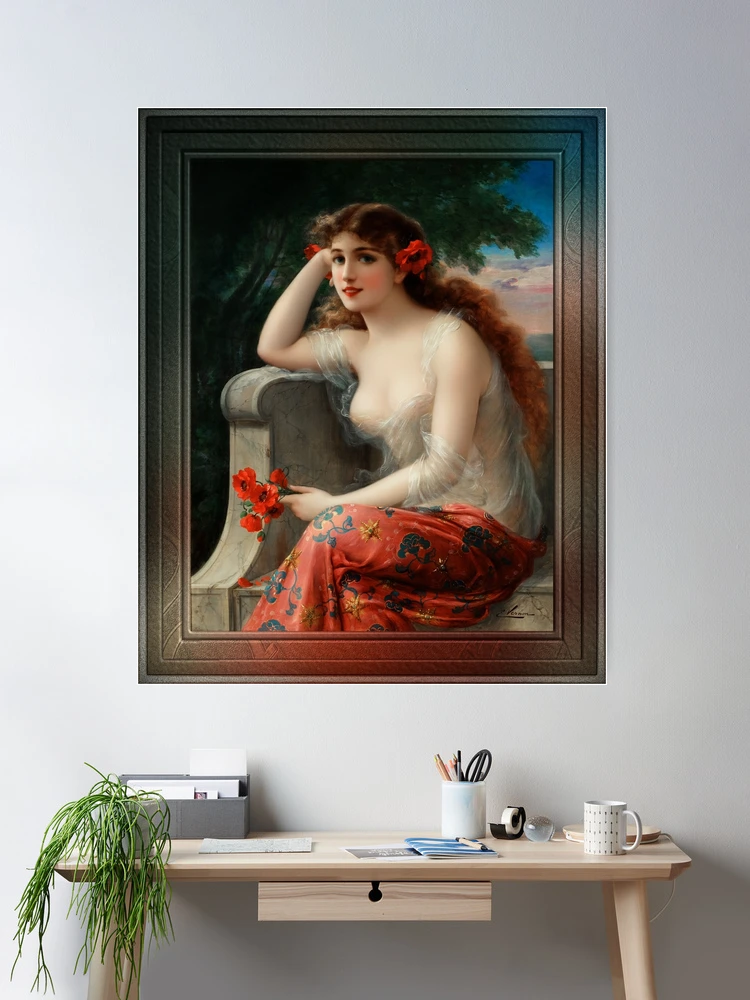
Tabla de contenido
Asunto principal: A Woman of Grace
At the heart of this piece is the woman with her radiant features and serene expression. Her rich auburn hair is styled with delicate curls that frame her face, with two bold red poppies tucked in the loose strands, adding a vivid contrast to her pale complexion.
The woman gazes gently toward the viewer, her expression calm yet filled with subtle mystery. Su pose, slightly tilted to the side as she rests on a stone bench, gives an air of introspection, and her posture exudes both grace and elegance.
Su atuendo, while simple, is imbued with luxurious softness. She wears a light, transparent garment that appears almost ethereal, flowing over her shoulder and extending in loose folds. The fine details of her garment’s fabric subtly reveal the artist’s attention to texture and depth, particularly in the way light catches on the translucent material. The poppies she holds in her left hand are vibrant and alive, contrasting with the softness of her skin and dress, symbolizing fleeting beauty and the passage of time.
Objects and Surrounding Elements
The focus on the young woman’s figure is surrounded by several key elements that enhance the painting’s romantic and contemplative atmosphere. She is seated on a marble bench, set against a lush, green landscape that suggests a garden or an outdoor space. The background is filled with dense foliage, including trees that reach upward toward the sky. This natural environment emphasizes the harmony between the subject and the world around her, as if she is one with the serene beauty of the landscape.
En el fondo, the sky transitions from a soft blue to a gentle, warm pinkish hue near the horizon, perhaps indicating either early morning or late afternoon. This delicate use of color invokes a sense of quietude, allowing the viewer to feel the calmness of the scene while drawing attention back to the subject at the forefront. La configuración, with its natural details and soft lighting, creates an idealized world that complements the theme of timeless beauty and femininity.
Estilo y técnica: Impressionistic Realism
Vernon’s artistic style is heavily influenced by both realism and impressionism. While his subject is depicted with lifelike accuracy, there is a distinct softness in the brushwork that allows the light to dance delicately on the surface of her skin and clothing. This effect contributes to a dreamy, almost otherworldly atmosphere, in which every detail, from the subtle contour of the figure to the play of light on her fabric, conveys the tenderness of the moment.
The artist’s approach to texture is particularly notable, as the fine details in the woman’s dress and the flowers she holds bring them to life. The translucent fabric of her dress seems to shimmer with the reflection of light, lending it a delicate, almost weightless quality. The poppies, vibrant in contrast to the muted tones of her attire and the soft, natural surroundings, symbolize the fleeting nature of youth and beauty, echoing the themes of impermanence in the piece.
The painting’s composition is carefully structured, drawing the viewer’s eye from the woman’s face to her hand, where she holds the poppies, and then outward to the lush background. The sense of depth in the piece, particularly in how the foliage recedes into the distance, enhances the sense of tranquility and quietude. The way Vernon uses light to subtly model the figure, along with the attention to detail in the flowers and the surrounding nature, suggests a deep understanding of both natural forms and human anatomy.
Estado de ánimo y tema: Transience and Beauty
El estado de ánimo general de “Chica con una amapola” is one of contemplation and calm. The young woman’s soft expression, combined with the gentleness of the light and the natural elements around her, invites the viewer into a world that seems removed from the concerns of modern life. There is an air of mystery about her, as if she is lost in thought or caught in a fleeting moment of tranquility.
The use of poppies in the artwork plays a significant symbolic role. Poppies are often associated with themes of both beauty and transience, as they are delicate flowers that bloom brightly for a short period before wilting. This symbolism could be seen as a meditation on the fleeting nature of youth and beauty, a common theme in art and literature of the time. The serene yet ephemeral quality of the piece suggests that the subject’s beauty, like the poppies she holds, is momentary, yet deeply meaningful in its own right.
Además, the natural setting and the subject’s gentle pose seem to convey a timeless connection to the earth, a theme often explored in art as a reflection on the relationship between humanity and the natural world. By placing the young woman in such a serene, almost idealized landscape, Vernon captures a universal sentiment of harmony between human life and the beauty of the natural world.
Materiales y Técnicas
Émile Vernon’s skillful use of oil paint in this piece is evident in the depth and richness of the colors, particularly the contrast between the soft skin tones of the woman and the vibrant red poppies. The fine brushstrokes used to capture the delicate textures of her skin, cabello, and clothing are indicative of the artist’s meticulous attention to detail. El uso de la luz, both to illuminate the figure and to create soft shadows, adds dimension to the painting, making it not only a visual feast but an emotionally resonant experience.
The subtle gradations of color, from the soft pinkish light in the background to the deep, earthy tones of the marble bench, contribute to a sense of balance and serenity. The artist’s technique emphasizes texture and the interplay of light and shadow, creating a timeless piece that draws the viewer’s eye and encourages a deeper reflection on the themes of beauty and transience.
Niña con amapola del pintor francés Emile Vernon (1872 – 1919); que se especializó en pintar acuarelas, con su tema principal siendo mujeres y niños en entornos rurales brillantes y coloridos. Se formó con William Bouguereau y Auguste Trouphème en la Escuela de Bellas Artes de París Francia.
Este es un maravilloso retrato idílico de una hermosa joven sentada en un banco de mármol en un jardín que lleva una blusa de seda blanca muy transparente y endeble y una falda roja con flores bordadas en azul y acentos de estrellas doradas..
Tiene flores de amapola en el pelo a ambos lados de la cabeza mientras apoya el lado derecho de la cabeza con el brazo doblado en la repisa alta del banco.; y sosteniendo una colección de flores de amapola en su mano izquierda que descansa sobre su pierna izquierda que está doblada sobre su pierna derecha.
Al fondo podemos ver árboles muy grandes a su derecha y justo detrás de ella, así como un río a lo lejos delimitado por un bosque muy grande y un hermoso color azul, blanco, tonos rosa y naranja.
Esta es una reproducción de viejos maestros de arte digital retocada de una imagen de dominio público.
Biografía del artista
Información debajo de Galería y Jan
Émile Vernon era alumno de la escuela de Bellas Artes de Tours, donde ganó el primer premio de dibujo en 1888; luego fue asesorado por William Bouguereau y Auguste Truphème.
Entonces en 1898 participó en la exposición Tours de Bellas Artes y Artes Decorativas y más tarde ese año, en la Exposición de Artistas Franceses y exhibió regularmente su trabajo allí desde 1898 a 1913; presentando retratos, paisajes, escenas de Bretaña, ramos de bodegones que pintó en acuarela, así como figuras femeninas, que luego se convirtió en su especialidad.
Émile se destacó en sus pinturas de luz tenue, adorables figuras de niños y elegantes jóvenes, con quien solía asociar una mascota como un gato, perro o pájaro, y adornaba sus imágenes con guirnaldas o ramos de flores, a lo largo de su carrera; pero también fue un artista muy polifacético que supo pintar con rigor y potencia como en sus obras el retrato de Madame Vernon y Sous la Lampe (Bajo la lámpara).