

Goddess of Water
Goddess of Water by Russian Painter Konstantin Makovsky (1839 – 1915); med speciale i russiske historiske malerier, der viser et idealiseret syn på russisk liv i tidligere århundreder.
Maleriet “Goddess of Water” is a masterful depiction of the divine beauty and power of water through classical mythology. The artist’s rich use of color, dramatisk belysning, and careful attention to detail create a vivid and serene representation of the goddess of water as she is transported by swans across a vast oceanic expanse.
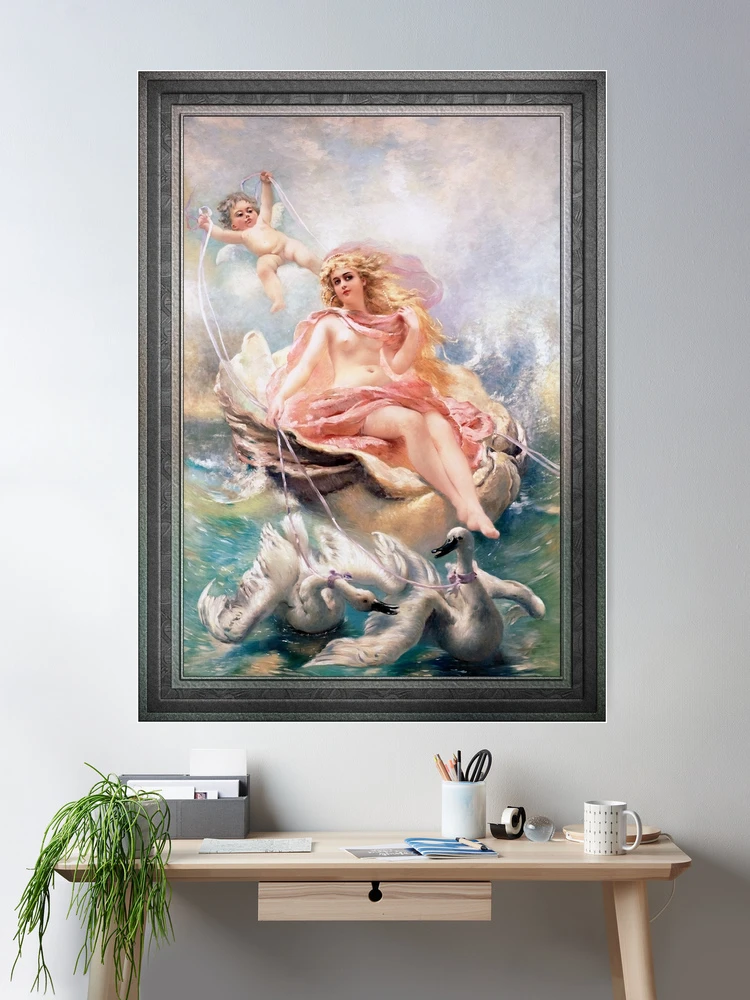
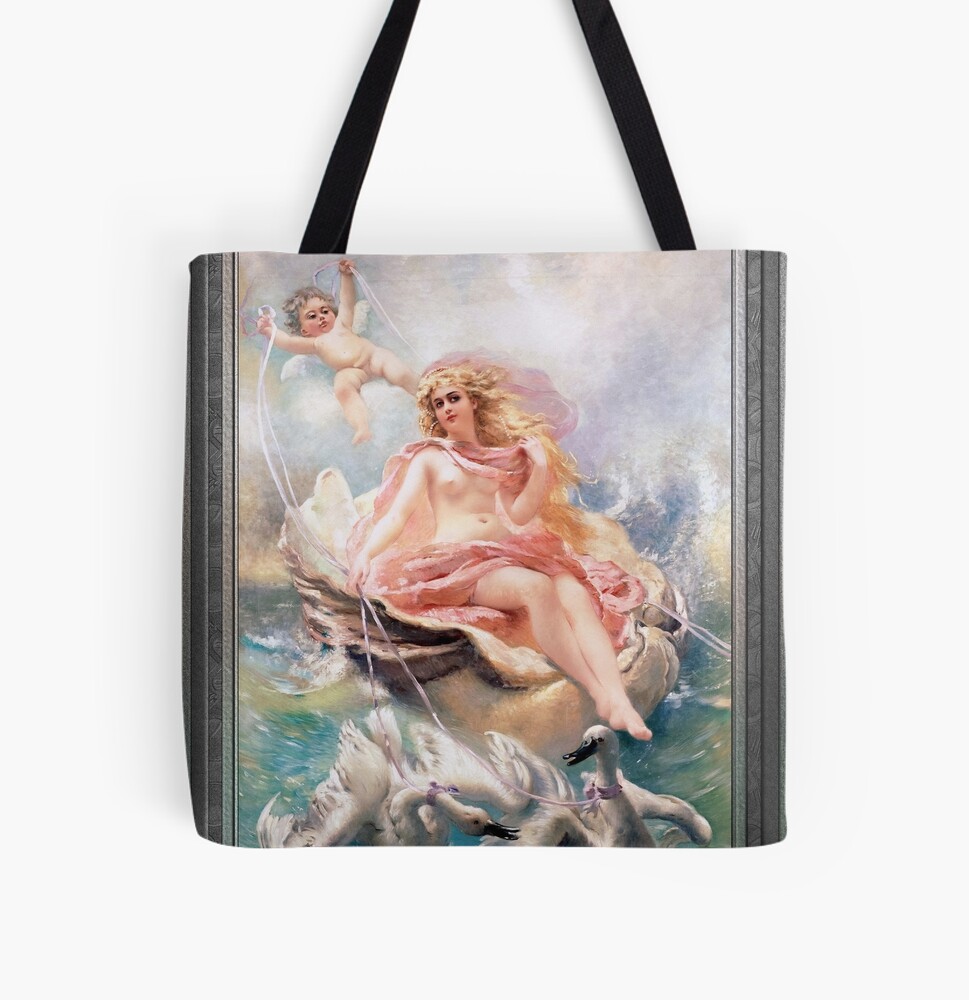
The central figure in the artwork is the goddess herself, a beautiful woman with flowing golden locks, her body partially draped in a pink and soft mauve sheer cloth that clings delicately to her form, revealing the curves of her body.
The goddess is seated serenely in a boat-like structure made of what appears to be soft seashells, floating on undulating waves, with a faint glow surrounding her, symbolizing her divine nature. Hendes ansigt, calm and composed, carries an air of grace and timeless beauty, reinforcing the ethereal nature of her character.
Bag hende, en kerubisk figur, a child-like angel, is tethered to the goddess by ribbons, symbolizing a divine connection between the mortal and the immortal. This child, whose face expresses innocence and purity, seems to guide or assist in the goddess’s journey across the waters.
The angel holds onto ribbons that extend out into the air, tethering the goddess to the swans pulling her vessel. The gentle hands of the cherub grasp the flowing ribbons with precision, and his childlike features lend a sense of playful innocence to the otherwise tranquil scene.
The swans, regal and powerful, are the carriers of the goddess, their long necks extending gracefully through the scene, and their white feathers rendered with a soft, almost glowing light, enhancing their majestic appearance.
The swans pull the boat forward, seemingly in motion as the ripples of water, shown through the smooth, soft waves, reflect the calmness of the scene. The swans’ presence in mythology often symbolizes purity and spiritual grace, which complements the goddess’s serene and powerful nature.
The background of the painting is a vast and dreamy oceanic landscape, bathed in soft, warm light, as if the sun itself is fading into the horizon. The water, although calm and peaceful, seems to ripple with the movement of the swans, adding life and a sense of motion to the otherwise still moment. The sky above is filled with soft, billowy clouds, reminiscent of a serene and timeless world where the goddess’s presence is natural and eternal.
The mood of the painting is peaceful, fredfyldt, and divine. The soft pastel colors used in the piece lend a sense of tranquility, while the glowing light surrounding the goddess and the angel enhances the mystical nature of the scene. There is a harmony in the painting that speaks to the balance of the elements—water, air, and earth—through the goddess’s gentle interaction with the swans, the water, and the sky.
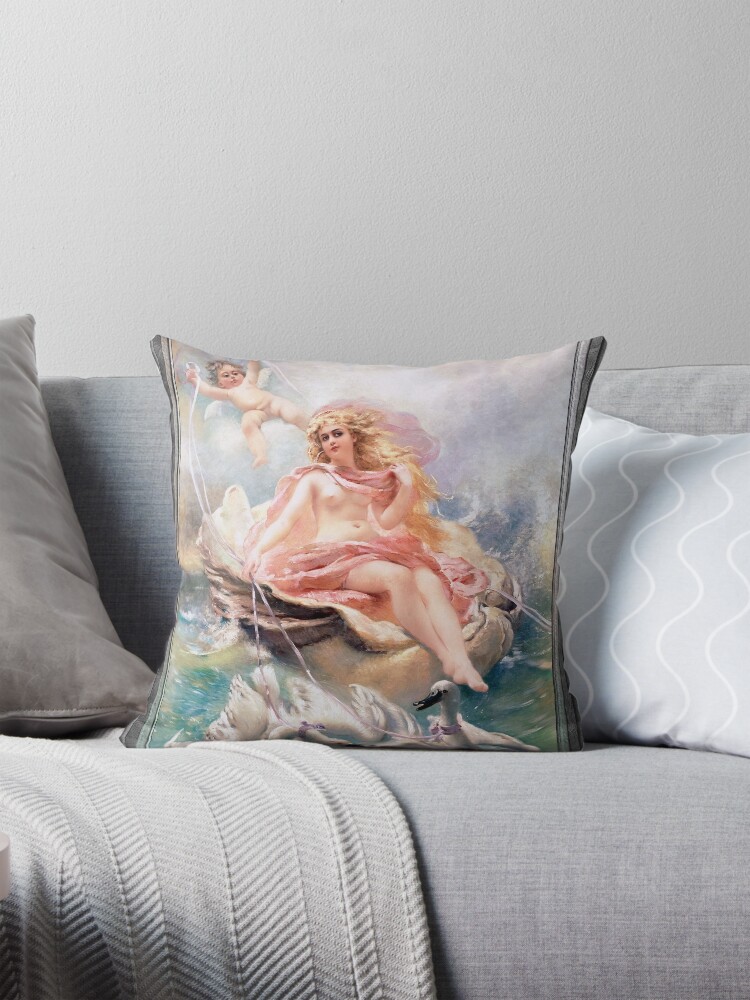
Makovsky’s mastery of classical techniques shines through in the detailed depiction of the figures, teksturer, and natural elements. The soft texture of the goddess’s flowing hair, the delicate folds of her clothing, and the smoothness of the swans’ feathers all demonstrate his skill in bringing the ethereal into the visual realm. The light, radiant atmosphere throughout the artwork communicates the theme of purity, guddommelighed, and the eternal cycle of nature.
The theme of water as a symbol of life, renhed, and fertility is prevalent in the painting. The goddess of water, accompanied by the cherubic guide and the swans, creates a powerful and harmonious image of nature’s beauty and divine intervention.
Water in mythological contexts often represents fluidity, change, and the nurturing aspects of life, all of which are conveyed through the painting’s serene depiction of the goddess as she floats effortlessly across the waters.
This painting embodies the 19th-century Russian fascination with classical themes, blending mythological subjects with a refined and sophisticated approach to realism. It showcases a period of artistic exploration that was both romantic and idealized, drawing on ancient mythological figures to embody ideals of beauty, nåde, and divine connection with nature.
Afslutningsvis, “Goddess of Water” is a masterpiece that combines the beauty of nature with the divine, creating a serene, mystical atmosphere that is both timeless and transcendent. The detailed execution, the symbolic presence of the goddess, angel, and swans, and the soft, flowing colors make this piece a vivid representation of classical mythology, encapsulating the quiet power of water as an eternal, life-giving force.
Info nedenfor stammer fra Wikipedia.org
Konstantin Makovsky var en indflydelsesrig russisk maler, tilknyttet “Peredvizhniki (Vandrere)”. Mange af hans historiske malerier, såsom Beneath the Crown (1889) også kendt som The Russian Bride's Attire og Before the Wedding, viste et idealiseret syn på russisk liv i tidligere århundreder. Han betragtes ofte som en repræsentant for akademisk kunst.
Konstantin Makovsky blev født i Moskva. Hans far var den russiske kunstfigur og amatørmaler, Yegor Ivanovich Makovsky. Hans mor var komponist, og hun håbede, at hendes søn en dag ville følge i hendes fodspor. Hans yngre brødre Vladimir og Nikolay og hans søster Alexandra blev også malere.
I 1851 Makovsky gik ind i Moskvas malerskole, Skulptur og arkitektur, hvor han blev den bedste studerende, nemt at få alle de tilgængelige priser. Hans lærere var Karl Bryullov og Vasily Tropinin. Makovskys tilbøjeligheder til romantik og dekorative effekter kan forklares med indflydelsen fra Bryullov.
Selvom kunst var hans passion, han overvejede også, hvad hans mor havde ønsket, at han skulle gøre. Han tog afsted for at lede efter komponister, han kunne henvise til, og tog først til Frankrig. Før, han havde altid været en elsker af klassisk musik, og lyttet til mange stykker. Han ønskede ofte, at han kunne ændre melodien, eller stil nogle af dem for at gøre dem sjovere. Senere i hans liv gik det i opfyldelse.
I 1858 Makovsky gik ind på Imperial Academy of Arts i Sankt Petersborg. Fra 1860 han deltog i Akademiets udstillinger med malerier som Curing of the Blind (1860) og Agenter for den falske Dmitry dræber Boris Godunovs søn (1862). I 1863 Makovsky og tretten andre studerende holdt en protest mod Akademiets indstilling af emner fra skandinavisk mytologi i konkurrencen om den store guldmedalje for akademiet; alle forlod akademiet uden et formelt eksamensbevis.
Makovsky blev medlem af et kooperativ (artel) af kunstnere ledet af Ivan Kramskoi, producerer typisk Wanderers-malerier i hverdagen (Enke 1865, Silde-sælger 1867, etc.). Fra 1870 han var et stiftende medlem af Society for Travelling Art Exhibitions og fortsatte med at arbejde på malerier, der var helliget hverdagen. Han udstillede sine værker på både Academia-udstillingerne og Vandrernes Rejsekunstudstillinger.
En betydelig ændring i hans stil skete efter at have rejst til Egypten og Serbien i midten af 1870'erne. Hans interesser ændrede sig fra sociale og psykologiske problemer til de kunstneriske problemer med farver og form.
I 1880'erne blev han en fashionabel forfatter af portrætter og historiske malerier. På verdensudstillingen i 1889 i Paris modtog han den store guldmedalje for sine malerier Ivan den grusommes død, Paris-dommen, og Demon og Tamara. Han var en af tidens mest værdsatte og højt betalte russiske kunstnere. Mange demokratiske kritikere betragtede ham som en frafalden af Wanderers’ idealer, producerer (ligesom Henryk Siemiradzki) slående, men overfladiske værker,[2] mens andre ser ham som en forløber for russisk impressionisme.
Makovsky blev dræbt i 1915 da hans hestevogn blev ramt af en elektrisk sporvogn i Sankt Petersborg.