

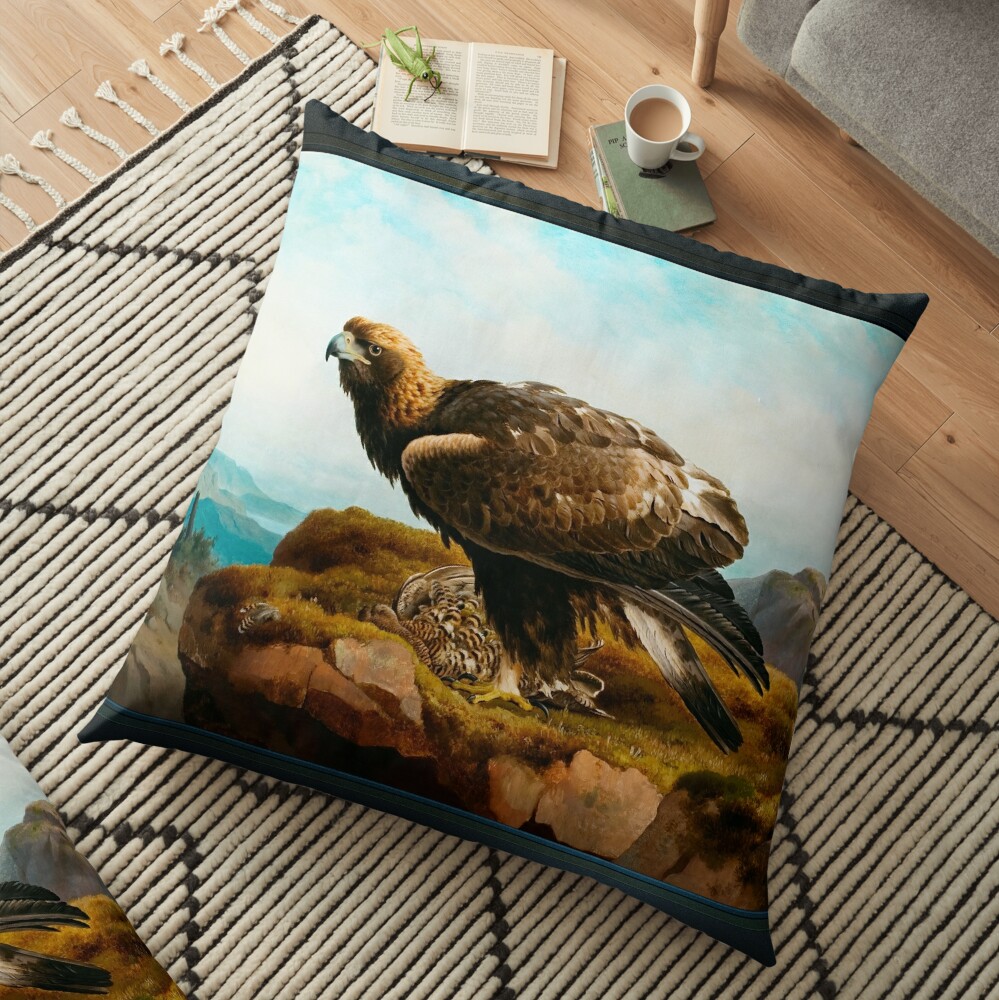
Golden Eagle At A Cliffs Edge c1880
“Golden Eagle At A Cliffs Edge” is a masterful artwork created in 1880 by the Finnish painter Ferdinand von Wright (1822–1906). This stunning klassista taidetta piece is a representation of the natural world that blends realistic detail with the atmospheric beauty of the landscape.
Known for his expertise in capturing the essence of wildlife, von Wright’s style in this painting elevates the noble and untamed nature of the golden eagle to a level of reverence, placing it at the forefront of the composition against a dramatic backdrop of a rugged, windswept terrain. His ability to illustrate the fine details of feathers, tekstuurit, and the play of light and shadow creates an immersive experience that transports the viewer into the wild and untamed world of the eagle.
Sisällysluettelo
Main Subject and Mood
At the heart of the painting stands the golden eagle, an embodiment of strength, majesty, and dominance. The bird is perched near the edge of a cliff, its powerful form commanding attention. The eagle’s posture, with its wings partially spread, suggests a sense of alertness and readiness to take flight at a moment’s notice.
The artist’s meticulous attention to detail in the depiction of the eagle’s feathers, especially the dark and light interplay along the wings and body, conveys the grace and power of this magnificent creature. The eagle’s gaze is intense, its eyes sharp and penetrating as though surveying its domain, while its sharp talons are slightly visible, clenching the rocky surface beneath it.
The mood of the painting is one of solitude and quiet strength. There is no sense of rush, but instead an impression of calm vigilance. The eagle, in its natural element, evokes a timeless quality, representing both the fierce beauty and the fragility of the wilderness. The contrast of light and shadow in the bird’s form adds a sense of depth and three-dimensionality, reinforcing the idea that the eagle is a living, breathing creature in a moment of quiet observation.
Terrain and Natural Setting
The terrain surrounding the eagle is rugged, with steep cliffs and distant mountains stretching across the horizon. The rocky outcrops on which the eagle stands are bathed in warm golden light, contrasting with the cooler, more muted tones of the distant hills and sky. The sparse vegetation, tufts of grass and scattered shrubs, are finely painted, emphasizing the harshness of the landscape. The color palette used for the terrain is dominated by earth tones: ochre, ruskea, and gray, interspersed with greens and blues in the distant landscape. These colors contribute to the sense of isolation and the unspoiled beauty of the natural world.
The sky above the eagle is expansive, pehmeällä, billowing clouds that hint at a serene day, though the eagle’s stance implies a readiness for the unpredictable nature of its environment. The distant mountains, painted with delicate brushstrokes, create a sense of scale and perspective, giving the scene a vastness that suggests the eagle’s lofty position at the apex of its world. There is a subtle tension between the grandeur of the eagle and the vastness of its surroundings, symbolizing the strength of the bird in contrast to the immensity of the natural world.
Materiaalit ja tekniikka
Ferdinand von Wright’s technique is rooted in the precision and clarity of realism. He masterfully captures textures, from the fine details of the eagle’s feathers to the rough, jagged edges of the cliffside. His use of light and shadow is particularly effective in adding depth to the painting, creating the illusion of three-dimensionality on a two-dimensional canvas. The eagle’s feathers are rendered with delicate, yet firm strokes that bring the bird to life, while the rugged landscape is similarly detailed but with broader strokes that convey a sense of wildness and natural beauty.
Von Wright’s choice of oil paints allows him to achieve rich textures and vibrant colors, imbuing the painting with a naturalistic glow. The varying tones of the earth, the eagle’s feathers, and the sky are seamlessly blended to create a harmonious composition. His understanding of light, particularly how it interacts with the forms in the painting, enhances the mood of the scene, infusing it with a quiet yet powerful energy.
Tyyli ja teema
The painting exemplifies the academic realism of the 19th century, with a focus on accurate and detailed representations of nature. Von Wright’s work, rooted in his training as an artist and his deep love for the Finnish landscape, often centered on wildlife and nature, Ja tämä pala ei ole poikkeus. The eagle, a symbol of freedom and strength, is portrayed in its natural environment, a theme that von Wright frequently explored in his art.
The theme of the painting can be interpreted as a tribute to the untamed beauty of nature, where the eagle represents the majesty of the wild, untamed landscapes that are both harsh and beautiful. The eagle’s solitary presence at the cliff’s edge suggests a contemplation of the grandeur and vastness of the natural world. The scene is devoid of human presence, allowing the focus to remain entirely on the bird and its environment, which is characteristic of von Wright’s commitment to portraying nature in its purest form.
Johtopäätös
“Golden Eagle At A Cliffs Edge” is a striking and evocative painting that encapsulates Ferdinand von Wright’s dedication to portraying the beauty and majesty of wildlife. Through his masterful rendering of the golden eagle and its rugged natural surroundings, von Wright invites the viewer to appreciate the strength and grace of the eagle as well as the grandeur of its environment. The painting captures a moment frozen in time, where nature is both fierce and serene, and the eagle, perched at the edge of the world, stands as a symbol of nature’s untamed spirit.
Tämä on remasteroitu digitaalisen taiteen vanhojen mestareiden kopio julkisessa käytössä olevasta kuvasta, joka on saatavilla a kanvastulostus verkossa.
Taiteilija Bio on johdettu Wikipedia.org
Ferdinand oli viimeinen eläkkeellä olevan suomalaismajuri Henrik Magnus von Wrightin yhdeksästä eloon jääneestä lapsesta.; hänen kaksi vanhempaa veljeään Magnus von Wright (1805 – 1868) ja Wilhelm von Wright (1810 – 1887) olivat maalareita ja kuvittajia, ja hän seurasi heidän jalanjäljänsä, osoittavat varhaista kykyä taiteeseen, joka kehitettiin hänen metsästyksensä ja luontoon tutustumisen aikana, kirjaamalla havaintojaan luonnoskirjoihin.
Sisään 1837 hän lähti Suomesta ja matkusti Ruotsiin toisen vanhimman veljensä Wilhelmin kanssa; joka tuolloin työskenteli kuvittajana ruotsalaiselle eläintieteilijälle Bengt Fredrik Friesille (1799 – 1839); sitten sisään 1838 he went back to Sweden to work for the Swedish amateur Ornithologist Count Nils Bonde (1685 – 1760).
Palattuaan takaisin Suomeen työnsä päätyttyä; sitten hän palasi Ruotsiin vuonna 1842 ja opiskeli hetken Ruotsin kuninkaallisessa taideakatemiassa ruotsalaisen kuvanveistäjä Johan Niclas Byströmin johdolla. (1783 – 1848); sitten kaksi vuotta myöhemmin palasi kotiin Suomeen.
Sitten sisään 1849 hän matkusti Turkuun, Suomeen, jossa hän otti ylimääräisiä maalaustunteja ruotsalaisen romanttisen taidemaalari Robert Wilhelm Ekmanin luona (1808 – 1873); opintojensa jälkeen, hän ja hänen veljensä lähtivät Helsinkiin, Suomen pääkaupunkiin ja perusti studion; ja kuusi vuotta myöhemmin hän matkusti Dresdeniin, Saksa opiskelee tunnetun saksalaisen eläinmaalari Johann Siegwald Dahlin johdolla (1827 – 1902).
1870-luvulla hän kärsi useista aivohalvauksista, jotka pitivät hänet vuoteessa; mutta hän jatkoi maalaamista, ja sisään 1881 teki viimeisen matkansa Orustiin tapaamaan veljeään Wilhelmiä, joka myös oli sairas.
Tästä eteenpäin hänen työstään tuli kaupallisempaa, ja sisään 1886 hän teki tunnetuimman maalauksensa “Taistelevat metsot” ja osallistui artikkeleihin erilaisiin lintutieteellisiin julkaisuihin.
Näihin aikoihin hän sai valtion taiteilijaeläkkeen; ja 1890-luvulla monet hänen entisistä oppilaisistaan tulivat käymään, while in the late 90s bird painter Matti Karppanen (1873 – 1953) pysyi hänen oppilaansa ja avustajanaan.