

Head of a Young Boy c1763
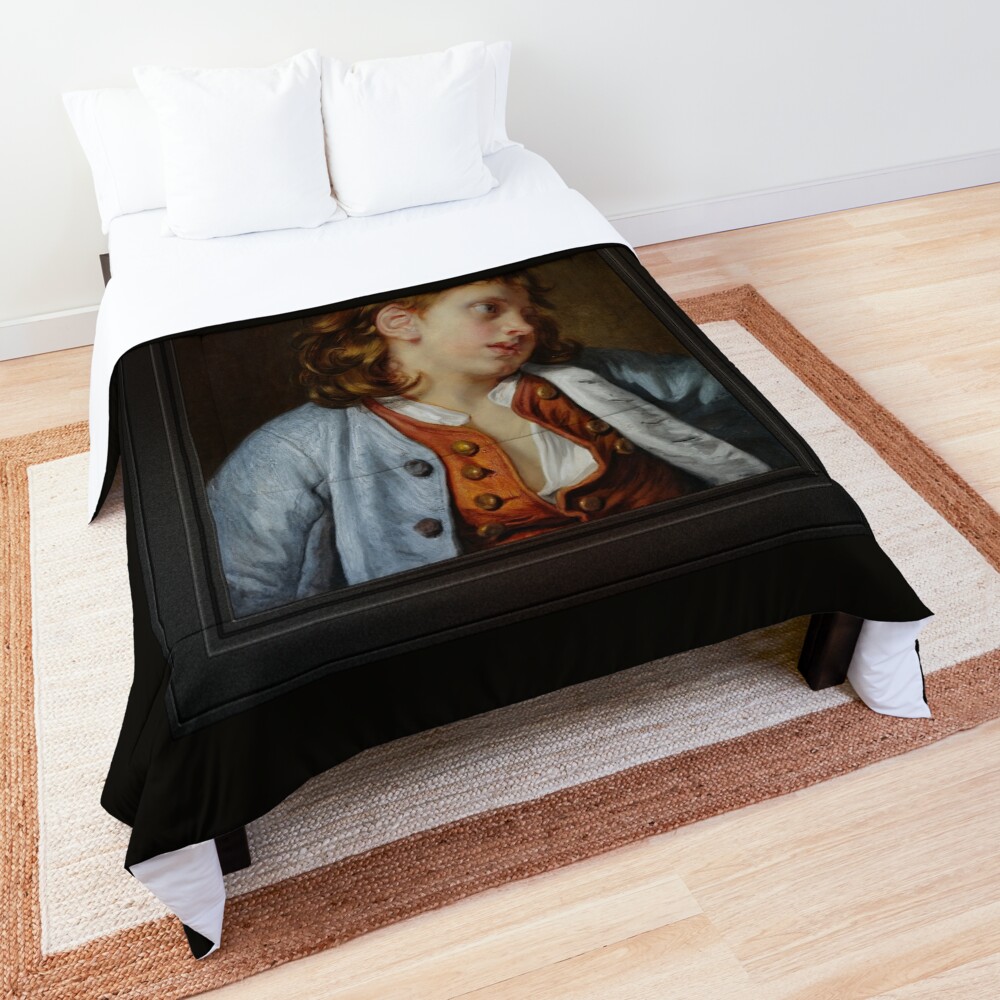
Izenburua duen artelanak Head of a Young Boy was created in 1763 by the renowned French painter Jean-Baptiste Greuze (1694 – 1774). This evocative portrait encapsulates the tenderness and innocence of youth, showcasing the artist’s remarkable skill in rendering emotion and character through subtle details and masterful brushwork. Greuze, often celebrated for his depiction of genre scenes, emotional expression, eta gai moralak, brings to life the essence of a young boy’s contemplative nature. The painting focuses on the head of the subject, highlighting the texture of his skin, the softness of his features, and his expression, all while employing Greuze’s characteristic realism and sensitivity to human emotion.
Edukien taula
Gaia eta Osaera
The primary focus of the painting is the head and upper torso of a young boy, his age perhaps around twelve or thirteen, in a quiet, pensive moment. His head is turned slightly to the side, with his gaze directed downward and to the right, giving him an air of introspection.
The boy’s delicate features are captured with such precision that one can almost feel the texture of his youthful skin and the lightness of his soft, ile kizkurra. His face, framed by loose waves of chestnut-brown hair, appears serene but is infused with a sense of melancholy. His eyes, though soft, seem to communicate an underlying depth of emotion, as if the artist intended to capture more than just a physical likeness but also a moment of emotional reflection.
The boy is dressed in a simple, yet somewhat refined, outfit characteristic of mid-18th century French fashion for young boys. He wears a garment with a reddish-brown underlay, partially revealed beneath a loose, blue jacket adorned with brass buttons.
The colors of his attire, earthy and muted, serve to complement the naturalistic tones of his face, emphasizing the lifelike quality of the portrait. The texture of his clothing is rendered with exquisite detail, with Greuze’s signature soft brushwork lending an almost tactile quality to the fabric, conveying the impression that the viewer could reach out and feel the texture of the materials.
Estilo artistikoa eta teknika
Jean-Baptiste Greuze is widely regarded as a master of Rococo realism, and this portrait is a prime example of his ability to merge delicate, refined aesthetics with profound emotional depth. The artist’s technique in Head of a Young Boy showcases his sensitivity to the nuances of light and shadow. The light source comes from the left, illuminating the boy’s face and highlighting the softness of his youthful skin.
The light plays delicately across his features, creating a gentle contrast between the highlights on his forehead, nose, and cheek, and the subtle shadows around his eyes and under his chin. This masterful use of chiaroscuro (argiaren eta ilunaren arteko kontrastea) brings a lifelike three-dimensionality to the figure, enhancing the sense of realism.
Greuze’s brushwork is soft yet precise, with every detail carefully rendered to evoke texture and form. The softness of the skin is portrayed through gentle, fluid strokes, while the more textured elements, such as the buttons on the jacket and the folds of fabric, are painted with sharper, more defined lines. This balance of soft and hard brushwork gives the portrait its depth and realism, and contributes to the tender mood of the piece.
Gaia eta Aldartea
The theme of the painting appears to focus on the quiet, reflective nature of childhood. Unlike other portraits of children from this period that may emphasize their status or wealth, Greuze seems to highlight the vulnerability and introspective quality of youth. The boy’s subtle, almost melancholic expression evokes a sense of innocence and fragility, suggesting that the subject’s internal world is being gently explored by the artist.
His somewhat somber expression does not indicate sadness, but rather a contemplation of his surroundings or of life itself. This emotional depth is characteristic of Greuze’s genre paintings, which often dealt with themes of morality, human emotion, and the complexities of youth.
The mood of the painting is calm and introspective. The boy’s expression, along with the gentle lighting and muted tones of his clothing, creates a sense of quietude and reflection. Konposizioaren sinpletasuna, focused solely on the boy’s head and upper torso, reinforces this meditative atmosphere, inviting the viewer to contemplate the nature of childhood and the emotional depth that Greuze was able to capture within his subjects.
Materialak eta Teknika
Head of a Young Boy is executed in oil paint on canvas, a medium in which Greuze excelled throughout his career. The use of oil allows for the rich, textured application of pigment, which enhances the three-dimensional quality of the figure and the intricate detailing of the boy’s features and clothing. Greuze’s skill in layering paint, as well as his ability to manipulate light and shadow, demonstrates the technical expertise that made him one of the most respected portraitists of his time.
The choice of canvas as the support material provides a smooth surface on which Greuze could build up his layers of paint with precision. The texture of the canvas itself, though barely perceptible to the naked eye, contributes to the painting’s overall atmosphere, helping to absorb and diffuse light in a way that enhances the lifelike appearance of the subject. The depth of color, particularly in the boy’s face, is achieved through delicate glazing techniques, which involve applying thin layers of translucent paint over a dried base layer to create a luminous effect.
Bukaera
In Head of a Young Boy, Jean-Baptiste Greuze demonstrates his exceptional talent for capturing the emotional and psychological depth of his subjects. The young boy, rendered with delicate realism, becomes not just a portrait of a child, but an exploration of the inner life of youth.
The painting’s serene mood, combined with its meticulous technique and evocative use of light and shadow, transports the viewer to a world where emotions and thoughts are quietly expressed through the subtleties of human expression. This artwork remains a testament to Greuze’s mastery in the realm of portraiture, offering a timeless reflection on the nature of youth and the complexities of human emotion.
Arte digital birmasterizatua da, sarean mihise inprimatu gisa eskuragarri dagoen domeinu publikoko irudi baten erreprodukzioa..
Artistaren biografia
Beheko informazioatik eratorria da NGA.gov
Jean Tournusen jaio zen, Frantzian 1725 adin txikitatik bere talentua aitortu zuen maisu teilatzaile baten seigarren semea baita; Lyonera bidaliz, Frantzia Charles Grandon margolari frantsesarekin ikasteko (1691 – 1762).
Urte gutxi gorabehera 30 Lyon utzi zuen, eta Parisera bidaiatu zuen, Frantziak Académie royale de peinture et de sculpture edo Pintura eta Eskultura Errege Akademian ikasteko; garai hartan Frantziako arte-erakunde nagusia zen Antzinako Erregimenaren azken zatian (Erregimen Zaharra ~ 1500 to 1789), urtean deuseztatu zen arte 1793 Frantziako Iraultzan.
Nahiz eta talentu handikoa eta arrakasta handia izan 1760 eta 1770eko hamarkadetan zehar, Pompadour markesa bezalakoen patroiak izatea (1721 – 1764), Katalina II.a Errusiako enperatriz (r. 1762 – 1796), eta La Live de Jully taldeko Ange Laurent (1725 – 1779); bere izaera errebeldea eta Akademiako eta Saloneko funtzionarioekin izandako gatazkak bere zorigaitza izango ziren; batez ere, Anne Marie Babutyrekin ezkondu ondoren 1759; berarentzat hondamendia izango litzatekeena, jakina baitzen bere ikasleekin eta eserlekuekin hainbat kontu izan zituela, horrek diru-sarreren galera eta umiliazio publikoa eragin zion.
Ezkontza amaitu zenean 34 urte geroago bere emazteak likidazio handia jaso zuen, horrek egoera ekonomiko larrian utzi zuen eta hil zenerako 1805 urterekin 80 ia apurtuta zegoen.