

Head of a Young Woman c1849
“cabeza de una mujer joven” c1849, by German painter Hermann Winterhalter (1808 – 1891), is an exquisite portrait that captures the refined elegance and subtle emotional depth characteristic of mid-19th century European art. Winterhalter, renowned for his portraits of royal families and aristocracy, excels in this work, showcasing a young woman in a composition marked by grace, serenidad, and an air of mystery. El estilo, ánimo, and technical execution place this piece squarely within the tradition of Romanticism, which celebrates the expression of emotion, belleza natural, and individualism.
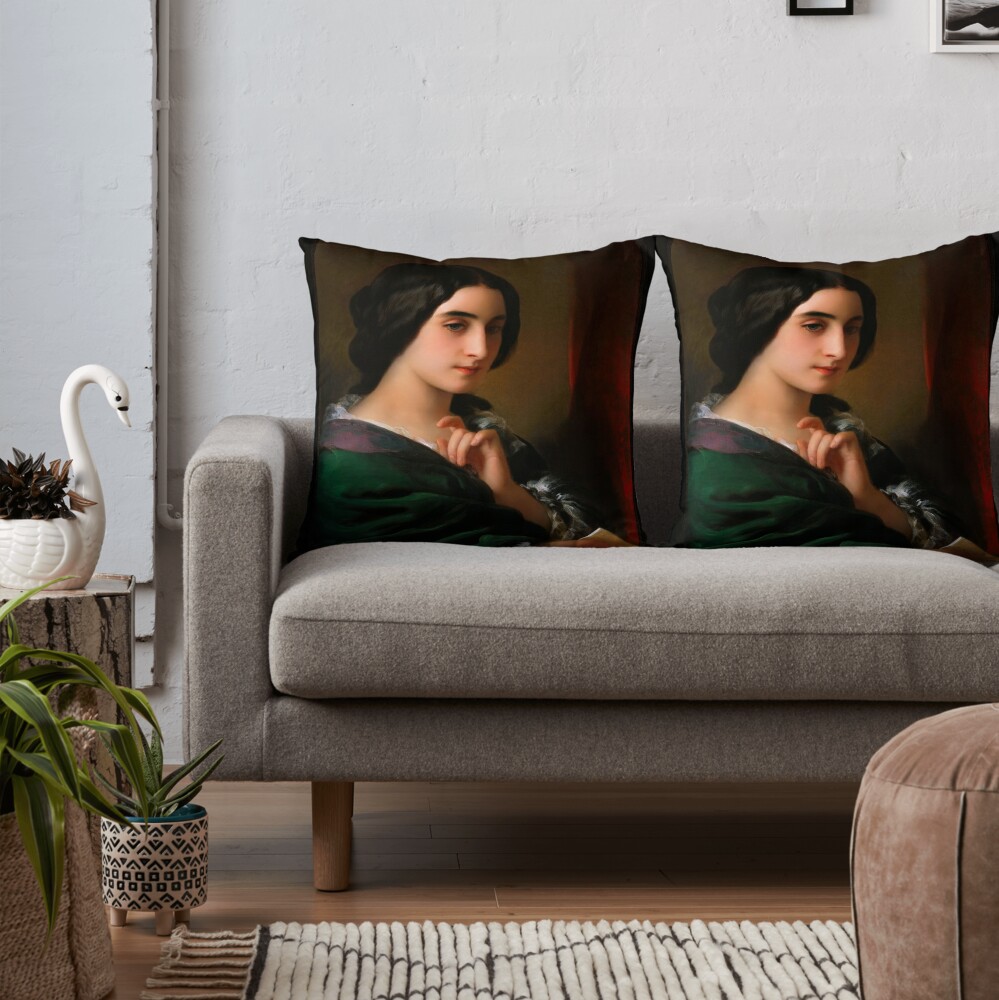
Tabla de contenido
Tema y composición
The subject of this portrait is a young woman, depicted in half-profile with an engaging yet contemplative expression. The woman is dressed in a dark, richly detailed gown, the flowing fabric of which contrasts elegantly with the softness of her pale skin. Su pelo, a cascade of dark waves, is styled neatly, framing her face and adding a sense of refinement and care to her appearance. She gazes slightly to the right, her eyes conveying a sense of quiet introspection, as if caught in a moment of personal reflection. Her right hand, gently resting on her chest, adds an intimate quality to the painting, as though she is caught in a fleeting, delicate gesture of thought or emotion.
The composition focuses tightly on her head and upper torso, with minimal background distraction. Lo suave, blurred background hints at a warm, ambient setting that complements her serene expression without drawing attention away from her figure. The artist uses light to delicately illuminate her face, emphasizing the softness of her features. The background itself is subtly rendered, with muted colors that do not compete with the woman’s detailed attire and poised demeanor.
Style and Techniques
Winterhalter’s style is steeped in the traditions of 19th-century portraiture, where precision in rendering the subject’s likeness was essential, but where emotional expression was also paramount. His careful use of light and shadow on the woman’s face highlights the gentle curvature of her cheeks and the softness of her jawline, emphasizing both the delicate and noble aspects of her character. This technique demonstrates Winterhalter’s mastery in the manipulation of chiaroscuro—the treatment of light and shade—which was integral to creating depth and volume in the painting.
The artist’s handling of the young woman’s gown is another remarkable aspect of the portrait. The fabric appears lush and tangible, its folds and drapery rendered with great care to suggest weight and texture. Winterhalter pays close attention to the rendering of the material’s sheen and the way the fabric naturally falls, allowing it to interact beautifully with the light sources in the painting. This skill not only emphasizes the luxurious quality of the woman’s attire but also reflects the importance of social status and wealth, which were central themes in Winterhalter’s portraiture.
The brushwork itself is smooth and almost invisible, giving the painting an almost ethereal quality. The meticulous finish, devoid of visible brushstrokes, imparts a sense of polish and refinement that befits the subject’s aristocratic portrayal. This technical finesse is characteristic of Winterhalter’s larger body of work, which often aimed to achieve a harmonious balance between idealized beauty and realism.
Tema y estado de ánimo
The theme of the portrait is deeply rooted in Romantic ideals, specifically the emphasis on individual beauty and introspection. Unlike many portraits of the time that focused on formal poses and overt displays of wealth, Winterhalter’s depiction of the young woman feels intimate and contemplative. There is no sense of boastful exhibitionism in her pose. En lugar de, her expression is quiet and reserved, allowing the viewer to interpret her emotions as one of thoughtful serenity or even melancholy. Her gaze is soft yet direct, drawing the viewer into her personal world.
The mood of the painting is reflective and calm. La iluminación suave, coupled with the muted palette of the background and the subject’s attire, imbues the scene with a sense of quiet elegance. This mood is reflective of the 19th-century fascination with inner life and personal reflection, as opposed to the more outwardly focused portrayals of earlier eras. The juxtaposition of the young woman’s graceful appearance with the gentle tone of the work emphasizes her emotional depth and the nuanced complexities of her character.
Materials and Presentation
This work is painted with oil on canvas, a medium that allows for the smooth blending of light and shadow. Oil paint was a standard medium during this period, prized for its richness and the ability to achieve a high degree of realism. The artist’s use of oil paint in this portrait allowed for the depiction of skin tones with remarkable subtlety and warmth, contributing to the soft luminosity of the subject’s face and the overall atmosphere of the piece.
The size of the painting is relatively intimate, further enhancing the personal and introspective nature of the portrait. The young woman is captured in a moment that feels private, as if she has been paused mid-thought. This closeness invites the viewer to connect with the subject on a more personal level, almost as if they are intruding on a private moment of introspection.
Conclusión
Hermann Winterhalter’s “cabeza de una mujer joven” is a testament to the artist’s skill in capturing the refinement, elegancia, and emotional depth of his subjects. Through his meticulous technique, use of light, and emphasis on the subject’s introspective nature, Winterhalter creates an intimate portrayal that transcends the mere visual. The woman’s graceful demeanor, combined with the rich textures of her clothing and the soft, contemplative atmosphere, makes this painting an exemplary work of 19th-century portraiture. It not only captures the likeness of the woman but also hints at the subtle emotional currents that run beneath her composed exterior, making it a timeless piece of classical art.
Head of a Young Woman es una reproducción remasterizada de viejos maestros de arte digital de una imagen de dominio público que está disponible como impresión de la lona en línea.
Biografía del artista
Información a continuación derivada de Wikipedia.org
Hermann Winterhalter nació en el pequeño pueblo de Menzenschwand, (ahora parte de Sankt Blasien), en la Selva Negra de Alemania en el Electorado de Baden, En abril 20, 1805.
Fue el séptimo hijo de Fidel Winterhalter (1773 – 1863), un agricultor y productor de resina en el pueblo., y su esposa Eva Meyer (1765 – 1838), miembro de una familia Menzenschwand establecida desde hace mucho tiempo.
Su padre era de origen campesino y fue una poderosa influencia en su vida que le hizo seguir los pasos de su hermano mayor, Franz Winterhalter, con quien Hermann era muy cercano.. De los ocho hermanos y hermanas, solo cuatro sobrevivieron a la infancia.
Hermann inició su carrera artística, cuando se formó por primera vez como litógrafo (La litografía es un método de impresión basado originalmente en la inmiscibilidad del aceite y el agua.. La impresión es de una piedra. (piedra caliza litográfica) o una placa de metal con una superficie lisa. Fue inventado en 1796 por el autor y actor alemán Alois Senefelder (1771 – 1834) como método barato de publicar obras teatrales.).
De allí pasó a estudiar pintura en Munich., Alemania y Roma, Italia; después de lo cual se mudó a París, Francia donde trabajó con su hermano Franz y expuso en el Salón de 1838 – 1841, 1847 y 1869.
En la década de 1850, Hermann inició de forma independiente una pequeña práctica de retratos propios., creando obras respetadas como Jovencita de Ariccia y el retrato de su mecenas parisino Nicolas-Louis Planat de la Faye.
Después de la caída del Segundo Imperio Francés (que fue el régimen bonapartista imperial de 18 años de Napoleón III desde enero 14, 1852 a septiembre 4, 1870, entre la Segunda República y la Tercera República, de Francia.); Hermann y su hermano Franz decidieron retirarse a Baden; un territorio histórico en el sur de Alemania y el norte de Suiza, a ambos lados del Alto Rin.
Donde Franz murió en 1873; mientras que Hermann por casi 20 más años, falleciendo en febrero 24, 1891 en Karlsruhe – la segunda ciudad más grande del estado federal alemán de Baden-Württemberg.