

Idleness c1900
John William Godward, a prominent British painter known for his stunning depictions of the Classical world, created the artwork “Idleness” yn 1900. Godward (1861 – 1922), celebrated for his mastery in portraying women in serene, timeless poses within classical and mythological settings, paints a poignant image of stillness and leisure in this particular work. The scene, though filled with vibrant color and serene composition, evokes a timeless mood that blends the antique with an almost dreamlike quality. Godward’s style, often associated with the Academic tradition, is on full display in this painting, where the skillful use of light, weefselstruktuer, and classical elements invites the viewer into a moment frozen in time.
Ynhâldsopjefte
It ûnderwerp
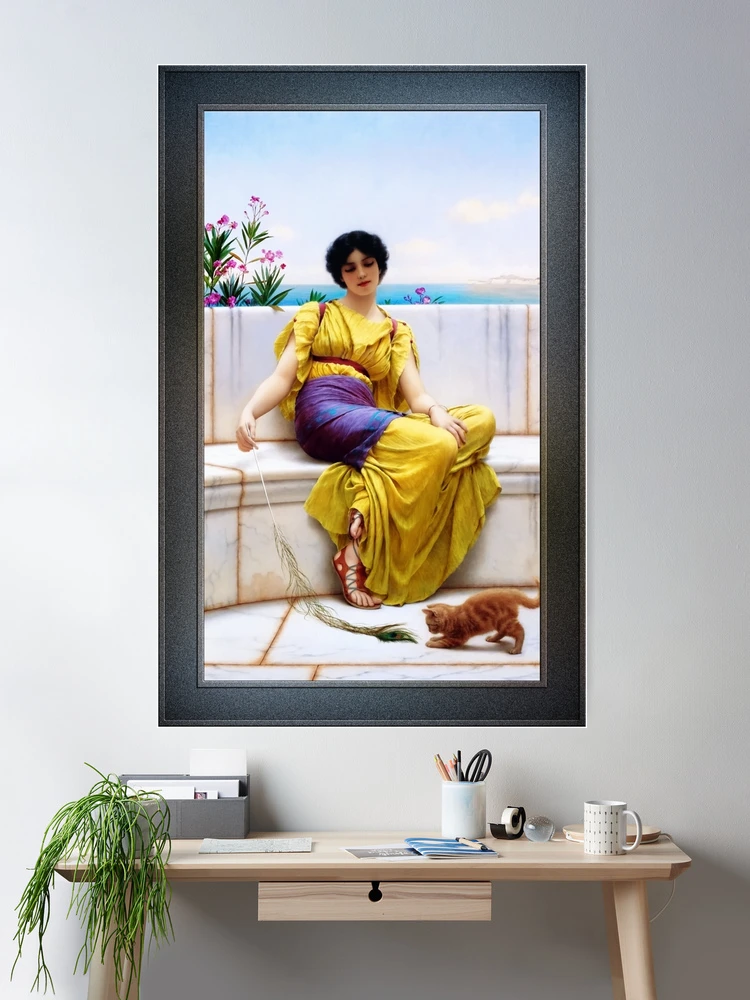
Yn it hert fan “Idleness” is the depiction of a young woman, sitting gracefully on a marble bench with a contemplative expression. Her delicate posture and the way she holds a long peacock feather, gently draped from her fingers, imply a quiet moment of repose, as she uses it to play with a kitten. Her body, draped in flowing garments of rich yellow and purple, suggests a figure both in the midst of relaxation and deep thought. The colors of her attire, set against the cool tones of the surrounding environment, add an ethereal quality to her figure, elevating her presence to that of an idealized beauty.
The woman’s dark, short hair contrasts with the golden hues of her clothing, creating a visual balance that complements the soft and inviting mood of the piece. Her facial expression is peaceful, with her gaze lowered as if lost in thought or perhaps in idle contemplation. It is an image of tranquility, drawing the viewer’s attention to the subject’s serene beauty. The slowness and grace of her movements are accentuated by the absence of any evident action or hurry in her pose, fitting the title “Idleness” perfectly. Her limbs, languidly arranged, exude a sense of stillness that enhances the theme of leisure.
Objekten en materialen
The bench on which the young woman rests is made of polished marble, its surface smooth and lustrous, contributing to the luxurious and timeless atmosphere of the artwork. The marble’s cool, pale tones contrast beautifully with the warmer hues of her attire. The surrounding scene includes delicate touches of floral elements, with vibrant pink flowers and green foliage sprouting from pots or planters that frame the scene. These natural elements serve to soften the otherwise pristine environment, adding a touch of liveliness to the otherwise tranquil setting.
The woman’s bare feet are visible, suggesting a connection to the earth beneath her, while her sandals are softly laced, further emphasizing her relaxed state. The twine she holds seems to gently cascade from her hand, a quiet object that contrasts with the elegance of her posture. The composition overall uses these subtle details, her clothing, the marble bench, de planten, and the twine, to evoke a sense of harmony between the subject and her environment, suggesting an idyllic escape from the demands of everyday life.
Terrein en eftergrûn
The backdrop of “Idleness” features a coastal vista, with a soft blue sky and distant views of the sea. The horizon appears calm, with gentle ripples on the water’s surface that mirror the peaceful stillness of the scene. This landscape, while not highly detailed, is nonetheless a crucial element in conveying the sense of serenity and escape. The background serves as a visual reminder of the natural world and its role in providing the perfect setting for the woman’s contemplative repose.
The architecture surrounding the subject, hoewol minimaal, suggests an outdoor space—perhaps a garden or courtyard of some ancient villa. The use of white and light tones in the stonework is in harmony with the soft pastel colors of the sky, further enhancing the atmosphere of classical elegance and beauty. The gentle curves of the stonework lead the viewer’s eye towards the figure, focusing attention on the stillness of the subject amidst a tranquil, almost dreamlike, setting.
Styl en technyk
Godward’s style is one rooted in the academic traditions of the 19th century, influenced by his early training under classical painters and his deep admiration for the ancient Roman and Greek worlds. Yn “Idleness,” his attention to detail is evident in the texture of the woman’s gown, the softness of her skin, and the lustrous quality of the marble. Each fold of the woman’s clothing is carefully modeled to convey the weight and flow of the fabric, while the skin is rendered with a soft glow that highlights the artist’s ability to capture the nuances of light.
The use of color is one of the defining features of Godward’s style. The warm yellow of the woman’s dress contrasts beautifully with the cooler blues of the sea and sky, creating a harmonious palette that exudes calm and contentment. The juxtaposition of purple and yellow further enhances the vibrant yet restrained mood of the painting. The choice of colors is not just aesthetically pleasing but serves to emphasize the classical theme of timeless beauty and the idea of idleness as an ideal state of mind.
Godward’s meticulous brushwork and mastery of light and shadow create a sense of depth and dimension within the composition. The sunlight that softly illuminates the woman’s face and the folds of her clothing enhances the sense of warmth in the scene. This soft rendering of light and shadow contrasts with the clarity of the background, making the figure appear almost ethereal in comparison. The careful application of paint, combined with Godward’s ability to capture the texture of different surfaces, such as the smooth marble, the softness of the woman’s skin, and the delicate fabric of her dress, demonstrates his exceptional skill as an artist.
Moommet en tema
De stimming fan “Idleness” is one of peacefulness, relaxation, and an almost reverent stillness. The figure of the young woman, with her contemplative pose and serene expression, captures the essence of the theme of idleness: a moment in time where nothing is required, and all that exists is the peaceful state of being. This sense of timeless leisure is further reinforced by the classical setting and the absence of any hurried motion in the scene. There is no sense of urgency or distraction in this moment, only the quiet, hast hillich, experience of simply being.
The theme of idleness, a concept often revered in classical art, suggests a harmonious balance between human beings and nature. It invites the viewer to reflect on the value of stillness and the simple pleasures of life. Yn dit wurk, Godward celebrates the beauty of leisure, not as a fleeting or wasteful moment, but as an ideal state of existence that connects the human figure with nature and the timeless, klassike wrâld.
Idleness is a remastered digital art old masters reproduction of a public domain image that is available as a canvas print online.
Dizze digitale keunst skepping, lykas mei al it keunstwurk dat te finen is op 'e Xzendor7-webside is online te keap yn in ferskaat oan materiaalformaten, ynklusyf canvasprints, acryl prints, metalen prints, hout prints, framed prints, posters, en as rôlde canvasprints yn in ferskaat oan grutte fan 12 inches oan 72 inch ôfhinklik fan de grutte fan it eigentlike keunstwurk en de print-on-demand winkel wêrfan jo kieze om de keunst te keapjen.
It keunstwurk is ek te krijen op in breed oanbod fan klean foar manlju en froulju, mokken, totes, sjaals, notebooks en tydskriften en in protte home decor produkten.
Oer The Artist
Info hjirûnder Fan Wikipedia.org
John William Godward wie de âldste fan fiif bern, en waard neamd nei syn heit Jan en pake Willem.
Hy eksposearre oan de Royal Academy fan 1887. Doe't er ferhuze nei Itaalje mei ien fan syn modellen yn 1912, his family broke off all contact with him and even cut his image from family pictures. Godward returned to England in 1921, died in 1922, and is buried in Brompton Cemetery, West London.
One of his best-known paintings is Dolce far Niente (1904), which was purchased for the collection of Andrew Lloyd Webber in 1995. As in the case of several other paintings, Godward painted more than one version; in this case, an earlier (and less well-known) 1897 version with a further 1906 version.
He committed suicide at the age of 61 and is said to have written in his suicide note that “the world is not big enough for [both] myself and a Picasso”.
His estranged family, who had disapproved of his becoming an artist, were ashamed of his suicide and burned his papers. Only one photograph of Godward is known to survive.
Godward was a Victorian Neo-Classicist, and therefore, in theory, a follower of Frederic Leighton. lykwols, he is more closely allied stylistically to Sir Lawrence Alma-Tadema, with whom he shared a penchant for the rendering of Classical architecture – in particular, static landscape features constructed from marble.
The vast majority of Godward’s extant images feature women in classical dress posed against landscape features; although there are some semi-nude and fully nude figures included in his oeuvre, a notable example being “In The Tepidarium c1913”.
A title shared with a controversial Alma-Tadema painting of the same subject that resides in the “Lady Lever Art Gallery”. The titles reflect Godward’s source of inspiration; which was classical civilization, most notably that of Ancient Rome; a subject binding Godward closely to Alma-Tadema artistically.
Sjoen dat klassike beurzen mear wiidferspraat wie ûnder it potinsjele publyk foar syn skilderijen yn syn libben dan yn 'e hjoeddeiske dei, sekuer ûndersyk nei detail wie wichtich om in status as keunstner yn dit sjenre te krijen.
Alma-Tadema wie ek archeolooch en skilder, dy't histoaryske plakken besocht en artefakten sammele dy't hy letter yn syn skilderijen brûkte: Godward, te, studearre sokke details as arsjitektuer en klean, om derfoar te soargjen dat syn wurken it stempel fan echtheid droegen.
Derneist, Godward makke mei soarch en sekuer oare wichtige funksjes yn syn skilderijen, bistehûden wêrfan de skilderijen “Noon Day Rest c1910” en “In koele retreat c1910” befettet foarbylden fan sa'n werjefte likegoed as wylde blommen “Nerissa c1906” en “Simmerblommen c1903”.
The appearance of beautiful women in studied poses in so many of Godward’s canvases causes many newcomers to his works to categorize him mistakenly as being Pre-Raphaelite, particularly as his palette is often a vibrantly colorful one. The choice of subject matter (ancient civilization versus, bygelyks, Arthurian legend) is more properly that of the Victorian Neo-classicist.
In common with numerous painters contemporary with him, Godward was a ‘High Victorian Dreamer’, producing images of an idealized and romanticized world that, in the case of both Godward and Alma-Tadema, came to be criticized as a world-view of Victorians in togas.
Godward “fêstige gau in reputaasje foar syn skilderijen fan jonge froulju yn in klassike setting en syn fermogen om mei gefoelichheid en technyske behearsking it gefoel fan kontrastearjende tekstueren fan fleis oer te bringen, marmer, bont en stoffen.
Godward's foarkar foar it meitsjen fan keunstwurken dy't yn 'e klassike perioade sette, kaam wierskynlik út 'e tiidperioade wêryn't hy berne waard; sa't it wie de lêste folsleine klassike oplibbing yn westerske skilderijen, dat bloeide yn Ingelân fan 'e 1860's oant de 1890's.