

Yn 'e Grove fan' e Tempel fan Isis
“Yn 'e Grove fan' e Tempel fan Isis” troch de Britske keunstner John William Godward (1861 – 1922) vangt in idyllysk en tiidleas momint dat de sjogger ferfiert nei in âlde, klassike wrâld. Bekend om syn ekspertize yn it ôfbyldzjen fan de serene skientme fan froulju, klassike arsjitektuer, en weelderige lânskippen, Godward presintearret in byld fol mei genede en elegânsje. Godward wie in foaroansteand figuer yn 'e neo-klassike beweging, in styl dy't him rjochte op it oplibjen fan âlde Grykske en Romeinske idealen, dochs mei in lucht fan romantyk. Dit bysûndere wurk, útfierd op it hichtepunt fan syn karriêre yn 1915, bliuwt syn bewûndering foar de klassike wrâld wjerspegelje, wylst hy syn behearsking oer tekstuer toant, kleur, en foarm.
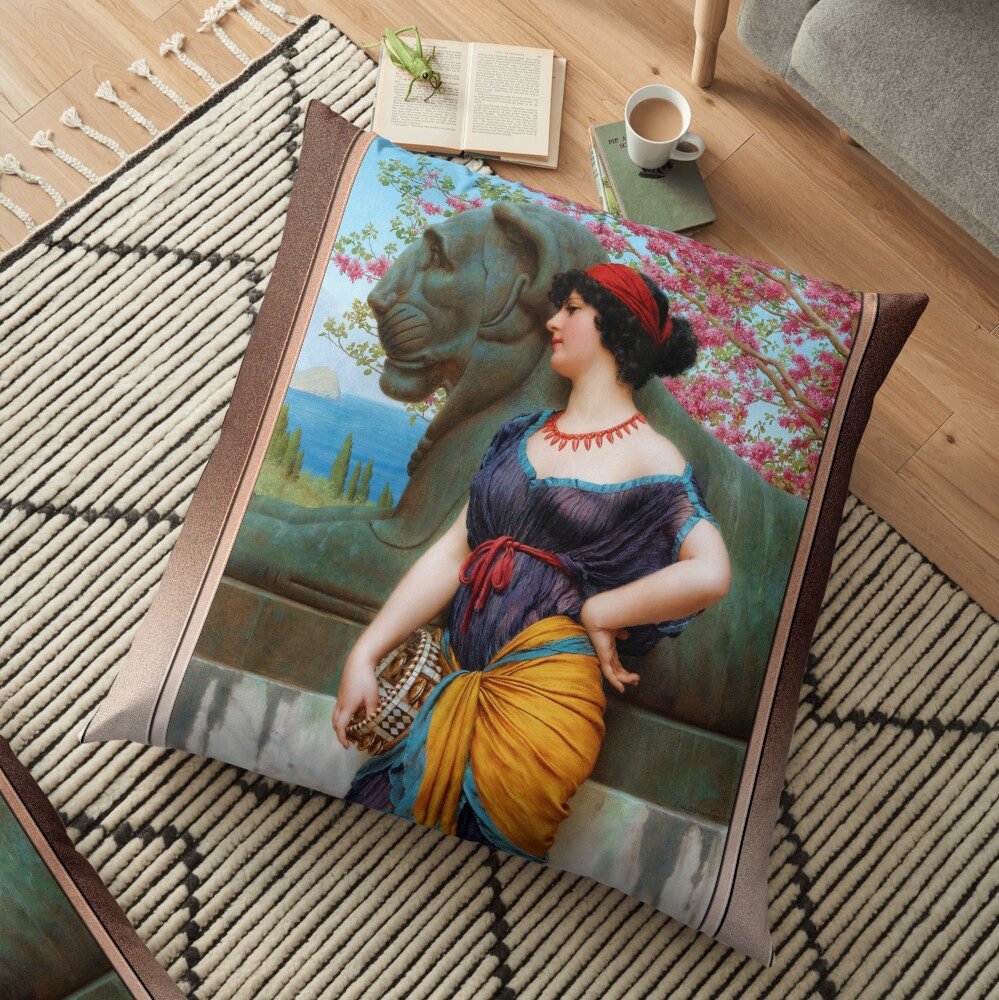
It skilderij hat in frou dy't yn 'e skaden fan in bosk stiet yn' e ruïnes fan in timpel wijd oan Isis, de âlde Egyptyske goadinne ferbûn mei fruchtberens, magy, en mem. De eftergrûn fan 'e timpelruïnes suggerearret de ferdwûne grutheid fan' e Aldheid, kontrastearjend mei it libbendige en libbene portret fan 'e frou. Dizze njonkenstân tusken de libbenleaze stiennen fan 'e timpel en de jeugdige enerzjy fan' e froulike figuer is in testamint fan Godward's fermogen om it ferrin fan 'e tiid te fangen en tagelyk skientme en fitaliteit te fieren.
Ynhâldsopjefte
It ûnderwerp: De frou yn 'e bosk
It sintrale ûnderwerp fan Godward syn stik is in jonge frou drape yn streamende klassike klean, docht tinken oan de Gryksk-Romeinske styl. Har ryk, layered robes of indigo and yellow silk cascade down her figure with an intricate sense of movement. The contrast between the dark purple of the gown and the bright golden hue of the sash offers a rich, luxurious color palette that highlights the sensuality of the fabric as it clings to the woman’s curves. The light catches the delicate folds of her clothing, which seem to shimmer, as though alive with movement. Har posysje, elegant yet relaxed, reflects the calm nature of the classical world that Godward is known for capturing in his works.
The woman’s face, turned slightly toward the viewer, reveals a serene expression. Har skaaimerken binne fyn byldhouwen, emphasizing the idealized beauty of women that was characteristic of Godward’s style. The small details such as her jewelry, a simple, yet elegant necklace, add to the sense of wealth and refinement. Her dark hair, pulled back and adorned with a red ribbon, complements the surrounding landscape and further enforces the sense of timeless grace. The woman appears absorbed in her surroundings, her gaze cast slightly down as if contemplating the ancient temple behind her, or perhaps reflecting on the mysteries of the past.
Yn har hannen, she holds a tambourine, which further connects her to the ritualistic and ceremonial life of the ancient world. This instrument, often associated with divine and sacred practices, hints at the religious or ritualistic theme of the painting, aligning with the temple’s association with Isis. The tambourine may also symbolize a connection to music and dance, which were intrinsic to the worship practices in ancient temples.
De Tempel en De Setting
The painting’s background is dominated by the crumbling remnants of a classical temple, half-obscured by lush foliage. This juxtaposition between the temple ruins and the living woman symbolizes the enduring spirit of beauty amid the passing of time. De ruïnes, which likely once formed part of a grand structure dedicated to Isis, appear weathered and aged, with portions of the stonework barely visible through the verdant overgrowth. This setting evokes the passage of centuries, with nature slowly overtaking human creations, but it also serves as a reminder of the power and grandeur of the ancient world.
Flanking the temple ruins are flowering trees, their pink blossoms in full bloom, creating a stark contrast to the ancient stone. The lush, almost dreamlike vegetation hints at a warm, Mediterranean climate, further connecting the work to the romanticized vision of antiquity. The flowers introduce a note of vitality, which not only enhances the visual beauty of the piece but also suggests the cyclical nature of life, with the blooming trees offering a sense of renewal in contrast to the decay of the temple. It ljocht, soft blues and greens of the distant landscape hint at the calm, peaceful existence of the classical world, a world where nature and humanity lived in harmony.
Materiaal en technyk
Godward’s technique is characterized by meticulous attention to detail, as evidenced in every brushstroke of the fabric, the woman’s skin, and the architecture. The use of oil paints gives the piece its depth and richness, allowing Godward to play with texture and light to create an almost photographic realism. The smooth finish of the woman’s skin contrasts with the rough texture of the stone, while the translucent quality of her clothing enhances the softness of her form. Godward’s handling of light in the composition is another striking feature; the sunlight filtering through the trees highlights the contours of the woman’s face and body, while also casting soft shadows that create a sense of depth and realism.
De stimming en tema's
The overall mood of the painting is one of serenity and tranquility. The woman’s calm demeanor and poised stance convey a sense of peace, as though she is at one with the ancient world surrounding her. This peacefulness is further emphasized by the gentle presence of nature, with the flowering trees and soft landscape inviting contemplation and reflection. De kleuren, primarily rich purples, gouden, and greens, create a harmonious balance that evokes a sense of timeless beauty and quietude.
Tematysk, the painting touches on the idealization of ancient cultures, particularly those of Egypt and Rome, and the reverence for beauty that characterized the Neo-Classical movement. Godward’s ability to merge the ancient with the living, the mythological with the natural, brings forth an appreciation for the eternal aspects of culture and humanity. The temple ruins, the woman, and the natural landscape together create a narrative of past grandeur and present serenity, reminding the viewer that beauty endures beyond the physical.
In The Grove Of The Temple Of Isis is a remastered digital art old masters reproduction of a public domain image that is available as metal, acryl en canvas prints online.
Dizze digitale keunst skepping, lykas mei al it keunstwurk dat te finen is op 'e Xzendor7-webside is online te keap yn in ferskaat oan materiaalformaten, ynklusyf canvasprints, acryl prints, metalen prints, hout prints, framed prints, posters, en as rôlde canvasprints yn in ferskaat oan grutte fan 12 inches oan 72 inch ôfhinklik fan de grutte fan it eigentlike keunstwurk en de print-on-demand winkel wêrfan jo kieze om de keunst te keapjen.
It keunstwurk is ek te krijen op in breed oanbod fan klean foar manlju en froulju, mokken, totes, sjaals, notebooks en tydskriften en in protte home decor produkten.
Artist Bio
Info hjirûnder Fan Wikipedia.org
John William Godward wie de âldste fan fiif bern, en waard neamd nei syn heit Jan en pake Willem.
Hy eksposearre oan de Royal Academy fan 1887. Doe't er ferhuze nei Itaalje mei ien fan syn modellen yn 1912, his family broke off all contact with him and even cut his image from family pictures. Godward returned to England in 1921, died in 1922, and is buried in Brompton Cemetery, West London.
One of his best-known paintings is Dolce far Niente (1904), which was purchased for the collection of Andrew Lloyd Webber in 1995. As in the case of several other paintings, Godward painted more than one version; in this case, an earlier (and less well-known) 1897 version with a further 1906 version.
He committed suicide at the age of 61 and is said to have written in his suicide note that “the world is not big enough for [both] myself and a Picasso”.
His estranged family, who had disapproved of his becoming an artist, were ashamed of his suicide and burned his papers. Only one photograph of Godward is known to survive.
Godward was a Victorian Neo-Classicist, and therefore, in theory, a follower of Frederic Leighton. lykwols, he is more closely allied stylistically to Sir Lawrence Alma-Tadema, with whom he shared a penchant for the rendering of Classical architecture – in particular, static landscape features constructed from marble.
The vast majority of Godward’s extant images feature women in classical dress posed against landscape features; although there are some semi-nude and fully nude figures included in his oeuvre, a notable example being “In The Tepidarium c1913”.
A title shared with a controversial Alma-Tadema painting of the same subject that resides in the “Lady Lever Art Gallery”. The titles reflect Godward’s source of inspiration; which was classical civilization, most notably that of Ancient Rome; a subject binding Godward closely to Alma-Tadema artistically.
Sjoen dat klassike beurzen mear wiidferspraat wie ûnder it potinsjele publyk foar syn skilderijen yn syn libben dan yn 'e hjoeddeiske dei, sekuer ûndersyk nei detail wie wichtich om in status as keunstner yn dit sjenre te krijen.
Alma-Tadema wie ek archeolooch en skilder, dy't histoaryske plakken besocht en artefakten sammele dy't hy letter yn syn skilderijen brûkte: Godward, te, studearre sokke details as arsjitektuer en klean, om derfoar te soargjen dat syn wurken it stempel fan echtheid droegen.
Derneist, Godward makke mei soarch en sekuer oare wichtige funksjes yn syn skilderijen, bistehûden wêrfan de skilderijen “Noon Day Rest c1910” en “In koele retreat c1910” befettet foarbylden fan sa'n werjefte likegoed as wylde blommen “Nerissa c1906” en “Simmerblommen c1903”.
The appearance of beautiful women in studied poses in so many of Godward’s canvases causes many newcomers to his works to categorize him mistakenly as being Pre-Raphaelite, particularly as his palette is often a vibrantly colorful one. The choice of subject matter (ancient civilization versus, bygelyks, Arthurian legend) is more properly that of the Victorian Neo-classicist.
In common with numerous painters contemporary with him, Godward was a ‘High Victorian Dreamer’, producing images of an idealized and romanticized world that, in the case of both Godward and Alma-Tadema, came to be criticized as a world-view of Victorians in togas.
Godward “fêstige gau in reputaasje foar syn skilderijen fan jonge froulju yn in klassike setting en syn fermogen om mei gefoelichheid en technyske behearsking it gefoel fan kontrastearjende tekstueren fan fleis oer te bringen, marmer, bont en stoffen.
Godward's foarkar foar it meitsjen fan keunstwurken dy't yn 'e klassike perioade sette, kaam wierskynlik út 'e tiidperioade wêryn't hy berne waard; sa't it wie de lêste folsleine klassike oplibbing yn westerske skilderijen, dat bloeide yn Ingelân fan 'e 1860's oant de 1890's.