

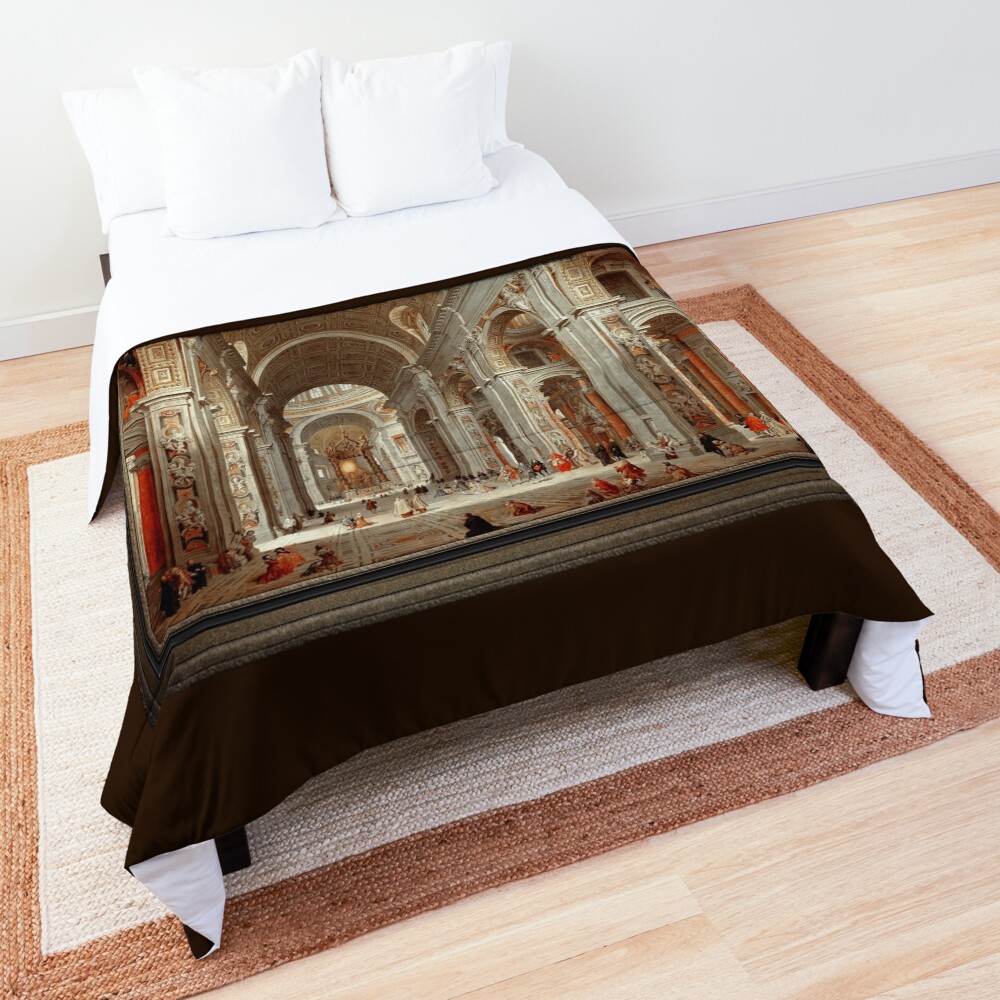
Interiörvy av St Peters Basilica c1750
Interior View of St Peters Basilica är en magnifik målning skapad i 1750 av den kända italienska konstnären Giovanni Paolo Pannini (1691 – 1765). Detta mästerliga verk exemplifierar Panninis enastående förmåga att fånga storheten hos arkitektur och andan från den klassiska antiken.
Genom sin konstnärliga vision, Pannini erbjuder en inblick i en av de mest ikoniska arkitektoniska strukturerna i världen; St. Peterskyrkan i Vatikanstaten. Kompositionen illustrerar inte bara rummets arkitektoniska underverk utan fördjupar också betraktaren i en detaljerad berättelse om det dagliga livet i den stora katedralen under 1700-talet.
Innehållsförteckning
Huvudämne och komposition
The painting’s primary subject is the interior of St. Peters basilika, a symbol of both religious devotion and architectural excellence. Pannini presents a sweeping view of the basilica’s vast nave, with towering columns, intricate arches, and expansive ceilings, all rendered with great precision and grandeur.
The vaults and domes rise majestically toward the heavens, drawing the viewer’s gaze upward toward the light that seems to pour into the structure from above. Den stora, circular windows and the dome of the church create a contrast between the serene, soft illumination from the windows and the richly detailed interiors.
The layout of the painting mirrors the layout of the basilica itself, offering a perspective that guides the viewer’s eye from the foreground, filled with figures, toward the distant altar, which is adorned with golden rays of light. The vastness of the space is emphasized by the presence of numerous small figures scattered throughout the scene, some in worship, others in casual conversation, and still more engaged in quieter, reflective activities. This addition of human figures brings life to the artwork, making the monumental space feel more approachable, men ändå imponerande.
Arkitektoniska detaljer
The intricacy and magnificence of St. Peter’s Basilica are captured through Pannini’s detailed renderings of the basilica’s structural elements. The soaring columns of the nave are painted with sharp precision, giving the illusion of depth and grandeur. The artist incorporates exquisite details of the marble textures, particularly in the columns’ rich reddish hues and creamy veins, contributing to the sense of luxury and permanence that pervades the building. I bakgrunden, elaborate arches and coffered ceilings stretch endlessly, further emphasizing the vast scale of the space.
One of the most striking features in the painting is the dome designed by Michelangelo. Pannini captures the essence of the dome’s curvature and its sculptural form, which seems to soar beyond the limits of the canvas, filling the viewer with a sense of awe. The use of light and shadow in the painting gives a tangible texture to the surfaces, ger arkitekturen en tredimensionell kvalitet. Färgerna är rika men ändå dämpade, med jordnära toner av sten och marmor som kontrasterar vackert med altarets gyllene accenter och religiösa ikoner.
Human Figures and Interaction
En viktig aspekt av Panninis arbete är inkluderingen av mänskliga figurer, som tillför en känsla av skala och aktivitet till det annars statiska rummet. Dessa individer är avbildade i olika poser – några knäböjer i bön, andra ägnade sig åt samtal eller vandrade genom det stora långhuset. Panninis uppmärksamhet på de olika gesterna och kläderna hos dessa figurer berikar berättelsen ytterligare. De elegant klädda män och kvinnor i förgrunden ger en inblick i det sociala livet på 1700-talet, visa upp tidens klädsel och seder.
The interactions among the figures in the scene suggest a peaceful coexistence within the sacred space. Some figures seem to pause in contemplation before the altar, while others, perhaps tourists or pilgrims, look around with admiration. This human presence, though small in comparison to the vast architecture, serves to enhance the grandeur of the basilica. It also invites the viewer to reflect on the spiritual and cultural significance of the church as a gathering place for both the faithful and the curious.
Humör och atmosfär
The mood of the painting is one of reverence and awe. The grandeur of the basilica’s interior creates a sense of tranquility and solemnity, while the human figures add a feeling of warmth and human presence. The use of light and shadow contributes to the overall atmosphere, with rays of light streaming through the large windows and casting a gentle glow on the figures and columns. The warm hues of the painting, combined with the serene figures in repose, create a peaceful, almost meditative environment.
There is also a sense of timelessness in the scene. The figures in the painting, while clearly of the 18th century, seem to be engaged in a kind of eternal ritual within the hallowed walls of the basilica. Arkitekturen, although representing the pinnacle of 17th-century Baroque design, also seems to transcend time, suggesting that the church has stood as a witness to countless generations of worshippers. The mood is contemplative and reverent, encouraging the viewer to reflect not only on the grandeur of the basilica but also on its significance as a place of religious and historical importance.
Slutsats
Giovanni Paolo Pannini’s “Interiörvy av St.. Peters basilika” is a breathtaking portrayal of one of the most celebrated architectural marvels in the world. Through meticulous attention to architectural detail, careful rendering of light and shadow, and the inclusion of human figures, Pannini conveys the awe-inspiring scale and spiritual significance of the basilica.
The painting serves as both a historical record and a work of art that captures the essence of 18th-century religious life. The balance between grandeur and intimacy, between architecture and humanity, allows the viewer to experience St. Peter’s Basilica not just as a monumental structure, but as a living, breathing space where art, arkitektur, and faith converge.
Interiörvy av St.. Peters basilika är en retuscherad digital konstreproduktion av en offentlig egendom.
Artist Bio härledd från Wikipedia.org
Giovanni Paolo Panini eller Giovanni Paolo Pannini var en målare och arkitekt som arbetade i Rom och är främst känd som en av vedutistierna (“visa målare”).
Som målare, Pannini är mest känd för sin utsikt över Rom, där han intresserade sig särskilt för stadens antikviteter.
Bland hans mest kända verk är hans syn på Pantheons interiör (på Francesco Algarottis vägnar 1712 – 1764 – En venetiansk polymat), och hans vedutmålningar av bildgallerier med utsikt över Rom.
De flesta av hans verk, särskilt de av ruiner, har en fantasifull och overklig utsmyckning som kännetecknar capriccio -teman. I detta liknar de capricci av den italienska målaren och grafikern Marco Ricci (1676 – 1730).
Panini målade också porträtt, inklusive en av påven Benedikt XIV (född Prospero Lorenzo Lambertini 1675 – 1758 – Chef för katolska kyrkan från 1740 – 1758).
I Rom, Panini fick ett namn för sig själv som dekoratör av palats. Några av hans verk inkluderade Villa Patrizi c1719/25, Palazzo de Carolis c1720, och Seminario Romano c1721/22).
I 1719, Panini antogs till kongressen av Virtuosi al Pantheon. Han undervisade i Rom vid Accademia di San Luca och Académie de France, där han sägs ha påverkat Jean-Honoré Fragonard. I 1754, han tjänade som prins (direktör) av Accademia di San Luca.