

Its Nothing To Sneeze At
Its Nothing To Sneeze At por Gil Elvgren (1914 – 1980), one of the most celebrated American illustrators of the 20th century. This piece exemplifies the vibrant and engaging style that made Elvgren famous, combining humor, sensualidad, and a touch of glamour.
Nacido en 1914, Elvgren’s career spanned much of the 20th century, and he is best known for his pin-up art, a genre that defined much of mid-century American illustration. His use of color, luz, and playful narratives in his work set a hallmark for advertisements, revistas, and calendars throughout the era.
The painting portrays a young woman seated with her feet in a basin of mustard, a remedy that would have been familiar to many of Elvgren’s audience as a common cure for ailments such as colds or aches. sin emabargo, this domestic scene is not without a touch of humor and playful irony.
The woman’s facial expression suggests both frustration and curiosity about the situation, amplifying the lighthearted tone of the artwork. Su pose, with one knee raised and the other foot submerged in the mustard bath, directs the viewer’s attention to the woman’s figure in an elegant yet comical way.
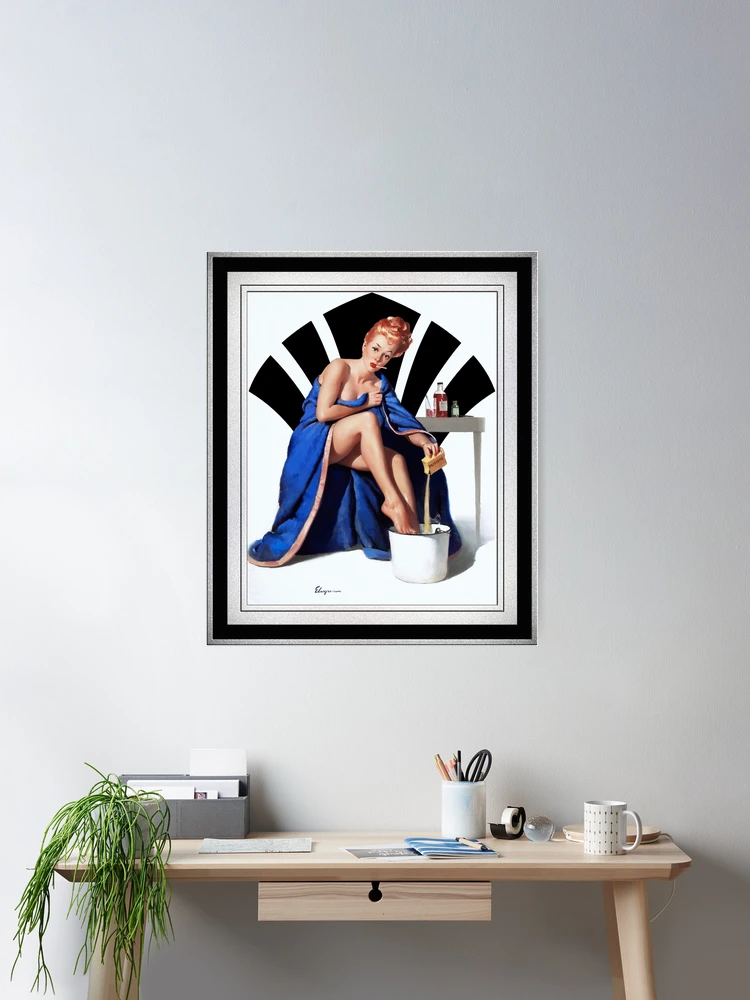
Tabla de contenido
El tema principal
La figura central en No es nada para estornudar is a young woman dressed in a vibrant blue robe. The robe, adorned with a delicate pink trim, is loosely draped over her form, adding an element of seductiveness without being overtly revealing. Su cabello rubio fresa tiene un estilo vintage., dándole un aire de belleza clásica de los años 50, enfatizando aún más su feminidad atemporal.
Su postura es un poco incómoda., añadiendo a la narrativa de la escena: ella está tratando de encontrar alivio a una dolencia, y su expresión insegura, combinado con el tratamiento mundano pero incómodo, invita tanto a la empatía como al humor por parte del espectador. El ángulo en el que se sienta., con las piernas cruzadas y un pie sumergido, Crea un momento íntimo pero cómico en un entorno doméstico..
El escenario y los objetos
Detrás de la figura, se coloca una mesa, encima del cual descansa una pequeña colección de artículos: una botella de whisky, un vaso, y lo que parece ser un frasco medicinal, tal vez una cura o un tónico para acompañar su tratamiento.
Estos objetos refuerzan el carácter doméstico., naturaleza privada de la escena, but they also point to the time period’s typical imagery, where relaxation and health remedies were often portrayed as part of a woman’s role in maintaining a household. The bottle of whiskey also suggests the idea of indulgence or comfort, playing into the classic visual codes of 1950s Americana.
The most significant object, sin emabargo, is the mustard box in the woman’s hand. She is in the process of pouring mustard into the basin of water, an action that is at once comical and relatable. Mustard baths were considered an old-fashioned remedy, but its inclusion here is both playful and nostalgic, reinforcing the humorous undertones of the painting. The mustard itself is represented in rich, bold yellow, providing a striking contrast to the otherwise soft color palette of the scene.
The backdrop of the painting features an abstract fan-like design, reminiscent of a 1950s Art Deco influence. This geometric pattern not only frames the figure but also adds a sense of dynamism to the otherwise calm scene. The fan-like design could be interpreted as a subtle nod to the popular aesthetic of the mid-20th century, reinforcing the painting’s roots in its time period.
El estado de ánimo y el tema
No es nada para estornudar is a study in juxtaposition. en la superficie, it portrays a typical domestic scene: a woman at home, relaxing, and attending to her health. sin emabargo, Elvgren infuses the painting with humor and lightheartedness, turning an ordinary moment into something more playful and inviting. The title itself suggests a double entendre, “sneeze” evoking the common cold or sickness, but also potentially pointing to the comical situation the woman finds herself in.
The mood is decidedly light and fun. The woman’s facial expression, a mix of slight bemusement and embarrassment, encourages the viewer to smile in sympathy, as if sharing in her mild misfortune. The use of bright colors, such as the woman’s blue robe and the yellow mustard, creates a lively contrast that enhances the playful nature of the scene. There is a sense of immediacy in the moment, as if the viewer has just walked into this woman’s world and is witnessing a brief, humorous episode in her daily life.
Estilo y materiales
In terms of artistic style, Elvgren’s brushwork is smooth and refined, with a clear focus on realism. The rendering of the woman’s skin, cabello, and robe is done with great attention to detail, creating a lifelike quality that makes the scene all the more relatable. Su uso de la iluminación es estratégico., resaltando la figura de la mujer y resaltando la calidez en su tono de piel.
Las sombras están cuidadosamente colocadas para sugerir volumen y profundidad., añadiendo realismo general a la pieza. El fondo, por el contrario, es más simplificado y abstracto, permitiendo que la figura se destaque como el punto focal principal.
Los materiales utilizados en la pintura son típicos de la obra de Elvgren.: pinturas al óleo, aplicado en capas para crear textura y riqueza. La fluidez del medio permite una suave, Acabado pulido que realza el glamour del tema y al mismo tiempo permite detalles sutiles como el brillo de la mostaza y las superficies reflectantes de las botellas sobre la mesa..
It's Nothing To Sneeze At es una reproducción remasterizada de viejos maestros de arte digital de una imagen de dominio público que está disponible como Esta es una elegante chica de glamour art deco vintage..
Biografía del artista derivada de Wikipedia.org
Gillette A. Elvgren nació en St. Paul, Minnesota, y asistió a la escuela secundaria universitaria. Después de la graduación, comenzó a estudiar arte en el Instituto de Artes de Minneapolis.
Más tarde se mudó a Chicago para estudiar en la Academia Estadounidense de Arte., y se graduó de la Academia durante la gran depresión, a la edad de veintidós.
Después de graduarse, Elvgren se unió al grupo de artistas en Stevens and Gross, La agencia de publicidad más prestigiosa de Chicago, y se convirtió en un protegido del artista Haddon Sundblom.
En 1937, Gil comenzó a pintar calendarios para Louis F. Dow, una de las editoriales líderes de Estados Unidos, durante el cual creó sobre 60 chica pin-up trabaja en lienzo de 22 ″ × 28 ″ y los distingue por una firma impresa.
Muchas de sus pin-ups se reprodujeron como arte de nariz en aviones militares durante la Segunda Guerra Mundial.; y fue por esta época en 1944, que Elvgren fue contactado por Brown and Bigelow Publishing Company; una empresa que todavía domina el campo en la producción de calendarios, especialidades publicitarias y productos promocionales.
El próximo año desde 1945 hasta 1972, Elvgren se asoció con el Brown & Compañía editorial Bigelow, y comencé a trabajar con 24 pulgada por 30 lienzos de pulgadas, un formato que usaría para el próximo 30 años, y firmó su trabajo en cursiva.
Elvgren fue un éxito comercial. Vivió en varios lugares, y estuvo activo desde la década de 1930 hasta la de 1970. En 1951 empezó a pintar en un estudio de su casa, luego en Winnetka, Illinois, usar un asistente para configurar la iluminación, construir utilería y escenas, conjuntos de fotografías, y prepara sus pinturas.
Entre sus clientes se encuentran empresas conocidas como Brown y Bigelow., Coca-Cola, General Electric y Sealy Mattress Company, para nombrar unos pocos. Además, Durante las décadas de 1940 y 1950 ilustró historias para una gran cantidad de revistas., como The Saturday Evening Post y Good Housekeeping.
Entre las modelos y leyendas de Hollywood que Elvgren pintó durante su carrera se encontraba Myrna Hansen., Donna Reed, Barbara Hale, Arlene Dahl, Lola Albright y Kim Novak.