

Joan of Arc Death at the Stake c1843
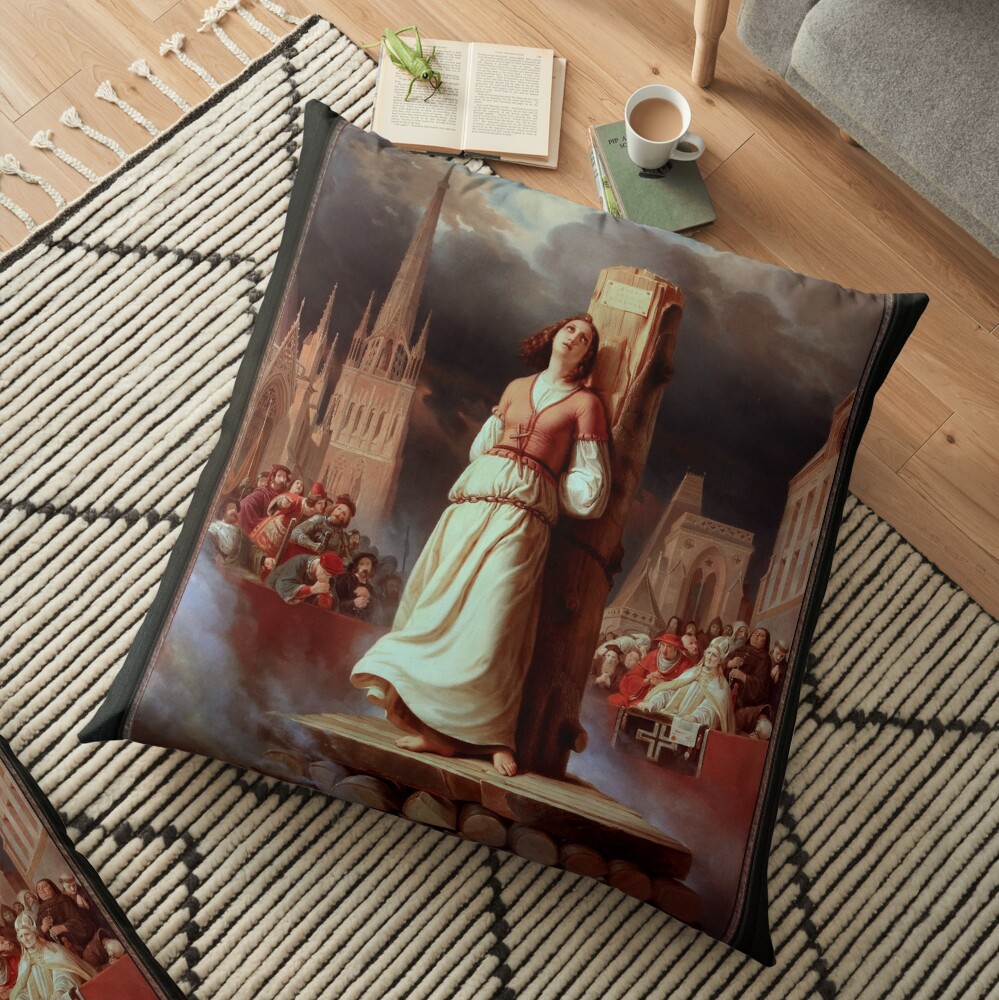
“Joan of Arc Death at the Stake,” air a chruthachadh a-steach 1843 by the German painter Hermann Stilke (1803 – 1860), depicts a pivotal moment in the life of one of history’s most courageous figures, Seonag à Arc. The painting is part of the larger cycle of works that capture the life of the French heroine. Stilke, known for his historical scenes and deep attention to detail, evokes a solemn atmosphere with his masterful treatment of light and texture, skillfully portraying the emotional gravity of Joan’s final moments. The artwork presents a dramatic and vivid scene, encapsulating the historical and religious significance of Joan of Arc’s martyrdom during the Hundred Years’ Cogadh.
Clàr-innse
Am Prìomh Chuspair
Is e prìomh fhigear an deilbh Seonag à Arc fhèin, air a riochdachadh ann am mionaid de àmhghar corporra agus faireachail. Tha i na seasamh ceangailte ri post fiodha, a tha an sàs ann an cur gu bàs, a' feitheamh air a shon. A ghùn geal, samhlachail air purrachd agus martyrdom, eadar-dhealaichte ris an t-suidheachadh lasrach a tha timcheall oirre. Tha an dòigh anns a bheil a gàirdeanan air an sìneadh a-mach agus air an ceangal le ròpannan na fhìor chuimhneachan air a dìth-cuideachaidh, gidheadh tha neart gun àicheadh 'na suidheachadh agus 'na sùil. Tha sùilean Sheonag air an togail a dh’ionnsaigh nan nèamhan, tha an abairt aice na mheasgachadh de dhùbhlan agus de shàmhchair, mar gu'm biodh i a' sireadh sòlais, no eadar-ghuidhe dhiadhaidh.
A dh'aindeoin an cunnart a tha faisg air làimh, tha an ìomhaigh aice a’ cumail aura de dh’ urram agus de sheasmhachd. Tha feartan aghaidh air an toirt seachad gu breagha, a’ sealltainn boireannach òg cò, a dh’ aindeoin an uabhas a tha oirre, a' cumail a creidimh agus a mhisneachd. Tha faireachdainn agus suidheachadh Sheonag a’ toirt a-steach faireachdainn iom-fhillte cuideigin a tha, fhad 'sa tha e a' fulang gu corporra, a’ cumail ceangal domhainn spioradail a tha a’ dol thairis air rìoghachd na talmhainn. Tha i an dà chuid air fulang le geur-leanmhainn mì-chothromach agus na samhla air creideas gun stad.
Cùl-fhiosrachadh agus suidheachadh
Tha cùl an deilbh a cheart cho riatanach don aithris ri figear Sheonag. Tha adhar dorcha is dràmadach a’ tighinn os an cionn, neòil a' sèideadh gu h-uamhasach os a ceann, a tha ag àrdachadh teannachadh agus èiginn an t-seallaidh. Tha sealladh a’ bhaile air fàire a’ nochdadh co-theacs eachdraidheil an t-seallaidh, Chaidh Seonag a chur gu bàs ann an Rouen, An Fhraing, where she was burned at the stake. The architecture of the surrounding buildings, though slightly blurred and distant, is Gothic, with pointed arches and towering spires that lend a sense of grandeur and tragedy to the composition.
The presence of a large crowd gathered in the background serves to highlight Joan’s public execution. The people are shown as spectators, some in grim contemplation, others in various states of anger and mockery. A few figures stand out more prominently, dressed in religious or official attire, reflecting the power structures that sentenced her to death. Their presence adds to the somber tone of the painting, emphasizing the role of the church and political forces in her condemnation.
Symbolism and Mood
The mood of the painting is undeniably somber, evoking a sense of tragedy, helplessness, and moral complexity. An dorch, swirling clouds in the sky symbolize the tumultuous nature of the times and the inner turmoil of the conflict. The contrast between the bright, almost glowing figure of Joan and the dark background imbues the painting with a spiritual dimension. A h-gòrach aice, directed upwards, is one of quiet resignation and spiritual transcendence, offering a glimmer of hope amid the overwhelming darkness surrounding her. The crowd, while varying in emotion, largely conveys the coldness and indifference of the world to her suffering.
The execution stake, itself an object of historical significance, is crafted with intense realism. The texture of the wood, the detail in the ropes binding Joan’s body, and the rough-hewn nature of the executioner’s platform all contribute to the realism of the scene. This stark representation of the wooden stake reinforces the brutality of Joan’s death while also making her ascension into martyrdom more poignant.
The painting’s color palette is subdued, air a riaghladh le browns, Greys, and dark blues. Am bog, almost ethereal lighting that illuminates Joan’s figure contrasts with the heavy shadows surrounding the rest of the scene. This effect highlights the central figure in a way that directs the viewer’s attention entirely on Joan, placing her as the focal point of both the composition and the larger historical narrative.
Cur gu bàs agus Stoidhle Ealain
Stilke’s style in this painting aligns with the historical romanticism of the 19th century. The dramatic portrayal of Joan of Arc is characteristic of the movement’s emphasis on emotion, eachdraidh, and the heroic. An aire aige gu mion-fhiosrachadh, particularly in the rendering of textures such as the fabric of Joan’s dress and the rough surface of the wooden stake, exemplifies his skill as a historical painter. His use of light and shadow creates a dynamic atmosphere that contrasts the divine serenity of Joan’s face with the tumultuous environment surrounding her.
Stilke’s brushwork, though meticulous, remains loose enough in the background to create a sense of movement, as if the scene is unfolding in real time. The figures in the crowd, while smaller and more indistinct, are rendered with enough detail to convey their various reactions to the event. Some are focused on Joan, while others seem indifferent, emphasizing the public nature of the execution and the apathy that surrounds it.
Co-dhùnadh
Hermann Stilke’s “Joan of Arc Death at the Stake” is a powerful, emotional portrayal of the final moments of a national hero and martyr. Tro bhith cleachdadh an t-solais, sgrìobhadh, agus samhlaidheachd, Stilke encapsulates the themes of faith, ìobairt, and political injustice. The somber atmosphere of the painting invites the viewer to reflect on the broader historical and spiritual significance of Joan of Arc’s death and her unwavering belief in her divine mission, even in the face of death. The work stands as a testament to the courage of a young woman who, in her final moments, became an enduring symbol of bravery and conviction.
Is e seo ath-riochdachadh seann mhaighstirean ealain didseatach de dh ’ìomhaigh poblach a tha ri fhaighinn air-loidhne mar a Clò-bhualadh roilled.
Neach-ealain bi a thàinig bho Wikipedia.org
Anton Hermann Stilke was born in Berlin the Kingdom of Prussia on January 29, 1803 he was a German Painter studying at the Berlin Academy of Fine Arts and then in 1821 studying at the Munich Academy of Fine Arts under German Master Professor Peter von Cornelius (1783 – 1867).
Às an sin chaidh e gu Acadamaidh nan Ealan Fine ann an Düsseldorf; far an do pheant e còmhla ris a’ pheantair Gearmailteach Karl Stürmer (1803 – 1881) am fresco neo-chrìochnaichte Am Breitheanas mu dheireadh anns an Assensensaal ann an Koblenz.
Ann an 1827 Shiubhail Anton tron Eadailt a Tuath air turas sgrùdaidh, a' tighinn a stigh do 'n Ròimh 1828. An uairsin a-steach 1833 thill e gu Acadamaidh Düsseldorf, cò às a bha e a’ teagasg 1839 – 1843.
Bho 1842 – 1846 Bha Anton ag obair ann an Talla an Ridire aig Caisteal Stolzenfels faisg air Koblenze air bruaichean Abhainn Rhine; agus a-steach 1850 chaidh e a dh'fhuireach ann am Berlin far an do chaochail e aig aois 57 air an t-Sultain 22, 1860.