

Joan of Arc in Battle c1843
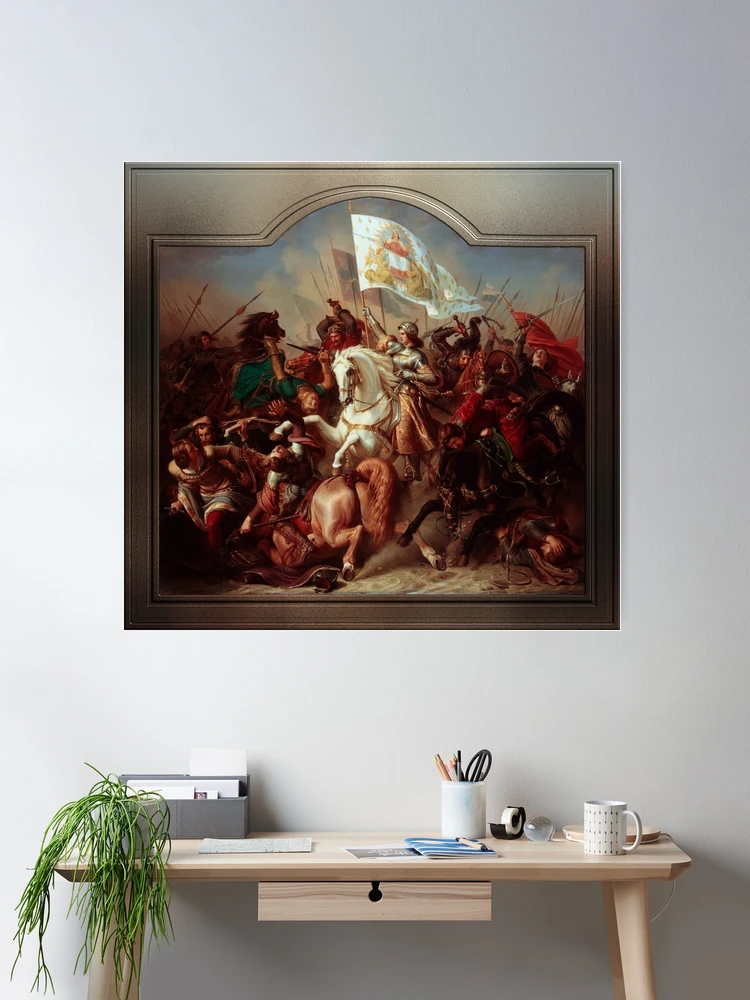
An dealbh Joan of Arc in Battle, air a chruthachadh a-steach 1843 by the German artist Hermann Stilke (1803 – 1860), is a masterful portrayal of one of the most iconic and heroic moments in French history. Positioned as the central part of the larger triptych titled The Life of Joan of Arc, this work embodies the intense valor and fervor that defined the legendary figure of Joan of Arc during her military campaign.
The painting captures the moment when Joan, mounted on a white steed, is seen brandishing a flag in the heat of battle, a symbol of divine leadership and unwavering courage. Stilke’s composition brilliantly encapsulates both the chaos of war and the steadfast resolve of Joan, emphasizing the contrast between her spiritual mission and the brutal nature of medieval warfare.
Clàr-innse
Composition and Key Figures
Is e prìomh fhigear an deilbh Seonag à Arc fhèin, dressed in shining armor, her face resolute and her posture commanding as she holds the banner high. The image of Joan on horseback, positioned against a tumultuous battlefield, speaks to both her physical and symbolic roles in the conflict.
Her white steed, which stands as a beacon of purity amidst the chaos, contrasts with the dark and grim atmosphere of the battle around her. The flag she holds is decorated with imagery that signifies her divine mandate, reinforcing the central theme of divine providence and heroism.
Surrounding Joan are various soldiers, both on horseback and on foot, engaged in the frantic combat of medieval warfare. Their faces display expressions of exertion, eagal, and aggression as they clash in the background, with swords raised and shields protecting them. The chaos of battle is vividly depicted through the tangled mass of bodies, eich, and weaponry, which together convey the brutality and confusion that marked these historical engagements.
Cruth-tìre agus suidheachadh
The battlefield is depicted as a vast and open expanse, with soldiers dispersed across the scene. The ground is littered with fallen combatants, while others are locked in brutal hand-to-hand combat. The landscape itself is somewhat blurred, emphasizing the immediacy of the action rather than offering a detailed view of the surroundings.
This technique allows the viewer to focus entirely on the chaotic energy of the battle, which serves as a backdrop to Joan’s divine mission. An adhar gu h-àrd, tinged with dark clouds, suggests the oppressive and violent nature of the conflict, but it also serves as a visual metaphor for the uncertain and tumultuous times that Joan faced.
Mood agus Symbolism
Faireachdainn de Joan of Arc in Battle is one of intense drama, underscored by the tumultuous environment and the focused figure of Joan herself. Stilke’s rendering of the battle scene is dynamic, filled with movement and urgency, yet Joan remains a steady and unyielding presence at the center. The contrast between Joan’s serenity and the chaos surrounding her is striking.
Tha an abairt aice mar aon de dhiongmhaltas sàmhach, almost as though she is untouched by the horrors of battle around her. This highlights her role as a spiritual and military leader who is steadfast in her belief and mission.
The flag she holds is a central symbol in the work, representing not just the military cause but also divine favor. The flag’s intricate design, with its celestial motifs, reinforces the notion that Joan’s mission was ordained by a higher power. The clash between the natural brutality of war and the supernatural power that Joan represents is a key theme in the painting, symbolizing the tension between earthly struggles and divine guidance.
Stoidhle is innleachd ealanta
Hermann Stilke’s style in this painting reflects the academic approach to historical painting that was prevalent in the 19th century. The use of classical techniques, such as chiaroscuro (an eadar-dhealachadh eadar solas agus dorchadas), detailed anatomical studies, and precise rendering of textures, brings a sense of realism to the scene.
Na figearan, particularly Joan, are rendered with great attention to detail, showcasing Stilke’s skill in capturing human expression and movement. The armor worn by Joan and the soldiers is meticulously depicted, with the reflective surfaces of metal and the folds of fabric rendered in exquisite detail.
Stilke’s use of light and shadow is particularly effective in guiding the viewer’s eye. Joan, illuminated by a soft light, stands out against the darker, more turbulent background. This creates a halo-like effect around her, symbolizing her divine role in the events depicted. The darker tones in the background serve to emphasize the violent and chaotic nature of the battle, while the lighter tones around Joan convey a sense of hope and spiritual clarity.
Co-dhùnadh
Joan of Arc in Battle is a remarkable example of historical painting that not only captures the dramatic essence of a pivotal moment in history but also imbues it with deep symbolism and emotional resonance.
Through his precise and detailed technique, Stilke brings to life the complex character of Joan of Arc, portraying her not only as a courageous warrior but also as a figure of divine strength and conviction. The juxtaposition of the violent, chaotic battle with the serene determination of Joan highlights the central conflict of her life and mission, making this artwork a powerful representation of her legacy.
Is e seo ath-riochdachadh seann mhaighstirean ealain didseatach ath-riochdachadh de ìomhaigh raon poblach, agus mar a tha a h-uile obair-ealain a gheibhear air làrach-lìn Xzendor7 ri fhaighinn airson a cheannach air-loidhne ann an caochladh chruthan stuth a’ gabhail a-steach clò-bhualaidhean canabhas, dealbhan acrylic, clò-bhualaidhean meatailt, clò-bhualaidhean fiodha, lèileagan frèam, postairean, agus mar clò-bhualaidhean canabhas rollaichte ann an caochladh mheudan bho 12 òirlich gu 72 òirlich a rèir meud an fhìor obair-ealain agus a’ bhùth clò-bhualaidh air iarrtas a thaghas tu airson an ealain a cheannach.
Neach-ealain bi a thàinig bho Wikipedia.org
Anton Hermann Stilke was born in Berlin the Kingdom of Prussia on January 29, 1803 he was a German Painter studying at the Berlin Academy of Fine Arts and then in 1821 studying at the Munich Academy of Fine Arts under German Master Professor Peter von Cornelius (1783 – 1867).
Às an sin chaidh e gu Acadamaidh nan Ealan Fine ann an Düsseldorf; far an do pheant e còmhla ris a’ pheantair Gearmailteach Karl Stürmer (1803 – 1881) am fresco neo-chrìochnaichte Am Breitheanas mu dheireadh anns an Assensensaal ann an Koblenz.
Ann an 1827 Shiubhail Anton tron Eadailt a Tuath air turas sgrùdaidh, a' tighinn a stigh do 'n Ròimh 1828. An uairsin a-steach 1833 thill e gu Acadamaidh Düsseldorf, cò às a bha e a’ teagasg 1839 – 1843.
Bho 1842 – 1846 Bha Anton ag obair ann an Talla an Ridire aig Caisteal Stolzenfels faisg air Koblenze air bruaichean Abhainn Rhine; agus a-steach 1850 chaidh e a dh'fhuireach ann am Berlin far an do chaochail e aig aois 57 air an t-Sultain 22, 1860.