

Infantin Luisa Fernanda de Borbon, Duquesa de Montpensier
Infantin Luisa Fernanda de Borbon, Duquesa de Montpensier c1851 by Spanish Painter Federico de Madrazo y Kuntz (1815 – 1894); also a lithographer, writer and politician.
This is an elegant portrait of Luisa Fernanda de Borbón (1832 – 1897) the youngest daughter of King Ferdinand VII (1784 – 1833) of Spain and is fourth wife Maria Christina (1806 – 1878) of the Two Sicilies, the queen-regent, who also happened to be his niece.
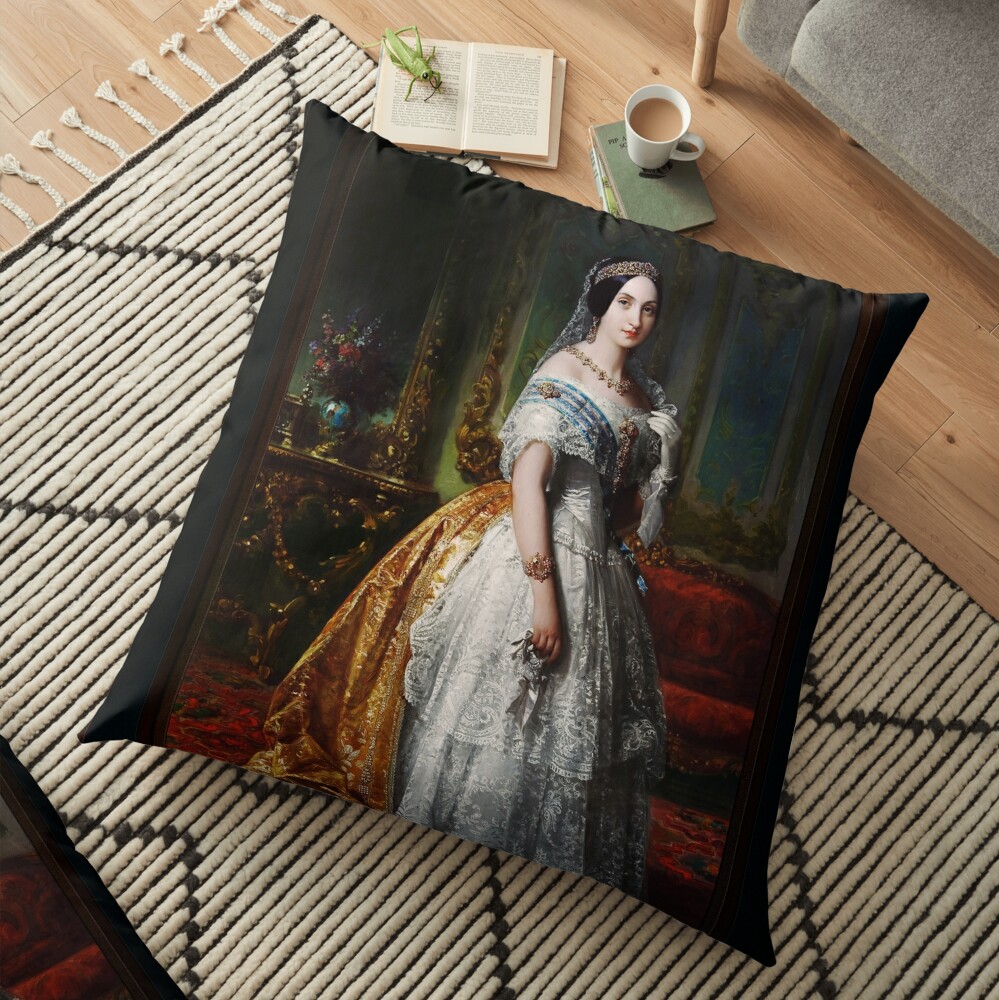
She is posed in a large lavish room standing on a colorfully patterned red carpet, which has in the background to the left of the image, a large wall mirror with gold accent gilding, that is positioned over an elaborately carved gold gilded table that has on top of it a decorative gold box, a beautiful blue spherical vase with a floral gold stand containing a bouquet of flowers.
In the middle wall panel is more decorative gilded wood work and a sculpted face high up; and on the last wall panel that has more decorative wood work is a decorative wall shelf with a blue vase on it and below that a decorative love with a gilded wood border.
Luisa is shown wearing a full length white embroidered lace gown that is complemented by a gold tail like trailing material with silver floral embroidered details and pearls, that flows from the back of her dress at the waist and wraps around to her right side on the floor.
She has a royal blue, white and pink sash that carries from her right shoulder down to the left side of her waist with an attached blue and white ribbon hanging from her left side.
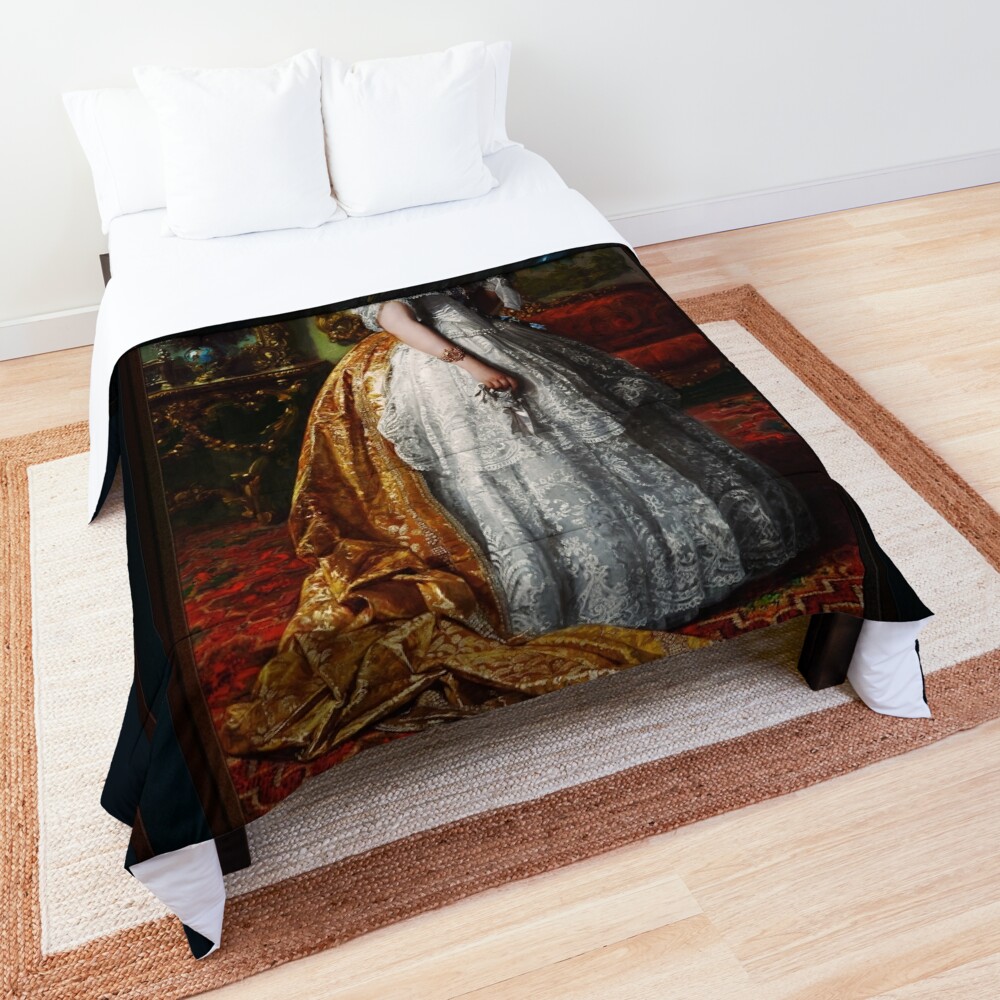
On her left hand which is positioned near the left side of her chest has a white silk evening glove on to and sheer handkerchief tucked into it; while her right hand holds the other evening clove to the right side of her body.
On her black hair, hang from the back she has a silk white lace kerchief that matches her dress; and around her head she is wearing a tiara comprised of silver and gold, with ruby gemstone.
The tiara is complemented with earrings, a necklace, a bracelet, a large brooch on the front of her dress and two smaller ones on the shoulders of the dress that bear the same and similar pattern.
Infantin Luisa Fernanda de Borbon, Duquesa de Montpensier is a remastered digital art old masters reproduction of a public domain image that is available as a Metall, Acryl-, Holz, Leinwanddruck online.
Informationen unten abgeleitet von Wikipedia.org
Federico wurde in Rom als Sohn von José de Madrazo y Agudo . geboren (1781 – 1859), ein Maler und ehemaliger Direktor des Prado-Museums; and was part of a line of great artists, that included his grandfather on his mother side; Tadeusz Kuntze (1733 – 1793), ein polnischer Maler.
Other members of this creative family include his brothers, who were the painter Luis de Madrazo (1825 – 1897), Pedro de Madrazo (1816 – 1898), ein Kunstkritiker und Juan de Madrazo (1829 – 1880), ein Architekt.

Among Federico’s his children were the painter Ricardo de Madrazo (1851 – 1917), Raimundo de Madrazo y Garreta (1841 – 1920) and Cecilia de Madrazo y Garreta (1846 – 1932) who married the great Orientalist artist, Marià Fortuny (1838 – 1874).
The Madrazo family has been described as one of the most important painting Spanish painting dynasties of the 19th century; which completely dominated painting in Spain during that period.
Federico began taking artistic lesson from his father, and while still attending the Royal Academy of San Fernando, painted his first picture The Resurrection of Christ c1829; which was purchased by Queen Christina.
Soon after that painting he created Achilles in his Tent, and after that presented to the Academy The Continence of Scipio, which secured him admission as a member “for merit”.
Three years later Federico left for Paris where he studied on the Franz Winterhalter and painted portraits of Baron Taylor and Ingres (ein französischer neoklassizistischer Maler).
Im 1837 er erhielt den Auftrag, ein Gemälde für die Galerie in Versailles zu schaffen, für die er gemalt hat “Godfrey de Bouillon wird zum König von Jerusalem ernannt”; bald darauf kehrte er nach Rom zurück und übernahm Porträtprojekte für die spanische Aristokratie.