

Portrait Of A Boyarynya
Portrait Of A Boyarynya by Russian Painter Konstantin Makovsky (1839 – 1915); spezialisiert auf russische historische Gemälde, die einen idealisierten Blick auf das russische Leben in den vergangenen Jahrhunderten zeigen.
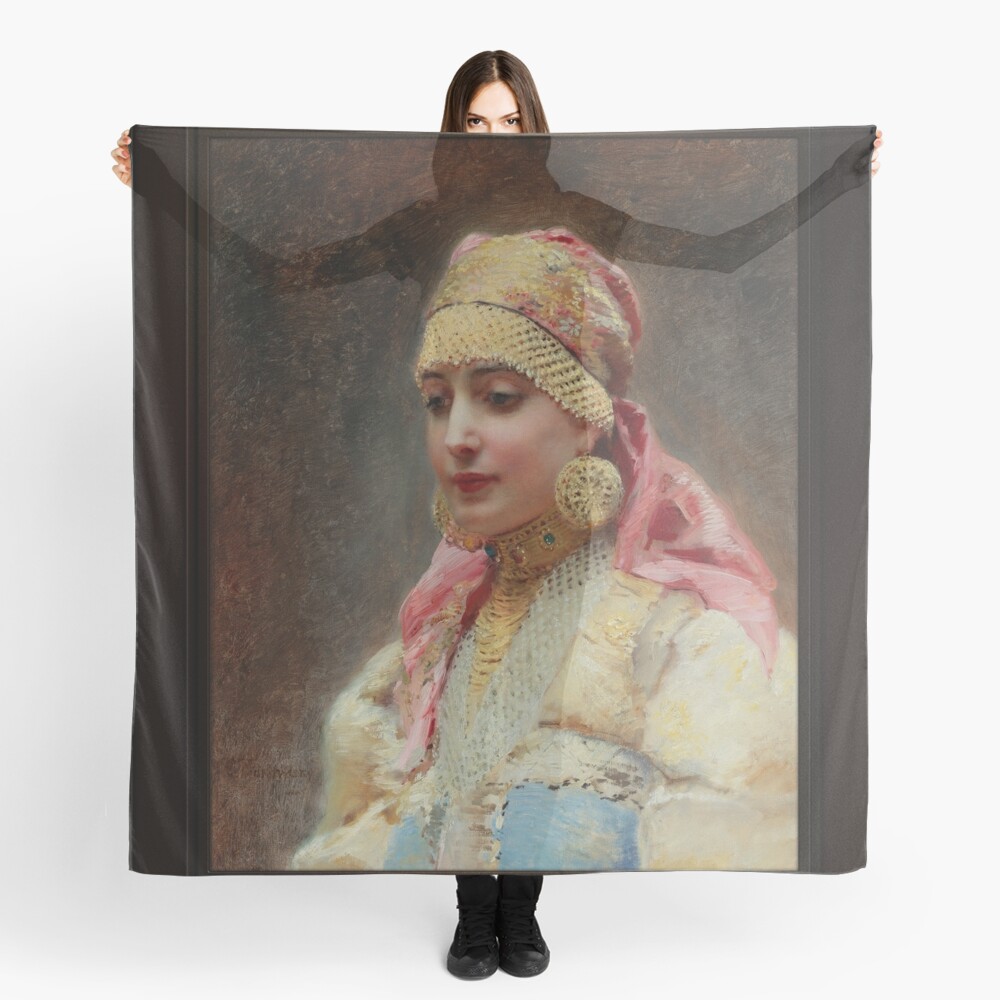
This is a beautiful portrait of a young Boyarynya or Boyarina, that is dressed in traditional Russian folk attire of the noble class of the time.
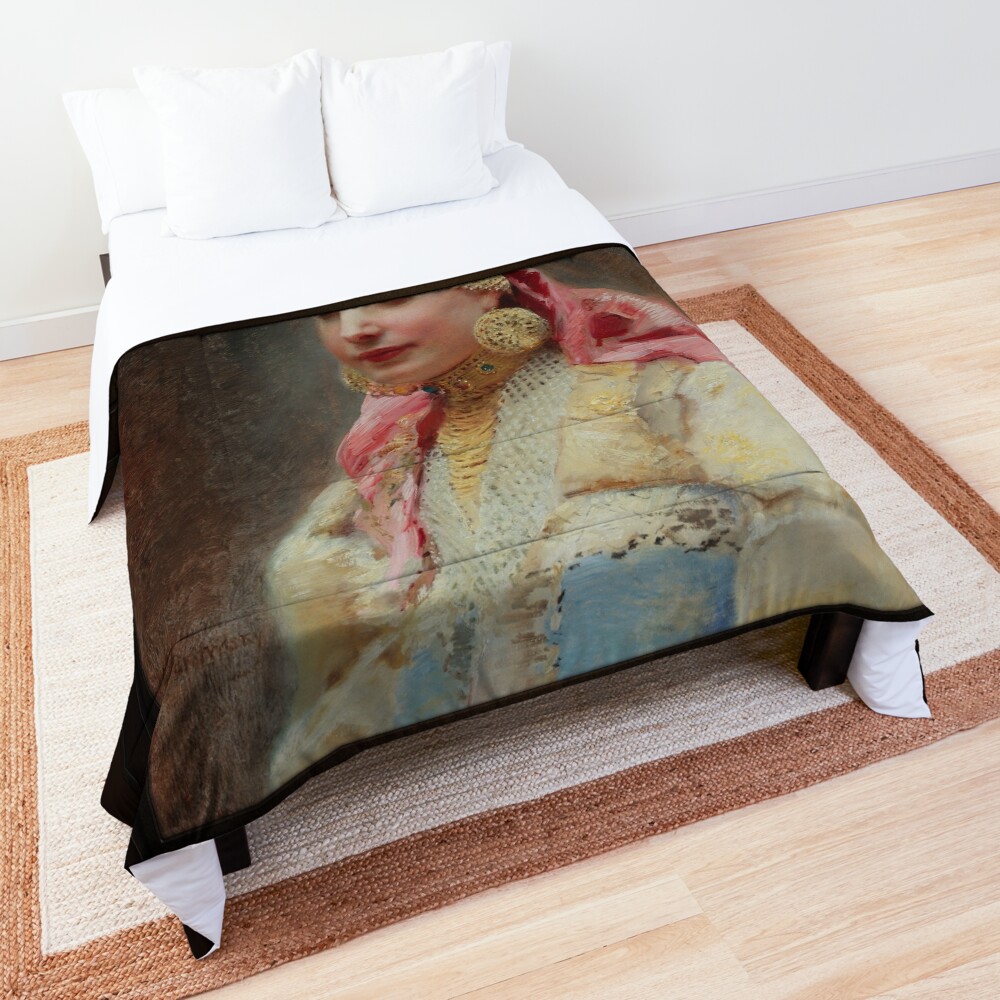
Beginning at the top of her head is a yellow braid headpiece with pearls along the perimeter, on top of that is a pink and red kerchief that flows on to her shoulders and then a very wide tan band with floral accents that wraps around everything.
She is wearing a matching set of large round braided yellow earrings, as well as a weaved and braided choker that has a red ruby in a gold piece placed on the front center, with two addition green emeralds on either side fitted to gold placements.
The choker then has another weaved element of yellow cloth that goes down the center of the chest with a white braided overlay on either side.
The kerchief that is resting on her right shoulder also has on it, a piece of gold jewelry, and beneath the white braided material we can see a white blouse.
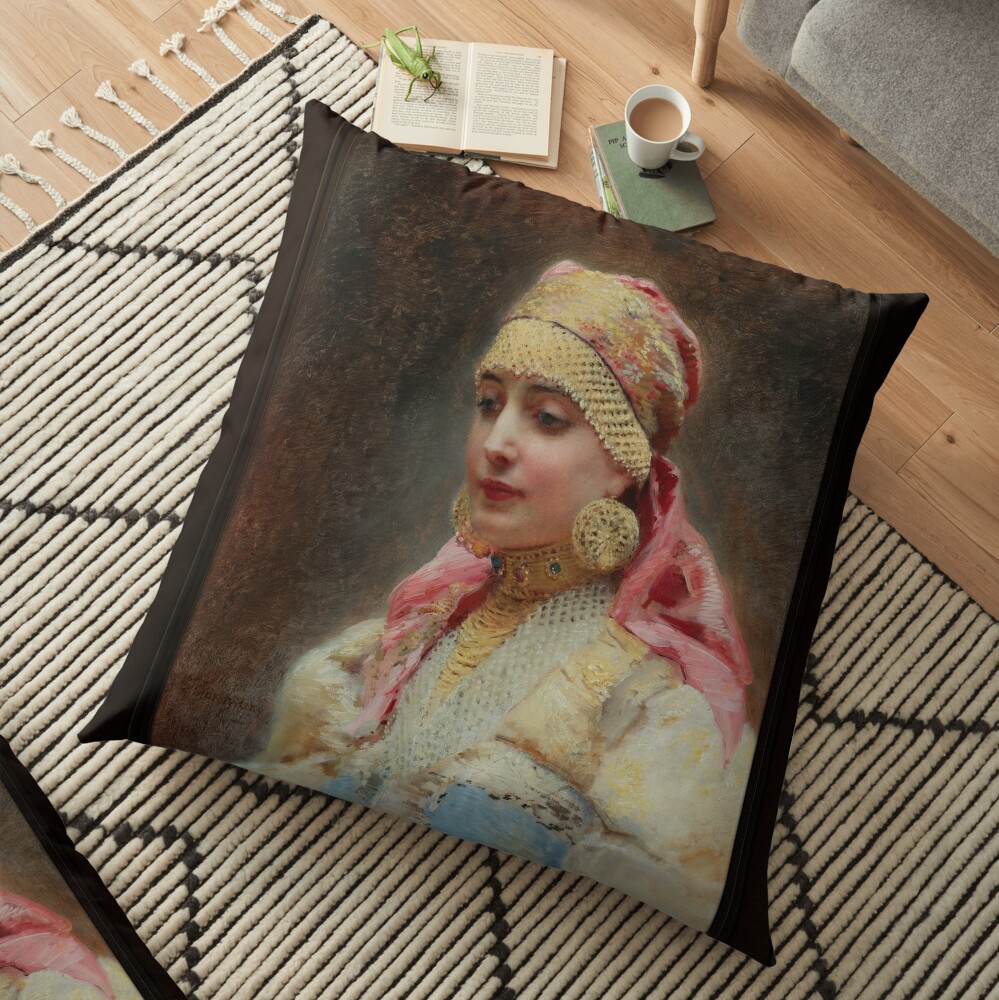
The final piece of clothing that she is wearing is a very thick and plush garment that is blue around her waist area; and yellow what along the sleeves and outer chest portions on either side.
Portrait Of A Boyarynya is a remastered digital art old masters reproduction of a public domain image that is available as a canvas print online.
Info unten abgeleitet von Wikipedia.org
Konstantin Makovsky war ein einflussreicher russischer Maler, verbunden mit der “Peredwischniki (Wanderer)”. Viele seiner historischen Gemälde, wie „Beneath the Crown“. (1889) auch bekannt als The Russian Bride’s Attire und Before the Wedding, zeigte eine idealisierte Sicht auf das russische Leben früherer Jahrhunderte. Er gilt oft als Vertreter der akademischen Kunst.
Konstantin Makovsky wurde in Moskau geboren. Sein Vater war der russische Kunstfigur und Amateurmaler, Jegor Iwanowitsch Makowski. Seine Mutter war Komponistin, und sie hoffte, dass ihr Sohn eines Tages in ihre Fußstapfen treten würde. Seine jüngeren Brüder Vladimir und Nikolay sowie seine Schwester Alexandra wurden ebenfalls Maler.
Im 1851 Makovsky trat in die Moskauer Malerschule ein, Bildhauerei und Architektur, wo er der beste Student wurde, ganz einfach alle verfügbaren Auszeichnungen erhalten. Seine Lehrer waren Karl Bryullov und Vasily Tropinin. Makovskys Neigungen zur Romantik und zu dekorativen Effekten lassen sich durch den Einfluss von Bryullov erklären.
Obwohl Kunst seine Leidenschaft war, Er dachte auch darüber nach, was seine Mutter von ihm gewollt hatte. Er machte sich auf die Suche nach Komponisten, auf die er sich beziehen konnte, und ging zunächst nach Frankreich. Vor, Er war schon immer ein Liebhaber klassischer Musik gewesen, und habe mir viele Stücke angehört. Er wünschte oft, er könnte die Melodie ändern, oder Stil einiger von ihnen, um sie angenehmer zu machen. Später in seinem Leben wurde es wahr.
Im 1858 Makovsky trat in die Kaiserliche Akademie der Künste in Sankt Petersburg ein. Von 1860 Er nahm an den Ausstellungen der Akademie mit Gemälden wie „Die Heilung von Blinden“ teil (1860) und Agenten des falschen Dmitry töten den Sohn von Boris Godunov (1862). Im 1863 Makovsky und dreizehn andere Studenten protestierten gegen die Vergabe von Themen aus der skandinavischen Mythologie durch die Akademie im Wettbewerb um die Große Goldmedaille der Akademie; alle verließen die Akademie ohne formelles Diplom.
Makovsky wurde Mitglied einer Genossenschaft (artel) von Künstlern unter der Leitung von Ivan Kramskoi, Typischerweise produziert er Wanderers-Gemälde über das Alltagsleben (Witwe 1865, Heringsverkäufer 1867, usw.). Von 1870 Er war Gründungsmitglied der Society for Travelling Art Exhibitions und arbeitete weiterhin an Gemälden zum Thema Alltag. Er stellte seine Werke sowohl auf den Academia-Ausstellungen als auch auf den Wanderkunstausstellungen der Wanderers aus.
Nach Reisen nach Ägypten und Serbien Mitte der 1870er Jahre kam es zu einer bedeutenden Stiländerung. Seine Interessen wechselten von sozialen und psychologischen Problemen zu künstlerischen Problemen von Farben und Formen.
In den 1880er Jahren wurde er ein gefragter Autor von Porträts und historischen Gemälden. Auf der Weltausstellung von 1889 in Paris erhielt er die Große Goldmedaille für sein Gemälde „Tod von Iwan dem Schrecklichen“., Das Urteil von Paris, und Dämon und Tamara. Er war einer der am meisten geschätzten und bestbezahlten russischen Künstler seiner Zeit. Viele demokratische Kritiker hielten ihn für einen Abtrünnigen der Wanderers’ Ideale, produzieren (wie Henryk Siemiradzki) auffällige, aber oberflächliche Werke, während andere ihn als Vorläufer des russischen Impressionismus betrachten.
Makovsky wurde getötet 1915 als seine Pferdekutsche in Sankt Petersburg von einer elektrischen Straßenbahn erfasst wurde.