

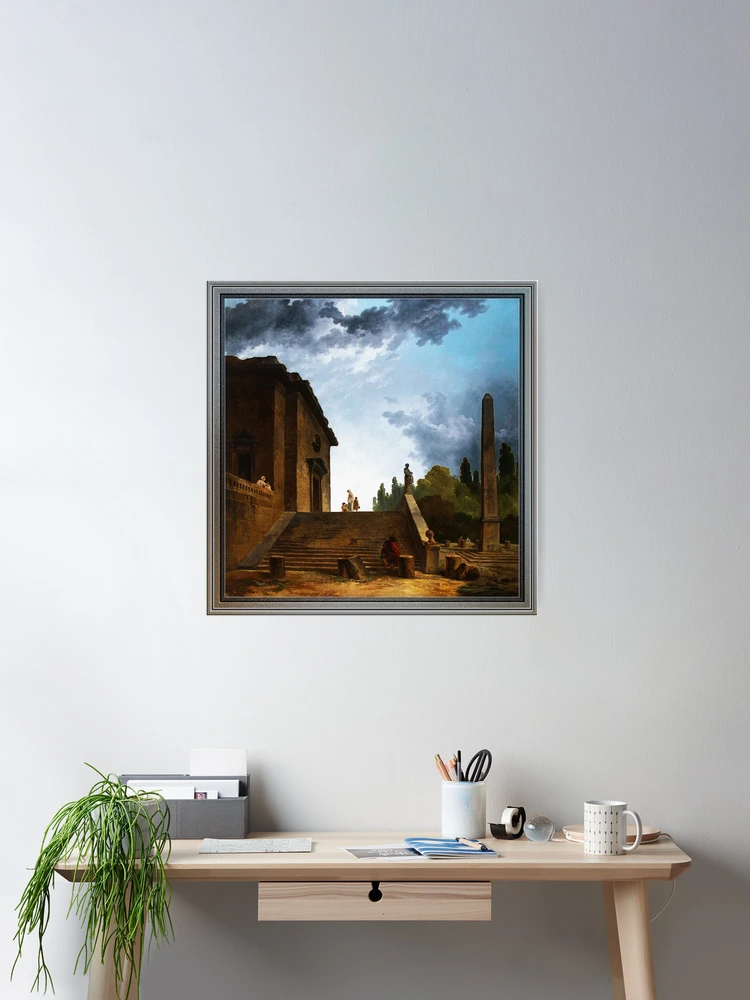
계단과 오벨리스크가 있는 풍경
“계단과 오벨리스크가 있는 풍경” is a striking example of 18th-century French landscape painting, created by 휴버트 로버트 약 1770-1780. Known for his fascination with classical ruins and grand architectural settings, 로버트 (1733 – 1808) captures a scene that exemplifies the romanticized aesthetic of the period. His work blends natural and man-made elements, illustrating a harmonious coexistence between the human-crafted structures and the vast, timeless landscape. This piece invites viewers to immerse themselves in a world where history, 자연, and architecture converge.
목차
주요 주제 및 구성
The central focus of this artwork is the majestic set of stairs leading to a grand building or temple, complemented by the towering obelisk in the background. The stairs themselves are weathered and appear to be made of stone, their steps leading upward toward a stone structure. The presence of these stairs suggests an ancient or noble setting, possibly linked to historical or mythological references, characteristic of Robert’s romanticized depictions of classical ruins.
전경에서, two individuals are depicted—one seated and another standing on the stairs. They are seemingly inconsequential to the grandeur of the setting but still play a vital role in adding a human presence that contrasts with the monumental architecture. Their placement helps balance the scale of the composition, providing a sense of human proportion amid the towering structures.
The obelisk, an ancient Egyptian monument re-imagined within a classical European setting, stands as another focal point to the right side of the composition. This object symbolizes the ancient world, evoking the sense of a lost civilization while anchoring the piece in the romantic classical themes Robert was known for. The use of the obelisk reinforces the notion of timelessness, a central theme in much of Robert’s work, where classical ruins are idealized to evoke both nostalgia and contemplation of past civilizations.
물체와 지형
The terrain surrounding the stairs and obelisk is lush and expansive. The ground appears to be cultivated or at least managed, with well-kept paths leading through the terrain. On the right, we see a few figures in the distance, seated or walking, giving the landscape a dynamic feel while reinforcing the setting’s tranquility. The backdrop of trees, with their expansive reach toward the sky, provides a striking contrast against the harsh lines of the stone architecture. The viewer’s eye is naturally drawn toward the horizon, where the trees begin to thin out, leading to a space dominated by clouds and a slightly darker sky.
The juxtaposition of human-made elements—such as the staircase, the obelisk, and the figures—and nature highlights the tension between civilization and the natural world. Robert’s careful rendering of the foliage, combined with the crisp outlines of the architectural elements, underscores the precision of his technique. This harmony between nature and architecture is a key characteristic of the Rococo and Neoclassical periods, where the human desire for understanding and order is reflected through such meticulously designed structures amid nature’s free-flowing form.
스타일과 테크닉
Robert’s style in this work is distinctly Rococo with elements of Neoclassicism, blending the ornate with the classical. His use of light, 그림자, and texture creates a sense of depth and dimension, inviting the viewer to step into the landscape. The clouds in the sky seem to swirl in dramatic motion, contrasting with the stillness of the stone objects below. This use of light and dark not only adds to the mood but also enhances the sense of timelessness that pervades the entire scene.
The application of light is masterful, with shadows creeping along the stone steps, highlighting the weathered texture of the structure. The obelisk, ~도, is illuminated with soft, diffuse light, giving it an almost ethereal quality. 그림, small in comparison to the surrounding objects, are subtly shaded, further emphasizing their secondary role within the larger composition.
Robert’s technique, while focused on naturalistic detail, maintains an idealized interpretation of the ruins. The rocks and stone are not simply representations of decay but are infused with a sense of romantic nostalgia for an era gone by. The stones seem to have a timeless quality, making them not just relics of the past, but symbols of enduring beauty.
분위기와 테마
그림의 분위기는 조용한 묵상 중 하나입니다. 설정, with its peaceful yet awe-inspiring structures, invites viewers to reflect on the past, 시간의 흐름, and the impermanence of human creations. The natural landscape, in its lushness and vividness, contrasts with the stone architecture, suggesting the ephemeral nature of human achievement against the vast, enduring power of nature.
The classical ruins, while not overtly ancient in this depiction, invoke the grandeur of civilizations long past, evoking a sense of nostalgia and reverence for the lost civilizations of Rome and Egypt. The obelisk, with its Egyptian origins, stands as a reminder of these ancient powers. By choosing to depict such ruins, Robert not only preserves the legacy of these ancient structures but also elevates them, presenting them as objects of beauty rather than mere remnants of past civilizations.
The inclusion of figures adds a human touch to the scene, but their small scale and passive actions suggest that humanity, while significant, is but a fleeting moment in the timeline of history. The vast sky, dotted with dark clouds and illuminated by bursts of light, further amplifies the theme of nature’s dominance over time and human endeavors.
결론
“계단과 오벨리스크가 있는 풍경” is a masterful example of Hubert Robert’s ability to merge the beauty of nature with the elegance of classical architecture. The scene captures a moment where the monumental and the natural coexist, creating a serene yet thought-provoking atmosphere. Robert’s meticulous attention to detail, his skillful use of light and shadow, and his celebration of classical ruins all serve to reinforce the timeless theme of nature’s dominance and the fleeting nature of human achievement. This work invites the viewer not only to admire its technical brilliance but to reflect on the deeper themes of history, 시간, and memory.
계단과 오벨리스크가 있는 풍경은 수정된 디지털 아트입니다. 롤 캔버스 온라인 인쇄.
아티스트 약력
아래에서 파생된 정보 Wikipedia.org
Hubert Robert는 파리에서 태어났습니다. 1733. 그의 아버지, 니콜라스 로버트, François-Joseph de Choiseul의 서비스에 있었다, 후작 드 스테인빌(Marquis de Stainville)은 로렌(Lorraine)의 주요 외교관. Young Robert는 Collège de Navarre에서 예수회와 함께 공부를 마쳤습니다. 1751 그리고 그에게 디자인과 원근법을 가르쳤지만 그림으로 전향하도록 격려한 조각가 Michel-Ange Slodtz의 아틀리에에 들어갔습니다.. 에 1754 그는 Étienne-François de Choiseul의 기차를 타고 로마로 떠났다., 아버지 고용주의 아들, 그는 프랑스 대사로 임명되었고 루이 15세의 외무장관이 되었다. 1758.
그는 로마에서 완전히 11년을 보냈다, 놀라운 시간; 로마에 있는 프랑스 아카데미에서 젊은 예술가의 공식 거주지가 끝난 후, 그는 abbe de Saint-Non과 같은 방문 감정가를 위해 제작한 작품으로 생계를 유지했습니다., 4월에 로버트를 나폴리로 데려간 사람 1760 폼페이 유적지를 방문하기 위해. 후작 드 마리니, Bâtiments du Roi의 감독은 Natoire와 통신하면서 그의 발전을 따라갔습니다., 프랑스 아카데미 원장, 연금 수급자들에게 야외에서 스케치를 하라고 촉구한 사람, 자연에서: 로버트는 재촉할 필요가 없었다; 그의 스케치북에 있는 그림은 그의 여행을 기록합니다.: 빌라 데스테, 카프라롤라.
로마의 리페타 항구 전경, 씨. 1766, 상상의 항구 옆에 고대 로마 판테온을 보여주는
고대 로마의 폐허와 당대의 삶의 대조는 그의 가장 뜨거운 관심을 불러일으켰습니다.. 그는 Pannini의 스튜디오에서 한동안 일했습니다., 폐허가 된 루브르 박물관의 상상 속의 모습에서 그 영향력을 볼 수 있습니다. (삽화). Robert는 Piranesi 서클의 젊은 예술가 회사에서 시간을 보냈습니다., 낭만적으로 자란 폐허의 변덕스러움이 그에게 큰 영향을 주어 그는 로베르 데 폐허라는 별명을 얻었습니다.. 그가 로마에서 수집한 스케치와 그림의 앨범은 그가 평생 동안 그림으로 작업한 모티브를 제공했습니다..