

Laurel
Laurel by Czech Painter Alphonse Mucha (1860 – 1939); a także znakomity ilustrator i grafik, który był główną siłą w okresie secesji; znany ze swojej stylizowanej, ozdobne i dekoracyjne plakaty teatralne.
This is a wonderful illustration of an attractive young lady presented in the art nouveau style in a side portrait view within a circular view port.
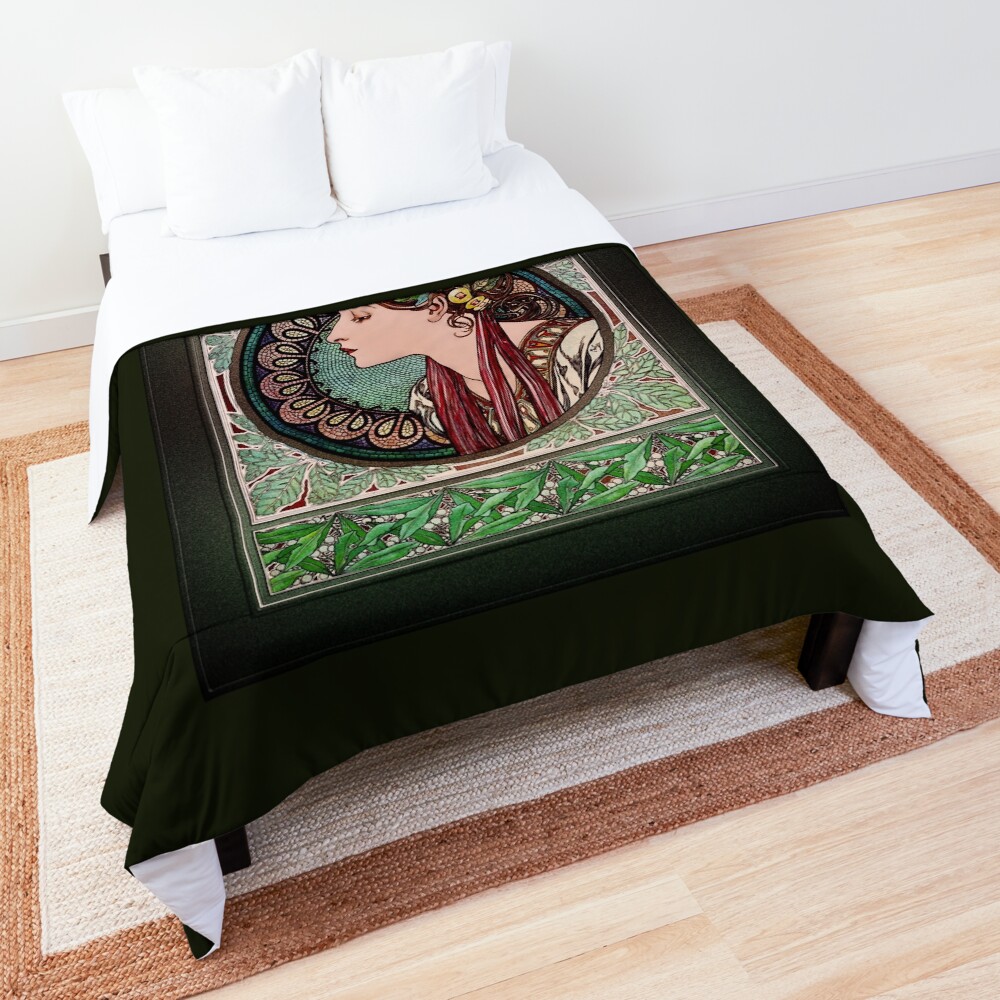
She is positioned in front of a circular tiled background at the inner core that is overlaid with wide tiled ring with with oval tiled shapes and then to a two layer tiled ring and finally a solid ring.
She has brown curly hair with yellow streaks running throughout with long strands of hair hanging on both side of her neck from the back of her head that are red and light pink.
Her hair is tied mid way on the top by a red ribbon and on the left side of her hair just above her ear is a flower with leaves; and below this is a head piece composed of disc that wraps around the back of her head.
She is wearing a white dress with a large wide collar that wraps around the entire upper portion of the dress that is decorated in colorful triangular and cone like designs.
Around this inner frame is a square frame filled with green plants that are directed to the four corners of the frame; and on the top and bottom of this frame are two rectangular boxes filled with plants and fruit, with the top box being smaller than the bottom box.

This all tied together with a separator the fits along the perimeter of the three different frames.
Jest to zremasterowana reprodukcja starych mistrzów sztuki cyfrowej obrazu należącego do domeny publicznej, która jest dostępna jako druk na płótnie online.
Informacje poniżej od Wikipedia.org
Alfons Maria Mucha Lipiec 24, 1860 – lipiec 14, 1939), był znany na całym świecie jako Alphonse Mucha. Był wybitnym czeskim malarzem, ilustrator i grafik, mieszkający w Paryżu w okresie secesji, i jest najbardziej znany ze swoich wyraźnie stylizowanych i dekoracyjnych plakatów teatralnych, szczególnie te Sarah Bernhardt.
Tworzył ilustracje, reklamy, panele dekoracyjne, i projekty, który stał się jednym z najbardziej znanych obrazów tego okresu.
W drugiej części swojej kariery, w wieku 43, wrócił do ojczyzny Czech i Moraw w Austrii i poświęcił się namalowaniu serii dwudziestu monumentalnych płócien znanych jako Epopeja słowiańska, przedstawiający historię wszystkich narodów słowiańskich świata, które namalował między 1912 i 1926.
W 1928, w 10. rocznicę niepodległości Czechosłowacji, przedstawił serię narodowi czeskiemu. Uważał to za swoje najważniejsze dzieło. Jest teraz na wystawie w Pradze.