

Meditation on the History of Italy
Meditation on the History of Italy: A Detailed Examination
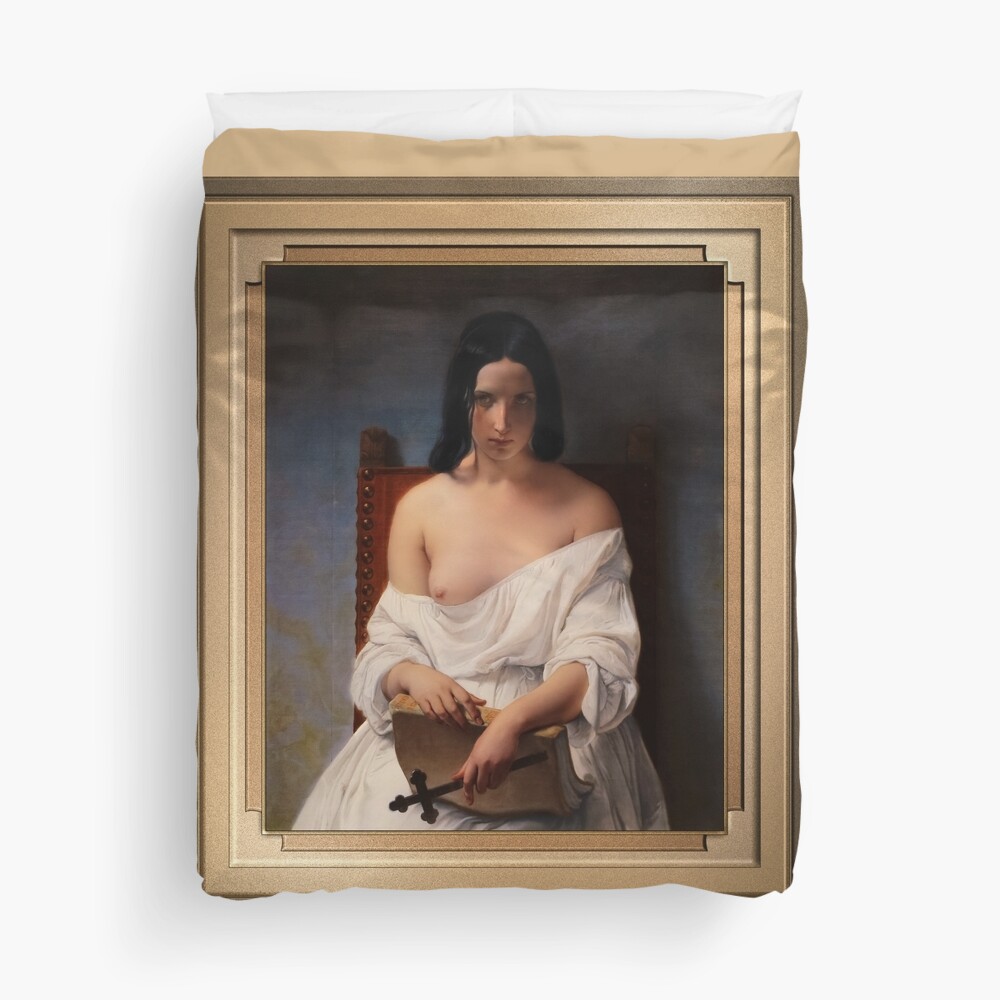
Francesco Hayez’s “Meditation on the History of Italy,”Herumgemalt 1851, is a compelling work within the Romantic tradition, deeply rooted in Italian nationalism and historical allegory. Das Gemälde, currently housed at the Pinacoteca di Brera in Milan, transcends a simple portrait to become a complex visual narrative reflecting the yearning for a unified and independent Italy during a period of political fragmentation and foreign domination. Hayez was a leading figure in the Risorgimento, the 19th-century movement that led to Italian unification, and his art frequently served as a vehicle for expressing patriotic sentiments.
Inhaltsverzeichnis
Kompositionsstruktur & Einstellung
The composition is dominated by a single female figure seated upon an ornate chair against a backdrop of muted blues and grays. The chair itself appears aged and slightly dilapidated, hinting at the decline of past glories. The background fades into obscurity, suggesting a timeless setting rather than a specific historical location. This ambiguity allows for broader interpretation, encompassing Italy’s long and turbulent history. Die Figur ist zentral positioniert, drawing immediate attention to her contemplative state. The overall effect is one of quiet introspection within a space that feels both intimate and monumental.
Die Figur: Identity & Kleidung
The woman depicted possesses striking features – dark hair cascading down her shoulders, pale skin, and intense, melancholic eyes. Her gaze is directed downwards, suggesting deep thought or sorrow. She is draped in a simple white gown, partially slipped from one shoulder, revealing the upper portion of her chest. The fabric appears soft and flowing, adding to the sense of vulnerability and grace. The lack of elaborate ornamentation on her attire contrasts with the ornate chair, further emphasizing her individual presence and internal focus. Her bare feet rest upon the floor, grounding her in a tangible reality despite the allegorical nature of the scene.
The Book & Cross: Symbolic Elements
Held within her hands is an open book, its pages filled with text that remains largely illegible to the viewer. This book clearly represents Italian history and literature – the accumulated knowledge and cultural heritage of the nation. Lying across the book’s cover is a large, dark cross. The presence of the cross introduces a layer of religious significance, referencing Italy’s strong Catholic tradition and potentially alluding to the role of faith in shaping national identity. jedoch, its placement atop the historical record suggests a complex relationship between religion and Italian history – perhaps a commentary on how faith has both supported and sometimes hindered the nation’s progress.
Beleuchtung & Farbpalette
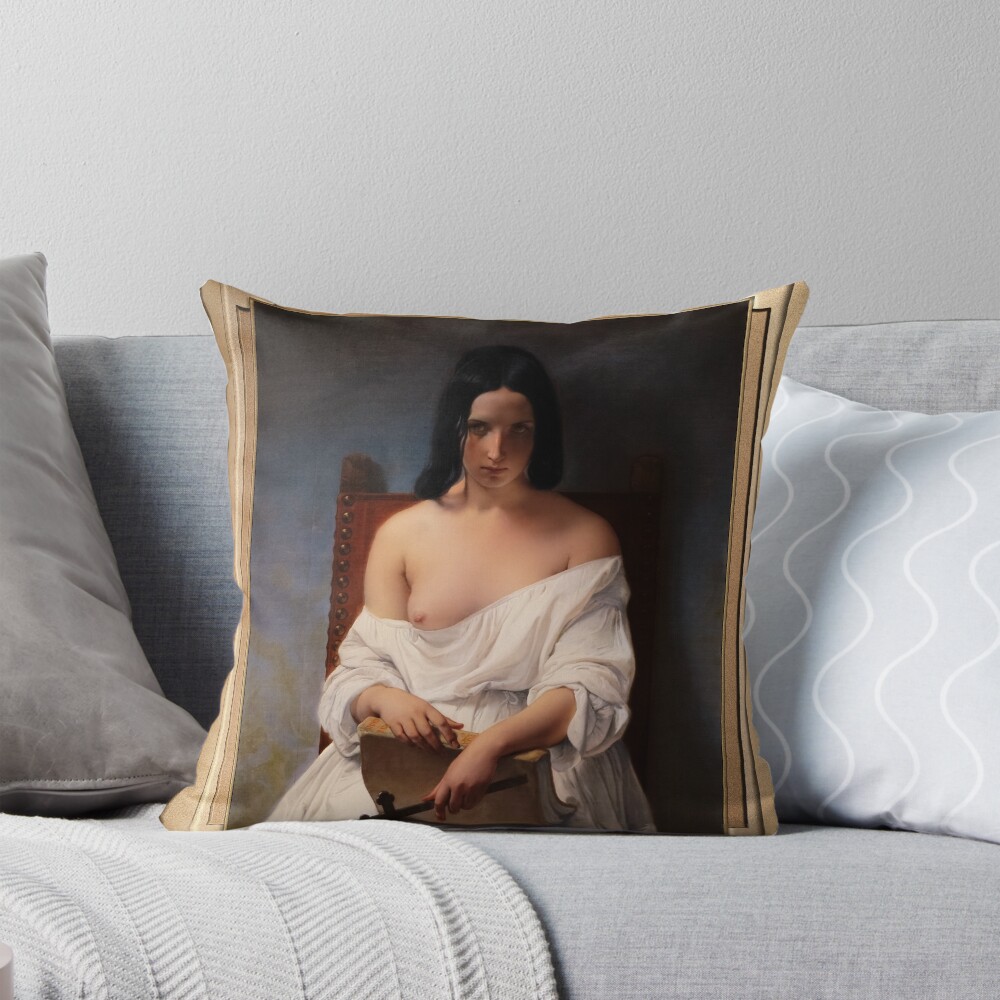
Die Beleuchtung drin “Meditation on the History of Italy” is carefully orchestrated to enhance the painting’s emotional impact. Ein weiches, diffused light illuminates the woman from above, highlighting her face and upper body while leaving much of the background shrouded in shadow. This creates a sense of mystery and emphasizes the figure’s isolation within her thoughts. The color palette is restrained, dominated by muted tones of white, grau, Blau, und braun. These colors contribute to the painting’s somber mood and reinforce the themes of reflection and melancholy. The limited use of vibrant hues draws attention to specific details, such as the dark cross and the woman’s eyes.
Künstlerischer Stil & Einflüsse
Hayez’s style is characteristic of Italian Romanticism, emphasizing emotion, Individualismus, and a fascination with history and mythology. The painting exhibits meticulous detail in rendering the figure’s features and clothing, demonstrating Hayez’s technical skill as an artist. There are echoes of Neoclassical influences in the composition’s balance and clarity, but the overall tone is decidedly Romantic, prioritizing emotional expression over strict adherence to classical ideals. The work shares affinities with other allegorical paintings of the period, particularly those exploring themes of national identity and historical memory.
Historischer Kontext & Interpretation
Painted during a time when Italy was divided into numerous states under foreign rule or dominated by regional powers, “Meditation on the History of Italy” served as a powerful symbol of hope for unification. The woman’s contemplative pose and sorrowful expression can be interpreted as representing the Italian people reflecting upon their past struggles and yearning for a brighter future. The book symbolizes the nation’s rich cultural heritage, while the cross suggests the enduring influence of religion in Italian life. Hayez deliberately avoided explicitly depicting specific historical events or figures, allowing viewers to project their own interpretations onto the painting and connect with its broader themes of national identity and aspiration.
Künstler Bio abgeleitet von Wikipedia.org
Francesco Hayez stammte aus einer relativ armen Familie aus Venedig. Sein Vater, Giovanni, war französischer Herkunft, während seine Mutter, Chiara Torcella, war aus Murano. Francesco war der jüngste von fünf Söhnen.
Er wurde von der Schwester seiner Mutter erzogen, der Giovanni Binasco . geheiratet hatte, ein wohlhabender Reeder und Kunstsammler. Hayez zeigte seit seiner Kindheit eine Veranlagung zum Zeichnen. Sein Onkel, als er sein frühreifes Talent bemerkt hat, machte ihn bei einem Kunstrestaurator in Venedig. Hayez wurde später Schüler des Malers Francesco Maggiotto, bei dem er drei Jahre lang studierte.

Er wurde in den Malkurs der Neuen Akademie der Schönen Künste in Venedig aufgenommen 1806, wo er bei Teodoro Matteini . studierte. Im 1809 er gewann einen Wettbewerb der Akademie von Venedig für einen einjährigen Aufenthalt an der Accademia di San Luca in Rom.
Er blieb in Rom, bis 1814, dann zog er nach Neapel, wo er von Joachim Murat beauftragt wurde, ein Hauptwerk zu malen, das Odysseus am Hof von Alcinous darstellt. Mitte der 1830er Jahre besuchte er den Maffei-Salon in Mailand, moderiert von Clara Maffei. Maffeis Ehemann gab Hayez später ein Porträt seiner Frau in Auftrag. Im 1850 Hayez wurde zum Direktor der Brera Academy ernannt.
Im Laufe einer langen Karriere, Hayez erwies sich als besonders produktiv. Sein Werk umfasste historische Gemälde, die die patriotische Sensibilität seiner Auftraggeber ansprechen sollten, sowie Werke, die den Wunsch widerspiegeln, einen neoklassizistischen Stil zu großen Themen zu begleiten, entweder aus biblischer oder klassischer Literatur.
Er malte auch Szenen aus Theateraufführungen. Auffallend abwesend in seinem Oeuvre, jedoch, sind Altarbilder – möglicherweise aufgrund der napoleonischen Invasionen, die viele Kirchen und Klöster in Norditalien entweihten. Der Kunsthistoriker Corrado Ricci beschrieb Hayez als einen Klassizisten, der sich dann zu einem Stil emotionalen Tumults entwickelte. Francesco Hayez, Der Kuss (1859)
Seine Porträts haben die Intensität von Ingres und der Nazarener-Bewegung. Oft sitzen, Hayez’ Motive sind oft streng gekleidet, schwarz-weiße Kleidung, mit wenig bis gar keiner Ausstattung. Während Hayez Porträts für den Adel machte, er erforschte auch andere Themen wie Künstlerkollegen und Musiker. Spät in seiner Karriere, er ist dafür bekannt, mit Fotografien gearbeitet zu haben.
Eines der Lieblingsthemen von Hayez war die halb bekleidete Odaliske, die an orientalische Themen erinnert – ein Lieblingsthema romantischer Maler.[3] Die Darstellungen von Harems und ihren Frauen ermöglichten es Künstlern, Szenen zu malen, die sonst in der Gesellschaft nicht akzeptabel wären. Sogar Hayez’ Maria Magdalena hat mehr Sinnlichkeit als religiöse Inbrunst.
Hayez' Gemälde Der Kuss wurde von seinen Zeitgenossen als eines seiner besten Werke angesehen, und ist möglicherweise sein bekanntestes Werk. Der Anonyme, die unberührte Geste des Paares erfordert keine Kenntnis von Mythen oder Literatur, um sie zu interpretieren, und appelliert an einen modernen Blick.
Eine wissenschaftliche Einschätzung von Hayez' Karriere wurde durch seine Neigung erschwert, seine Werke nicht zu signieren oder zu datieren. Oftmals geben Daten in seinen Gemälden an, wann das Werk erworben oder verkauft wurde, nicht die Zeit seiner Entstehung. darüber hinaus, er malte oft die gleichen Kompositionen mehrmals mit minimalen Variationen, wenn überhaupt.
Zu seinen Schülern der Brera-Akademie gehörten Carlo Belgioioso, Amanzio Cattaneo, Alessandro Focosi, Giovanni Battista Lamperti, Livo Schafe, Angelo Pietrasanta, Antonio Silo, Carlo Antonio Tavella, Ismaele Teglio Milla und Francesco Valaperta.
Hayez starb in Mailand, Alter 91. Sein Atelier an der Brera-Akademie ist mit einem Schild gekennzeichnet.
Dies ist eine retuschierte digitale Kunst-Reproduktion alter Meister eines gemeinfreien Bildes, das online als erworben werden kann gerollter Leinwanddruck.