

Melancholie
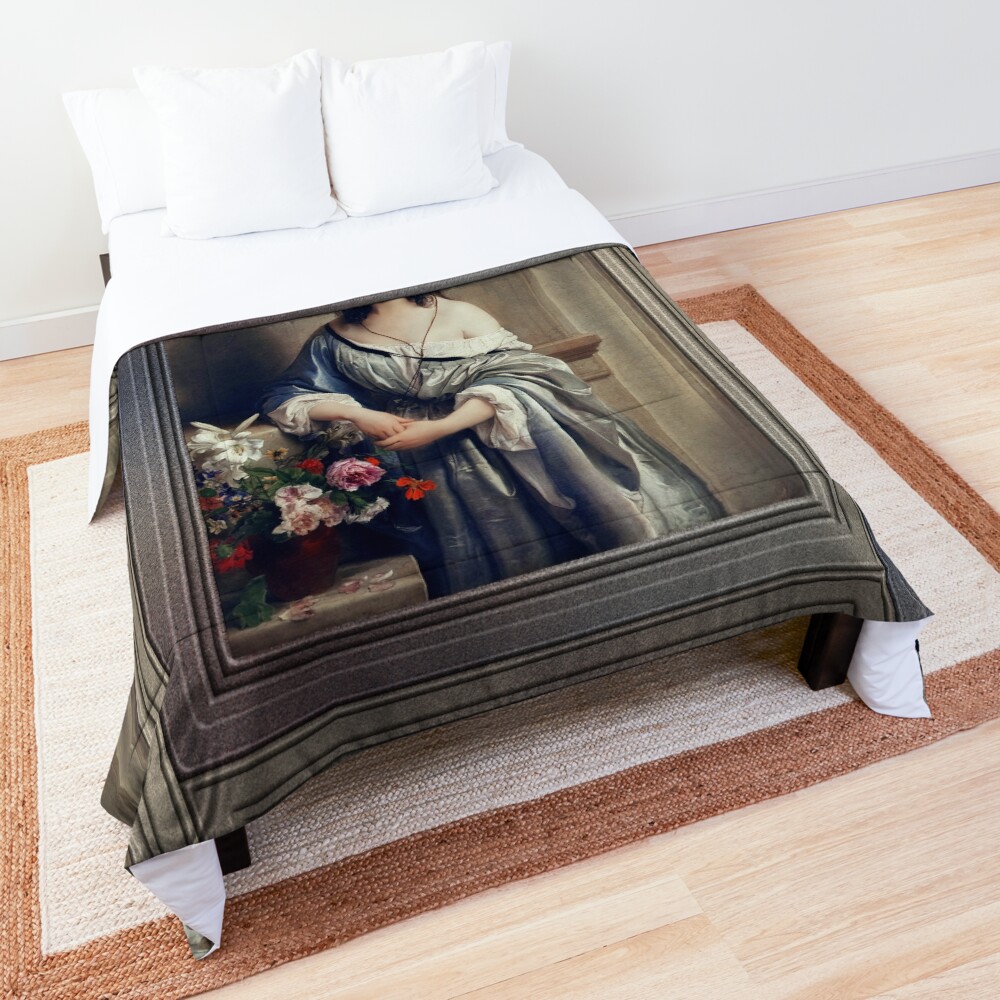
Melancholie c1841-42 des italienischen Malers Francesco Hayez (1791 – 1882); der Mitte des 19. Jahrhunderts in Mailand Italien als der führende Maler der Romantik galt. Er war bekannt für seine großartigen historischen Gemälde, politische Allegorien und außergewöhnliche schöne Porträts.
Francesco Hayez, a prominent Italian painter of the Romantic period, captured the emotive power of human expression and drama in his renowned work “Melancholie”. This poignant portrait, umhergestellt 1841-42, epitomizes the Romantic ideals of intense emotional depth, reiche Symbolik, and the exploration of human inner turmoil. The painting features a young woman in a reflective pose, her body angled slightly away from the viewer, yet her gaze directly engages with the observer. Her expression is one of deep contemplation and melancholy, a theme that resonates throughout much of Hayez’s oeuvre.

The primary subject of the artwork is a woman dressed in a luxurious yet simple gown of muted silvery-blue fabric. Her attire is both modest and elegant, indicative of her high social standing but also suggesting a restrained, subdued personality.
The material of her gown is rendered with Hayez’s signature meticulous brushwork, which gives the fabric a soft, fast durchscheinende Qualität. It reflects light in such a way that one can almost feel its weight and texture. The delicacy of the gown contrasts with the weight of her expression, reinforcing the thematic tension of the painting.
The subject’s hair, dark and glossy, falls in loose waves around her shoulders, umrahmt ihr Gesicht. Her posture is demure yet sorrowful, her hand gently resting on a vase of flowers placed on a table to her side. The inclusion of flowers—likely meant to symbolize transience and the fragility of life—adds a layer of complexity to the emotional narrative.
The flowers themselves are rendered with meticulous detail, a hallmark of Hayez’s technical prowess. They appear lifelike, as if they could be plucked from the canvas at any moment. This detailed rendering contrasts sharply with the somber tone of the subject, creating a sense of fragility in both the floral elements and the human form.
Hinter dem Thema, the setting is an interior space, subtly lit to evoke a sense of isolation and introspection. The light seems to enter from an unseen source, casting soft shadows that envelop the subject, further intensifying the feeling of seclusion. The muted colors of the background, which include soft earth tones and shades of gray, highlight the figure of the woman, making her the focal point of the composition.
The architectural features of the room, particularly the classical columns that frame the space, suggest a timeless quality. This classical influence also evokes a sense of the past and the passage of time, which ties in with the theme of melancholy.
Die Stimmung von “Melancholie” is one of introspective sadness. The woman’s expression is not one of overt grief or despair but rather a quiet, contemplative sorrow. Ihr Blick, though distant, suggests a mind lost in thought—perhaps reflecting on personal loss, unfulfilled desires, or an existential longing. Hayez was deeply interested in the psychological states of his subjects, and this painting showcases his ability to capture the complexity of emotion through subtle facial expressions and body language.
While the subject’s melancholy could be interpreted in various ways, it is important to consider the broader cultural and historical context of the painting. Created during the early 1840s, the work was produced at a time of political and social unrest in Italy.
Die romantische Bewegung, mit seiner Betonung auf Emotionen, Individualismus, and rebellion against societal norms, had a profound impact on the intellectual climate of the time. Hayez’s “Melancholie” could be seen as a reflection of the inner turmoil experienced by many individuals living through the tensions of political upheaval, as well as the personal, emotional struggles that often accompanied such periods of uncertainty.
The symbolism within the painting also speaks to broader themes of romanticism. The wistful nature of the subject, combined with the classical elements of the room and the natural motifs of the flowers, suggests an idealization of the past and an awareness of life’s fleeting nature. The woman’s contemplative pose and the stillness of the surrounding environment suggest an acceptance of these fleeting moments, evoking a sense of resignation that is characteristic of many Romantic works.
Hayez’s use of light and shadow in this painting further enhances the emotional tone. The light that falls gently across the woman’s face and gown creates a sense of intimacy, almost as if we are intruding on a private moment. Noch, the shadows that play across her figure suggest something darker—perhaps an unspoken sadness or the weight of an unvoiced emotion. This interplay of light and shadow is a powerful tool in conveying the internal conflict of the subject, highlighting the emotional depth and complexity that Hayez was able to achieve in this piece.
In Sachen Stil, “Melancholie” is quintessentially Romantic in its focus on emotion and individual experience. Hayez’s technical mastery is evident in his handling of texture and light, and his ability to convey psychological depth through subtle details is what makes this painting a standout example of Romantic portraiture. The realism with which he renders his subject, coupled with the idealization of the woman’s form, reflects the Romantic ideal of the artist as a master of both technique and emotional expression.
Letztlich, “Melancholie” is a masterpiece of emotional and psychological depth. Through the figure of the young woman, Hayez explores themes of introspection, Verlust, and the complexity of human emotion. His masterful use of light, Farbe, and composition creates a timeless portrait that continues to resonate with viewers, evoking feelings of empathy and contemplation. The painting remains one of the most iconic representations of Romantic portraiture and exemplifies Francesco Hayez’s ability to capture the profound emotional states of his subjects.
Info unten von Wikipedia.org
Francesco Hayez stammte aus einer relativ armen Familie aus Venedig. Sein Vater, Giovanni, war französischer Herkunft, während seine Mutter, Chiara Torcella, war aus Murano. Francesco war der jüngste von fünf Söhnen.
Er wurde von der Schwester seiner Mutter erzogen, der Giovanni Binasco . geheiratet hatte, ein wohlhabender Reeder und Kunstsammler. Hayez zeigte seit seiner Kindheit eine Veranlagung zum Zeichnen. Sein Onkel, als er sein frühreifes Talent bemerkt hat, machte ihn bei einem Kunstrestaurator in Venedig. Hayez wurde später Schüler des Malers Francesco Maggiotto, bei dem er drei Jahre lang studierte.
Er wurde in den Malkurs der Neuen Akademie der Schönen Künste in Venedig aufgenommen 1806, wo er bei Teodoro Matteini . studierte. Im 1809 er gewann einen Wettbewerb der Akademie von Venedig für einen einjährigen Aufenthalt an der Accademia di San Luca in Rom.
Er blieb in Rom, bis 1814, dann zog er nach Neapel, wo er von Joachim Murat beauftragt wurde, ein Hauptwerk zu malen, das Odysseus am Hof von Alcinous darstellt. Mitte der 1830er Jahre besuchte er den Maffei-Salon in Mailand, moderiert von Clara Maffei. Maffeis Ehemann gab Hayez später ein Porträt seiner Frau in Auftrag. Im 1850 Hayez wurde zum Direktor der Brera Academy ernannt.
Im Laufe einer langen Karriere, Hayez erwies sich als besonders produktiv. Sein Werk umfasste historische Gemälde, die die patriotische Sensibilität seiner Auftraggeber ansprechen sollten, sowie Werke, die den Wunsch widerspiegeln, einen neoklassizistischen Stil zu großen Themen zu begleiten, entweder aus biblischer oder klassischer Literatur.
Er malte auch Szenen aus Theateraufführungen. Auffallend abwesend in seinem Oeuvre, jedoch, sind Altarbilder – möglicherweise aufgrund der napoleonischen Invasionen, die viele Kirchen und Klöster in Norditalien entweihten. Der Kunsthistoriker Corrado Ricci beschrieb Hayez als einen Klassizisten, der sich dann zu einem Stil emotionalen Tumults entwickelte. Francesco Hayez, Der Kuss (1859)
Seine Porträts haben die Intensität von Ingres und der Nazarener-Bewegung. Oft sitzen, Hayez’ Motive sind oft streng gekleidet, schwarz-weiße Kleidung, mit wenig bis gar keiner Ausstattung. Während Hayez Porträts für den Adel machte, er erforschte auch andere Themen wie Künstlerkollegen und Musiker. Spät in seiner Karriere, er ist dafür bekannt, mit Fotografien gearbeitet zu haben.
Eines der Lieblingsthemen von Hayez war die halb bekleidete Odaliske, die an orientalische Themen erinnert – ein Lieblingsthema romantischer Maler.[3] Die Darstellungen von Harems und ihren Frauen ermöglichten es Künstlern, Szenen zu malen, die sonst in der Gesellschaft nicht akzeptabel wären. Sogar Hayez’ Maria Magdalena hat mehr Sinnlichkeit als religiöse Inbrunst.
Hayez' Gemälde Der Kuss wurde von seinen Zeitgenossen als eines seiner besten Werke angesehen, und ist möglicherweise sein bekanntestes Werk. Der Anonyme, die unberührte Geste des Paares erfordert keine Kenntnis von Mythen oder Literatur, um sie zu interpretieren, und appelliert an einen modernen Blick.
Eine wissenschaftliche Einschätzung von Hayez' Karriere wurde durch seine Neigung erschwert, seine Werke nicht zu signieren oder zu datieren. Oftmals geben Daten in seinen Gemälden an, wann das Werk erworben oder verkauft wurde, nicht die Zeit seiner Entstehung. darüber hinaus, er malte oft die gleichen Kompositionen mehrmals mit minimalen Variationen, wenn überhaupt.
Zu seinen Schülern der Brera-Akademie gehörten Carlo Belgioioso, Amanzio Cattaneo, Alessandro Focosi, Giovanni Battista Lamperti, Livo Schafe, Angelo Pietrasanta, Antonio Silo, Carlo Antonio Tavella, Ismaele Teglio Milla und Francesco Valaperta.
Hayez starb in Mailand, Alter 91. Sein Atelier an der Brera-Akademie ist mit einem Schild gekennzeichnet.
Diese digitale Kunstschöpfung, Wie alle Kunstwerke, die auf der Xzendor7-Website zu finden sind, können sie online in einer Vielzahl von Materialformaten einschließlich Leinwanddrucken erworben werden, Acryldrucke, Metalldrucke, Holzdrucke, gerahmte Drucke, Plakate, und wie gerollte Leinwanddrucke in verschiedenen Größen von 12 Zoll zu 72 Zoll, abhängig von der Größe des tatsächlichen Kunstwerks und dem Print-on-Demand-Shop, in dem Sie das Kunstwerk kaufen möchten.