

Meditation on the History of Italy
Meditation on the History of Italy: A Detailed Examination
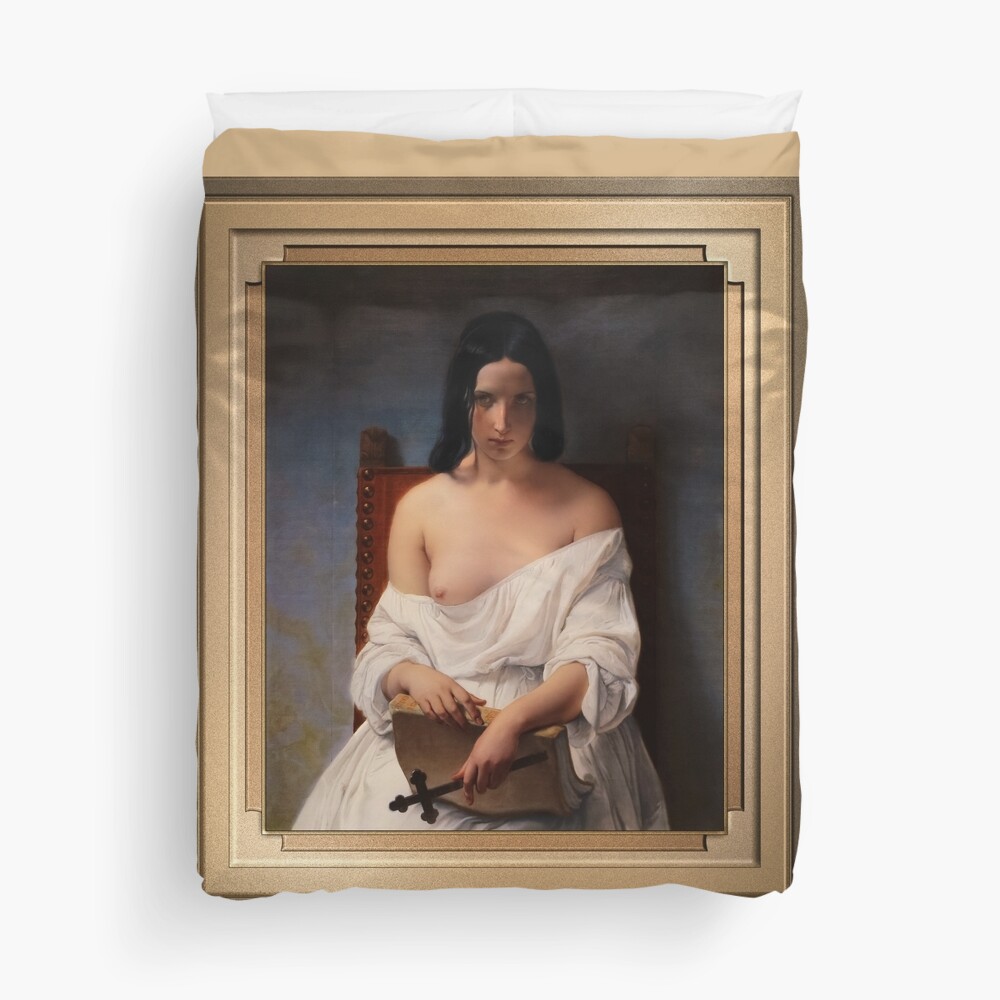
Francesco Hayez’s “Meditation on the History of Italy,'omheen geschilderd 1851, is a compelling work within the Romantic tradition, deeply rooted in Italian nationalism and historical allegory. Het schilderij, currently housed at the Pinacoteca di Brera in Milan, transcends a simple portrait to become a complex visual narrative reflecting the yearning for a unified and independent Italy during a period of political fragmentation and foreign domination. Hayez was a leading figure in the Risorgimento, the 19th-century movement that led to Italian unification, and his art frequently served as a vehicle for expressing patriotic sentiments.
Inhoudsopgave
Compositorische structuur & Instelling
The composition is dominated by a single female figure seated upon an ornate chair against a backdrop of muted blues and grays. The chair itself appears aged and slightly dilapidated, hinting at the decline of past glories. The background fades into obscurity, suggesting a timeless setting rather than a specific historical location. This ambiguity allows for broader interpretation, encompassing Italy’s long and turbulent history. The figure is centrally positioned, drawing immediate attention to her contemplative state. The overall effect is one of quiet introspection within a space that feels both intimate and monumental.
The Figure: Identity & Kleding
The woman depicted possesses striking features – dark hair cascading down her shoulders, pale skin, and intense, melancholic eyes. Her gaze is directed downwards, suggesting deep thought or sorrow. She is draped in a simple white gown, partially slipped from one shoulder, revealing the upper portion of her chest. The fabric appears soft and flowing, adding to the sense of vulnerability and grace. The lack of elaborate ornamentation on her attire contrasts with the ornate chair, further emphasizing her individual presence and internal focus. Her bare feet rest upon the floor, grounding her in a tangible reality despite the allegorical nature of the scene.
The Book & Cross: Symbolic Elements
Held within her hands is an open book, its pages filled with text that remains largely illegible to the viewer. This book clearly represents Italian history and literature – the accumulated knowledge and cultural heritage of the nation. Lying across the book’s cover is a large, dark cross. The presence of the cross introduces a layer of religious significance, referencing Italy’s strong Catholic tradition and potentially alluding to the role of faith in shaping national identity. Echter, its placement atop the historical record suggests a complex relationship between religion and Italian history – perhaps a commentary on how faith has both supported and sometimes hindered the nation’s progress.
Verlichting & Kleurenpalet
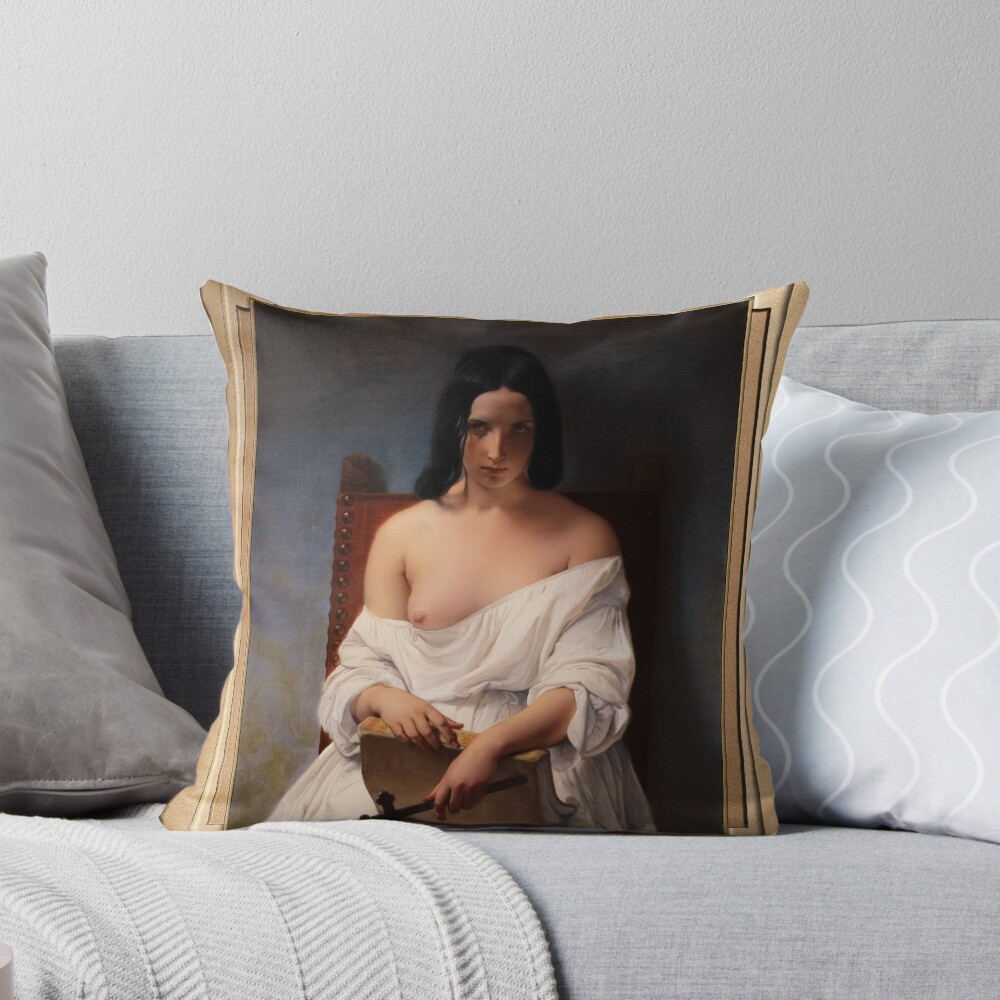
The lighting in “Meditation on the History of Italy” is carefully orchestrated to enhance the painting’s emotional impact. Een zachte, diffused light illuminates the woman from above, highlighting her face and upper body while leaving much of the background shrouded in shadow. This creates a sense of mystery and emphasizes the figure’s isolation within her thoughts. The color palette is restrained, dominated by muted tones of white, gray, blauw, en bruin. These colors contribute to the painting’s somber mood and reinforce the themes of reflection and melancholy. The limited use of vibrant hues draws attention to specific details, such as the dark cross and the woman’s eyes.
Artistieke stijl & Invloeden
Hayez’s style is characteristic of Italian Romanticism, emphasizing emotion, individualism, and a fascination with history and mythology. The painting exhibits meticulous detail in rendering the figure’s features and clothing, demonstrating Hayez’s technical skill as an artist. There are echoes of Neoclassical influences in the composition’s balance and clarity, but the overall tone is decidedly Romantic, prioritizing emotional expression over strict adherence to classical ideals. The work shares affinities with other allegorical paintings of the period, particularly those exploring themes of national identity and historical memory.
Historische context & Interpretatie
Painted during a time when Italy was divided into numerous states under foreign rule or dominated by regional powers, “Meditation on the History of Italy” served as a powerful symbol of hope for unification. The woman’s contemplative pose and sorrowful expression can be interpreted as representing the Italian people reflecting upon their past struggles and yearning for a brighter future. The book symbolizes the nation’s rich cultural heritage, while the cross suggests the enduring influence of religion in Italian life. Hayez deliberately avoided explicitly depicting specific historical events or figures, allowing viewers to project their own interpretations onto the painting and connect with its broader themes of national identity and aspiration.
Bio van kunstenaar afgeleid van Wikipedia.org
Francesco Hayez kwam uit een relatief arm gezin uit Venetië. Zijn vader, Giovanni, was van Franse afkomst terwijl zijn moeder, Chiara Torcella, kwam uit Murano. Francesco was de jongste van vijf zonen.
Hij werd opgevoed door de zus van zijn moeder, die was getrouwd met Giovanni Binasco, een welgestelde reder en kunstverzamelaar. Hayez vertoonde van kinds af aan aanleg voor tekenen. Zijn oom, zijn vroegrijp talent hebben opgemerkt, hem in de leer bij een kunstrestaurator in Venetië. Hayez zou later een leerling worden van de schilder Francesco Maggiotto bij wie hij zijn studie drie jaar voortzette.
Hij werd toegelaten tot de schildercursus van de Nieuwe Academie voor Schone Kunsten in Venetië in 1806, waar hij studeerde onder Teodoro Matteini. In 1809 hij won een wedstrijd van de Academie van Venetië voor een verblijf van een jaar aan de Accademia di San Luca in Rome.
Hij bleef in Rome tot... 1814, verhuisde vervolgens naar Napels, waar hij van Joachim Murat de opdracht kreeg om een groot werk te schilderen met de afbeelding van Ulysses aan het hof van Alcinous. In het midden van de jaren 1830 bezocht hij de Maffei Salon in Milaan, gehost door Clara Maffei. Maffei's man zou Hayez later een portret van zijn vrouw laten maken. In 1850 Hayez werd benoemd tot directeur van de Brera Academy.
In de loop van een lange carrière, Hayez bleek bijzonder productief te zijn. Zijn output omvatte historische schilderijen die waren ontworpen om een beroep te doen op de patriottische gevoeligheid van zijn opdrachtgevers, evenals werken die de wens weerspiegelen om een neoklassieke stijl te begeleiden bij grote thema's, hetzij uit bijbelse of klassieke literatuur.
Hij schilderde ook scènes uit theatervoorstellingen. Opvallend afwezig in zijn oeuvre, echter, zijn altaarstukken – mogelijk als gevolg van de Napoleontische invasies die veel kerken en kloosters in Noord-Italië hebben ontwijd. Kunsthistoricus Corrado Ricci beschreef Hayez als een classicus die vervolgens evolueerde naar een stijl van emotioneel tumult. Francesco Hayez, De kus (1859)
Zijn portretten hebben de intensiteit van Ingres en de Nazarener-beweging. Vaak zittend, De onderwerpen van Hayez zijn vaak sober gekleed, zwarte en witte kleding, met weinig tot geen uitrusting. Terwijl Hayez portretten maakte voor de adel, hij verkende ook andere onderwerpen zoals collega-artiesten en muzikanten. Laat in zijn carrière, het is bekend dat hij met foto's heeft gewerkt.
Een van de favoriete thema's van Hayez was de halfgeklede Odalisque, die doet denken aan oosterse thema's - een favoriet onderwerp van romantische schilders.[3] De afbeeldingen van harems en hun vrouwen gaven kunstenaars de mogelijkheid om scènes te schilderen die anders niet acceptabel waren in de samenleving. Zelfs Mary Magdalene van Hayez heeft meer sensualiteit dan religieuze ijver.
Het schilderij van Hayez De kus werd door zijn tijdgenoten als een van zijn beste werken beschouwd, en is misschien wel zijn meest bekende poging. de anonieme, onaangetast gebaar van het paar vereist geen kennis van mythe of literatuur om te interpreteren, en appelleert aan een moderne blik.
Een wetenschappelijke beoordeling van de carrière van Hayez is bemoeilijkt door zijn neiging om zijn werken niet te signeren of te dateren. Vaak geven data in zijn schilderijen aan wanneer het werk is aangekocht of verkocht, niet de tijd van zijn schepping. Bovendien, hij schilderde vaak dezelfde composities meerdere keren met minimale variaties of helemaal niet.
Onder zijn leerlingen van de Brera Academy waren Carlo Belgioioso, Amanzio Cattaneo, Alessandro Focosi, Giovanni Battista Lamperti, Livo Schaap, Angelo Pietrasanta, Antonio Silo, Carlo Antonio Tavella, Ismaele Teglio Milla en Francesco Valaperta.
Hayez stierf in Milaan, leeftijd 91. Zijn atelier aan de Brera Academy is gemarkeerd met een bord.
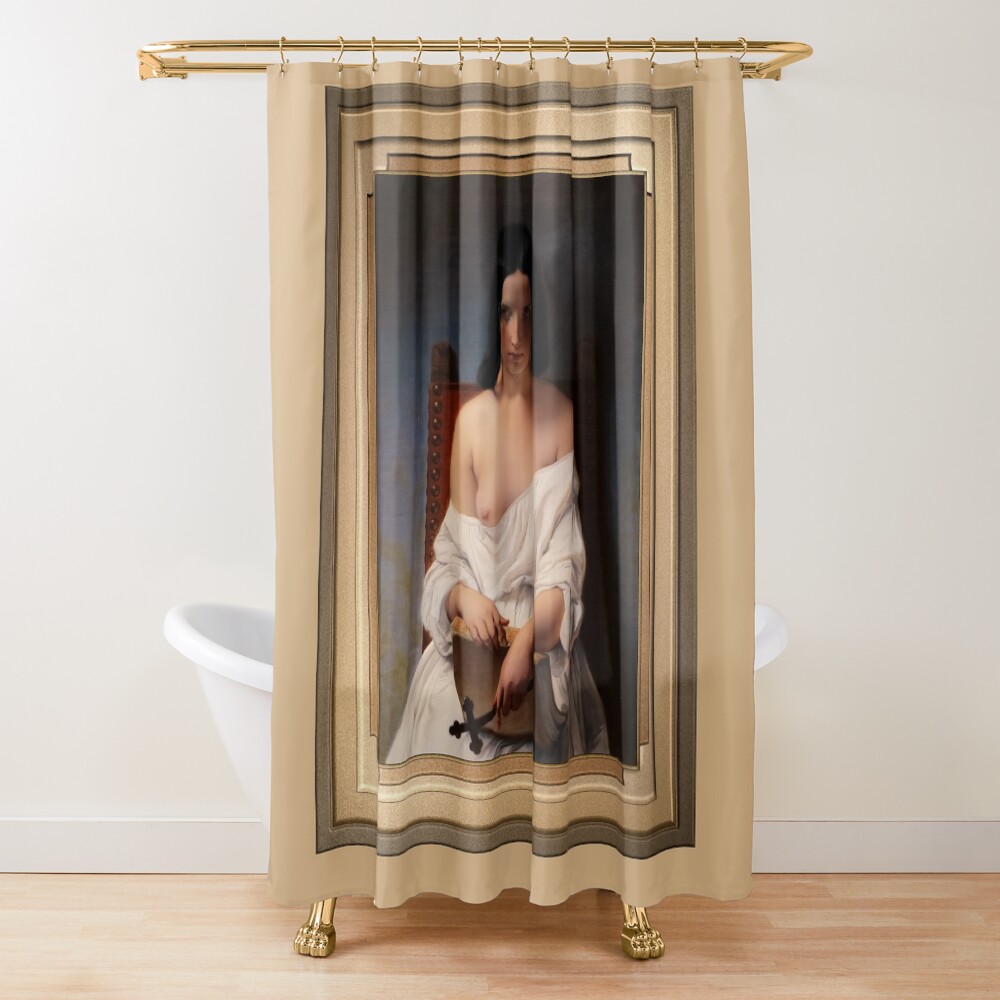
Dit is een retoucheerde reproductie van digitale kunst oude meesters van een openbaar domeinafbeelding die voor aankoop online beschikbaar is als a opgerold canvas afdrukken.