

Der Buchstabe
Der Brief des französischen Malers Gabriel Ferrier (1847-1914); ein Orientalist und Porträtmaler
Das Kunstwerk, titled The Letter, presents a serene and captivating scene, evoking a sense of classical romance and elegance. The image features a young woman deeply immersed in thought as she gently holds a quill, poised over parchment. The setting seems timeless, with a soft yet richly atmospheric background that enhances the quiet, reflective nature of the scene. A delicate angel, with wings unfurled, hovers over her shoulder, offering an almost ethereal touch to the composition.
The woman is the central subject of the artwork. She is depicted with a fair, porcelain complexion and soft, auburn hair that cascades loosely in gentle waves, framing her face. Her eyes are the focal point of the piece, with an expression that combines contemplation and wistfulness, suggesting that she is either lost in a moment of personal reflection or on the verge of writing something deeply emotional.
She sits in a relaxed, yet poised manner, dressed in flowing, translucent green fabric that drapes elegantly over her shoulders and down her arms. The fabric’s soft folds and subtle highlights demonstrate the artist’s mastery of capturing delicate textures and light.
Her hand, held delicately in front of her face, supports her chin, while the other holds a quill, pointing to the paper in front of her. The paper is covered with faint traces of ink, possibly hinting at the beginnings of a letter or a poetic message, adding to the intimate, almost secretive nature of the scene. Die Einstellung, while softly blurred, hints at an indoor environment, likely a study or drawing room, characterized by a dark, warm-toned backdrop. The light is gentle, illuminating the woman’s face and the details of the soft, floral bouquet resting on the table.
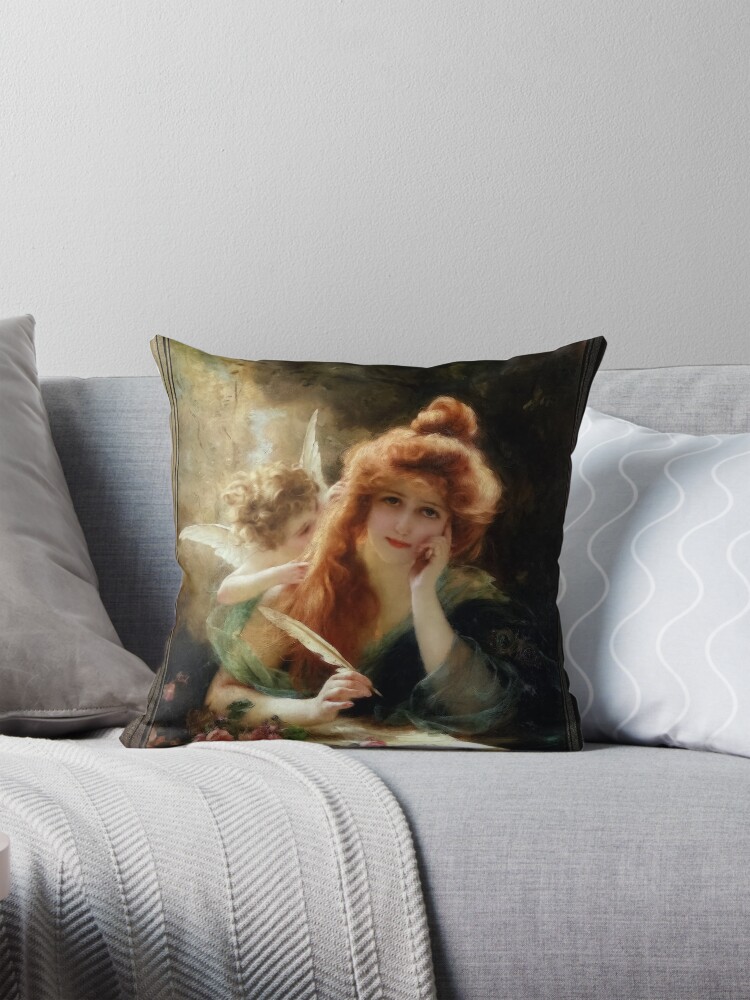
Neben ihr, a soft pink and white bouquet of roses can be seen resting on the surface of the table. Die Rosen, painted with care, convey a sense of romance and timeless beauty, further enhancing the emotional tone of the piece. The soft interplay of colors, from the muted green of her attire to the subtle shades of pink in the roses, evokes a sense of calmness and grace. The color palette overall remains delicate, with a harmonious mix of soft pastel hues and deep shadows.
In the upper-left corner, an angel-like figure appears, floating gently behind the woman. The angel’s wings, depicted with delicate brushstrokes, are soft and almost translucent. The figure’s youthful form, with an innocent and almost mischievous expression, adds a layer of mystical charm to the composition. The angel appears to be whispering or playing a role of guidance, which infuses the scene with a sense of divine intervention or inspiration.
The mood of the painting is soft, introspective, and infused with a sense of romanticism. It evokes a timeless moment of quiet solitude, where the viewer feels drawn into the emotional world of the subject. The artist has carefully created a sense of privacy and intimacy, inviting the viewer to imagine what the woman might be writing or contemplating, and the angel’s presence lends an air of spiritual guidance, suggesting that her words are significant, perhaps the beginnings of a love letter, a poem, or a missive imbued with personal sentiment.
The theme of communication, whether through written word or quiet reflection, is central to the narrative, reinforced by the presence of the writing tools, the paper, and the serene ambiance.
The use of light is particularly noteworthy. The artist employs a gentle, diffused light that bathes the figures in soft radiance, eine fast traumhafte Atmosphäre schaffen. The light seems to emanate from a source off-screen, casting a glow that highlights the woman’s face and shoulders, while the shadows around her deepen, focusing attention on her thoughtful expression and the delicate motions of the angel. The play of light and shadow enhances the emotional depth of the artwork, giving it a timeless, almost otherworldly quality.
The style of the painting leans toward the late 19th century Romanticism, with soft brushstrokes, a focus on emotional expression, and an ethereal, almost mystical theme. The soft focus and blurred background reflect the technique of soft-focus realism, a method commonly used by artists of this period to capture the idealized beauty of the subject without sharp, distracting details. The use of color also follows the romantic tradition, mit weich, muted tones creating a serene atmosphere, while still allowing for deep shadows to evoke mystery and introspection.
In Bezug auf Materialien, the artist’s medium appears to be oil on canvas, with a richly layered application of paint. The texture of the brushstrokes is visible, especially in the portrayal of the angel’s wings and the woman’s clothing, where the artist has applied the paint in a loose, fluid manner to create a sense of movement and softness. The contrast between the soft textures of the figures and the still life elements, such as the roses and parchment, adds a tactile quality to the artwork, inviting the viewer to feel as though they could reach out and touch the surface of the canvas.
Gesamt, The Letter captures a moment of profound introspection and spiritual connection, framed within a richly romantic narrative. The harmonious use of color, Licht, and form creates a captivating, timeless image that speaks to the viewer on an emotional and intellectual level. The presence of the angel offers an element of divine inspiration, while the quiet contemplation of the young woman draws the viewer into a narrative that is both personal and universal.
Der Brief ist eine retuschierte digitale Kunstreproduktion alter Meister eines gemeinfreien Bildes, das als verfügbar ist gerollter Druck online.
Info unten abgeleitet von Wikipedia.org
Gabriel begann sein Kunststudium an der École des Beaux-Arts, wo er mit dem französischen akademischen Maler Ernest Hébert . zusammenarbeitete (1817 – 1908) und Isidore Pils (1815 – 1875); er studierte auch an der Französischen Akademie in Rom von 1873 zu 1876.
Seine erste Ausstellung war im Salon in 1869; und zwei Jahre später, als er in Rom war, er erhielt den Prix de Rome für seine Darstellung einer Szene aus der Flut.
Als er nach Frankreich zurückkehrte, er begann sich auf die Erstellung von Porträts bemerkenswerter Persönlichkeiten zu spezialisieren, die mit der Dritten Französischen Republik in Verbindung standen.
Im 1883, er unternahm eine ausgedehnte Reise nach Algerien, wo er Werke im orientalistischen Stil schuf; mit einigen dieser Arbeiten erhielt er eine Goldmedaille bei der Exposition Universelle in 1889.
Gabriel wurde später zum Professor für Design am House of Education der Ehrenlegion ernannt, und dann wurde er Dozent an der École des Beaux-arts, Nachfolger des französischen akademischen Malers Jean-Léon Gérôme (1824 – 1904).
Er war auch Dozent an der Académie Julian; und in 1906, er wurde in die Académie des Beaux-Arts gewählt. Er war auch Mitglied der Société des Artistes Français, und in 1911, wurde Ritter in der Légion d’honneur.
Zu den bekanntesten Studenten von Gabriel Ferrier zählen Paul-Émile Bécat (1885 – 1960), Roger bissiere (1886 – 1964), André Fau (1896 – 1982), Luis Ricardo Falero (1851 – 1896) und Albert Lynch (1860 – 1950); einige ihrer Werke sind auch auf dieser Seite zu finden.