

Mischief and Repose c1895
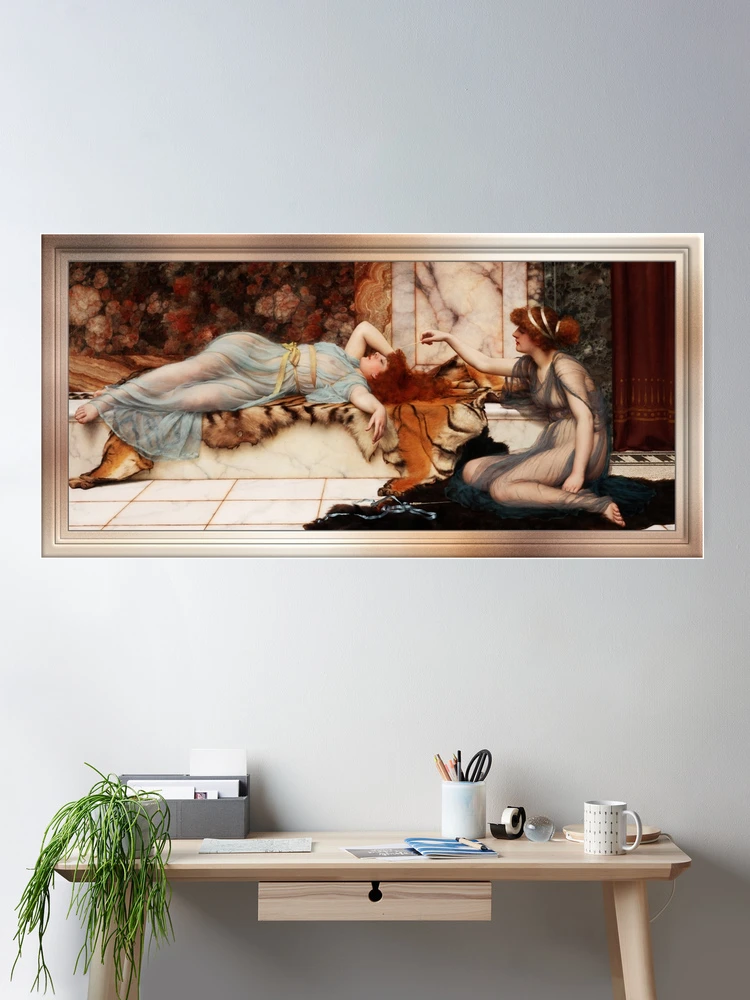
John William Godward’s painting, Mischief and Repose c1895, captures the essence of his signature classical style, offering a glimpse into a world of serene beauty and luxurious indulgence. verso Dio (1861 – 1922), is known for his exquisite depictions of classical figures and tranquil settings, influenced heavily by the neoclassical traditions. In questa opera d'arte, Godward combines two starkly contrasting elements: mischief and repose, embodied in the characters of two young women. Through his delicate portrayal of these figures and their environment, Godward delivers a narrative rich with emotional depth and historical reverence.
Sommario
The Main Subjects
At the center of the composition are two women, seemingly caught in a delicate moment of interaction. The reclining figure, dressed in a pale gown, lies languidly across a fur-covered divan. La sua postura, suggestive of repose, hints at an atmosphere of idle relaxation, with her head turned toward the other figure. The relaxed, almost languid pose of the first figure evokes a sense of indifference to the world around her, a luxury afforded only to those of wealth and status in the classical world.
In stark contrast, the second woman leans over her companion with a playful expression, gently touching her hair. This act of mischief is subtle, as she delicately twirls a strand of the reclining woman’s auburn hair around her finger. Her posture—sitting, yet leaning forward with a sense of intent—imbues the scene with a sense of energy and flirtation. Il sottile sorriso che gioca sulle sue labbra suggerisce un senso di giocoso dominio sull'altra figura, creando una dinamica tra le due donne.
The Objects and Terrain
L'ambiente lussuoso che circonda le figure amplifica ulteriormente il carattere aristocratico della scena. Le figure sono collocate all'interno di una stanza riccamente decorata progettata per trasudare opulenza. Il pavimento è in marmo lucido, con intricati motivi geometrici che aumentano il senso di profondità e grandiosità. Un grande, il tappeto di pelliccia poggia sul pavimento di marmo, fornendo uno spazio lussuoso per la figura sdraiata. La pelliccia, insieme ai tenui toni pastello del donnei suoi vestiti, aggiunge un ulteriore livello di ricchezza all'estetica generale.
Lo sfondo del dipinto è altrettanto impressionante, con uno sfondo lussureggiante, red marble walls that are swirled with white and gold veins. This intricate texture not only suggests wealth but also brings a sense of timelessness to the piece, reinforcing the classical theme that Godward often employed in his works. The use of marble, both on the floor and the walls, enhances the feeling of permanence and the eternal, as if these figures are timeless beings captured in a fleeting moment of mischief and repose.
Materiali e Tecnica
John William Godward’s technique in Mischief and Repose is meticulous and refined, demonstrating his exceptional skill in rendering textures and light. His use of oil paints allows for the rich depth of color that enhances the luxurious textures of the fur, marmo, and flowing garments. The women’s skin is rendered with a smoothness that suggests softness, almost ethereal in quality, while the texture of their gowns is meticulously depicted, flowing in soft, natural folds.
The background and foreground are equally well-executed, with Godward’s careful application of light and shadow creating a depth that allows the figures to stand out against the rich marble and fabric. The interplay between the light falling across the women’s faces and bodies highlights their delicate features, adding a sense of realism to the dreamlike setting. The smooth transitions of light between the figures and the environment further demonstrate Godward’s mastery of the medium.
Lo stile e l'atmosfera dell'opera d'arte
The style of Mischief and Repose firmly places it within the neoclassical tradition, with its reverence for classical forms, idealized figures, and an emphasis on harmony and beauty. L'attenzione di Godward ai dettagli e l'atmosfera serena che crea esemplificano gli ideali neoclassici di bellezza e perfezione. La composizione attentamente costruita, con la sua enfasi sui motivi geometrici nell’architettura e la levigatezza delle forme delle figure, invita lo spettatore in un mondo in cui il passato classico incontra il momento presente di indulgenza e lusso.
L'atmosfera del dipinto è serena ma carica di una sottile corrente sotterranea di tensione giocosa. La figura sdraiata trasuda tranquillità, forse rappresenta un momento di pace interiore o di introspezione. Al contrario, la figura protesa in avanti per arrotolare i capelli del suo compagno introduce un momento di civettuola malizia, rompendo la quiete della scena con un lieve gesto. This contrast between repose and mischief lends the painting an air of intrigue, where the viewer is left to wonder about the relationship between the two women and the story unfolding in the quiet space they inhabit.
Godward’s ability to capture the nuances of human interaction, paired with his impeccable technique, makes Mischief and Repose a prime example of the artist’s skill and the allure of the classical tradition. Through his portrayal of these two women, Godward brings to life a moment of contrast, where relaxation and playfulness coexist, offering a snapshot of a world filled with both tranquility and the promise of adventure.
Questa è una riproduzione ritoccata di arte digitale dei vecchi maestri di un'immagine di pubblico dominio.
Questa creazione di arte digitale, come tutte le opere d'arte che si possono trovare sul sito Web di Xzendor7 è disponibile per l'acquisto online in una varietà di formati di materiali, comprese le stampe su tela, stampe acriliche, stampe in metallo, stampe su legno, stampe incorniciate, manifesti, e come stampe su tela arrotolata in una varietà di formati da 12 pollici a 72 pollici a seconda delle dimensioni dell'opera d'arte effettiva e del negozio di stampa su richiesta da cui scegli di acquistare l'arte.
L'opera d'arte è disponibile anche su un'ampia gamma di abbigliamento da uomo e da donna, tazze, borse, sciarpe, quaderni e diari e tanti prodotti per l'arredamento della casa.
Biografia dell'artista
Informazioni sotto da Wikipedia.org
Era il maggiore di cinque figli, e prende il nome da suo padre John e dal nonno William. Fu battezzato a St. Mary's Church a Battersea su 17 ottobre 1861.
Godward era un neoclassico vittoriano, e quindi, in teoria, un seguace di Frederic Leighton. tuttavia, è più strettamente legato stilisticamente a Sir Lawrence Alma-Tadema, con il quale ha condiviso un debole per la resa dell'architettura classica – in particolare, elementi statici del paesaggio costruiti in marmo.