

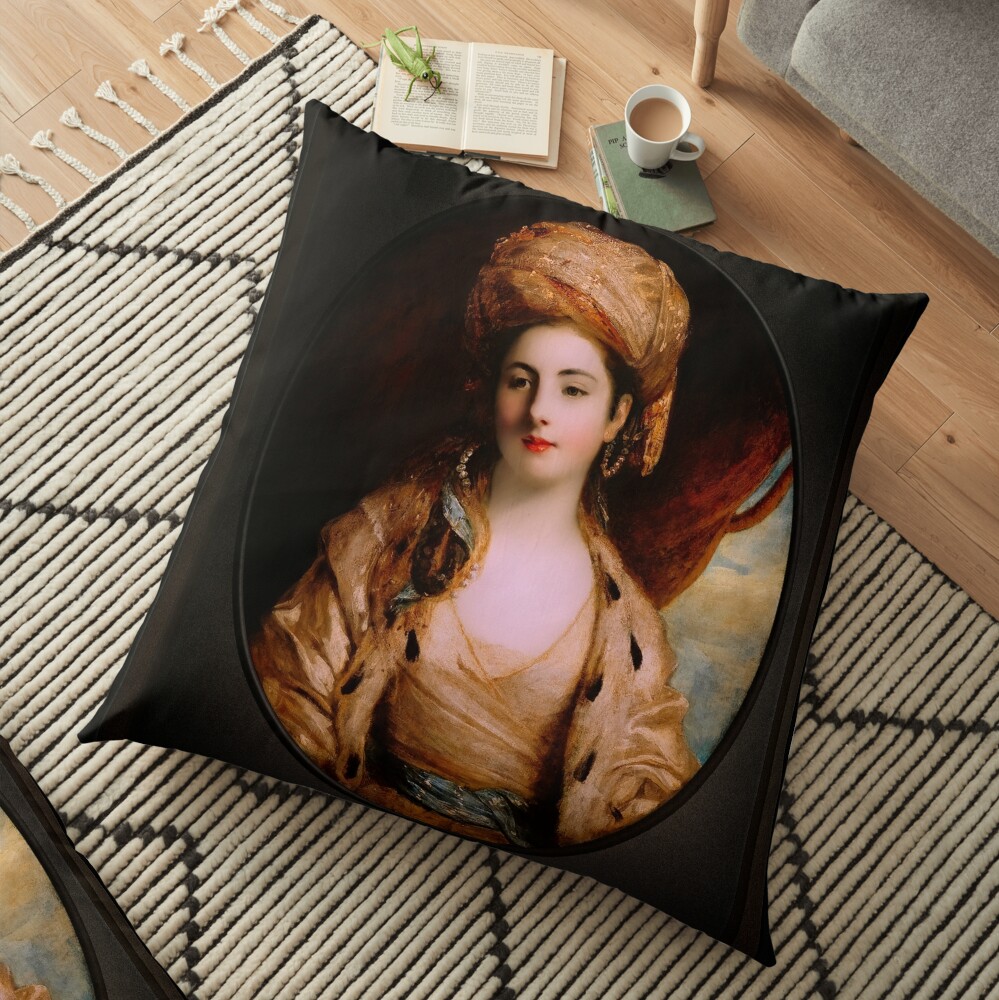
Mrs Richard Paul Jodrell (Vertue Jodrell) c1774-76
La pentraĵo titolita Mrs Richard Paul Jodrell (Vertue Jodrell), created between 1774 kaj 1776 by renowned British artist Sir Joshua Reynolds (1723 – 1792), is a fine example of portraiture from the Georgian era. The work beautifully captures the elegance and opulence of the period, offering a glimpse into the sophistication and style of late 18th-century British society. As was characteristic of Reynolds’ portraits, the depiction combines technical mastery with an emphasis on the sitter’s personality, beleco, and social status. The subject of the painting, Mrs. Richard Paul Jodrell, is portrayed in the classical style of the time, dressed in a luxurious gown, with her posture and demeanor radiating an air of refinement.
The composition of the painting places Mrs. Jodrell ĉe la avangardo, kun simpla sed riĉa fono kiu servas por plibonigi ŝian ĉeeston. La uzo de la artisto de silentigita sed varma kolora paletro reflektas la mildan lumon kaj kreas aŭron de eleganteco.. La figuro estas delikate enkadrigita en rondeta ovala formo, arta aparato ofte uzita en portretado por emfazi la individuon kaj forigi la distraĵon de okupata fono. La bonaj detaloj de Mrs. La vesto kaj akcesoraĵoj de Jodrell montras la riĉecon kaj statuson de la vartistino, dum ŝia trankvila pozo kaj trankvila esprimo parolas pri ŝia rafinado kaj la gracio kiun Reynolds povas kapti en siaj subjektoj..
Enhavtabelo
Stilo kaj Tekniko
Sir Joshua Reynolds was a leading figure in British portraiture during the 18th century, and his work is often associated with the Rococo and early Neoclassical styles. His technical expertise is evident in this portrait, where the careful attention to detail and the rich textures of fabric, skin, and hair are remarkable. Reynolds was known for his use of broad, yet controlled brushstrokes, which can be seen in the way the fabric of Mrs. Jodrell’s gown flows across her body. The smoothness of the skin is masterfully rendered, with subtle highlights and shadows that give her face a lifelike glow.
The soft modeling of light on her face and gown enhances her beauty and grace, a hallmark of Reynolds’ technique. The rendering of her delicate features, her slightly turned head, her serene expression, and the gentle contours of her neck and shoulders, further exemplifies Reynolds’ ability to blend realism with idealization. La fono, rendered with soft, painterly strokes, emphasizes the subject without detracting from her importance. It is not an overtly detailed scene but rather a calming, harmonious backdrop that contrasts with Mrs. Jodrell’s rich attire and radiant skin.
Reynolds employed a method of creating texture that was very advanced for his time. The folds in the fabric of Mrs. Jodrell’s gown appear soft and luxurious, while the sheen on her silk shawl suggests its weight and tactile quality. The use of light and shadow gives volume to the materials, making them almost tangible. Ŝiaj haroj, styled in the fashionable high coiffure of the time, is both finely rendered and stylish, further demonstrating Reynolds’ mastery over different textures.
Temo kaj Humoro
The mood of this portrait is one of poised elegance and serene composure. Mrs. Jodrell is depicted as a woman of dignity and grace, her face reflecting a calm and confident demeanor. This was typical of the period’s portraiture, where subjects were often shown in a light that conveyed their higher social standing and respectable character. The calmness in her expression suggests a certain inner strength, as well as the social expectations placed on women of the time, especially those of the upper classes.
The theme of the portrait is one of refinement and status, not only in Mrs. Jodrell’s appearance but also in her surroundings. The rich materials of her gown, her fine jewelry, and the overall elegance of her attire suggest that she was a woman of means, likely from a prominent family in Georgian Britain. The softness of the lighting and the minimalistic background emphasize her figure, making her the undeniable focus of the painting. There is a sense of formality in the composition, suggesting that the portrait was commissioned to showcase her elegance and social prominence, as well as her connection to the artistic and intellectual circles of the time.
The oval framing of the portrait adds to this sense of timelessness, making it seem as though Mrs. Jodrell’s grace and poise are eternal qualities. The use of an oval frame was a common device in Reynolds’ portraits, serving to give the subject an almost saintly, immortal quality. The lack of a highly detailed background further isolates her from the surrounding world, directing the viewer’s attention entirely on her.
La Signifo de la Portreto
The portrait of Mrs. Richard Paul Jodrell (Vertue Jodrell) is significant not only as a work of art but also as a representation of the role and image of women in 18th-century British society. It offers a glimpse into the fashion, beleco, and social mores of the Georgian period, providing a historical record of the attire, posture, and composure expected of women in the upper echelons of society.
For Reynolds, this portrait reflects his ability to transcend the simple act of depicting a person and instead craft an image of lasting elegance. He was able to capture the essence of his subjects, making each portrait an exploration of their character, personality, and social position. In this particular portrait, Mrs. Jodrell’s beauty and wealth are undeniable, but there is also a deeper sense of humanity and grace that resonates through Reynolds’ masterful rendering.
As one of Reynolds’ key contributions to British portraiture, this work remains an iconic example of 18th-century portrait art, a testament to his skill and his understanding of both his subjects and the world around him. It continues to captivate audiences with its timeless elegance and the sophistication of the period it represents.
Ĉi tio estas retuŝita cifereca arto malnova majstra reproduktaĵo de publika domajna bildo aĉetebla interrete kiel a tolo presaĵo.
Artisto Bio Derived Vikipedio.org
Sinjoro Joshua Reynolds PRA FRS FRSA (16 julio 1723 – 23 februaro 1792) estis angla pentristo, specialiĝanta pri portretoj. John Russell diris ke li estis unu el la plej gravaj eŭropaj farbistoj de la 18-a jarcento.[1] Li promociis la “Granda Stilo” en pentrado kiu dependis de idealigo de la imperfekto. Li estis fondinto kaj unua prezidanto de la Royal Academy of Arts (Reĝa Akademio de Arto)., kaj estis nobeligita fare de George III en 1769.
Reynolds estis naskita en Plympton, Devon, on 16 julio 1723[2] la tria filo de la Rev. Samuel Reynolds, majstro de la Plympton Free Grammar School en la urbo. Lia patro estis ulo de Balliol College, Oksfordo, sed neniun el siaj filoj sendis al la universitato.[3] Unu el liaj fratinoj estis Mary Palmer (1716–1794), sep jarojn lia pli aĝa, verkinto de Devonshire Dialogue, kies ŝato al desegnado laŭdire havis multe da influo sur li kiam estis knabo.
En 1740 ŝi disponigis 60 £, duono de la premio pagita al Thomas Hudson la portretisto, por la pupilo de Josuo, kaj naŭ jarojn poste avancis monon por siaj elspezoj en Italio. Liaj aliaj gefratoj inkludis Frances Reynolds kaj Elizabeth Johnson.
Kiel knabo, li venis sub la influon de Zachariah Mudge, kies platona filozofio restis ĉe li dum lia tuta vivo. Reynolds faris eltiraĵojn en sia ordinara libro de Teofrasto, Plutarko, Seneko, Marcus Antonius, Ovidio, William Shakespeare, John Milton, Aleksandro Papo, John Dryden, Jozefo Addison, Richard Steele, Aphra Behn, kaj trairejoj pri artteorio de Leonardo da Vinci, Charles Alphonse Du Fresnoy, kaj André Félibien.
La laboro kiu havis la plej influan efikon al Reynolds estis An Essay on the Theory of Painting de Jonathan Richardson. (1715). Reynolds’ komentita kopio estis perdita dum preskaŭ ducent jaroj ĝis ĝi aperis en Kembriĝa libroservo, surskribita kun la subskribo ‘J. Reynolds Pictor', kaj nun estas en la kolekto de la Reĝa Akademio de Arto, Londono.