

Musidora
Musidora c1825 by American Painter Asher Brown Durand (1796 – 1886); who was part of the Romanticism Art Movement and was a graduate of the Hudson River School. Asher syn haadfokus wie op lânskipsskilderijen.
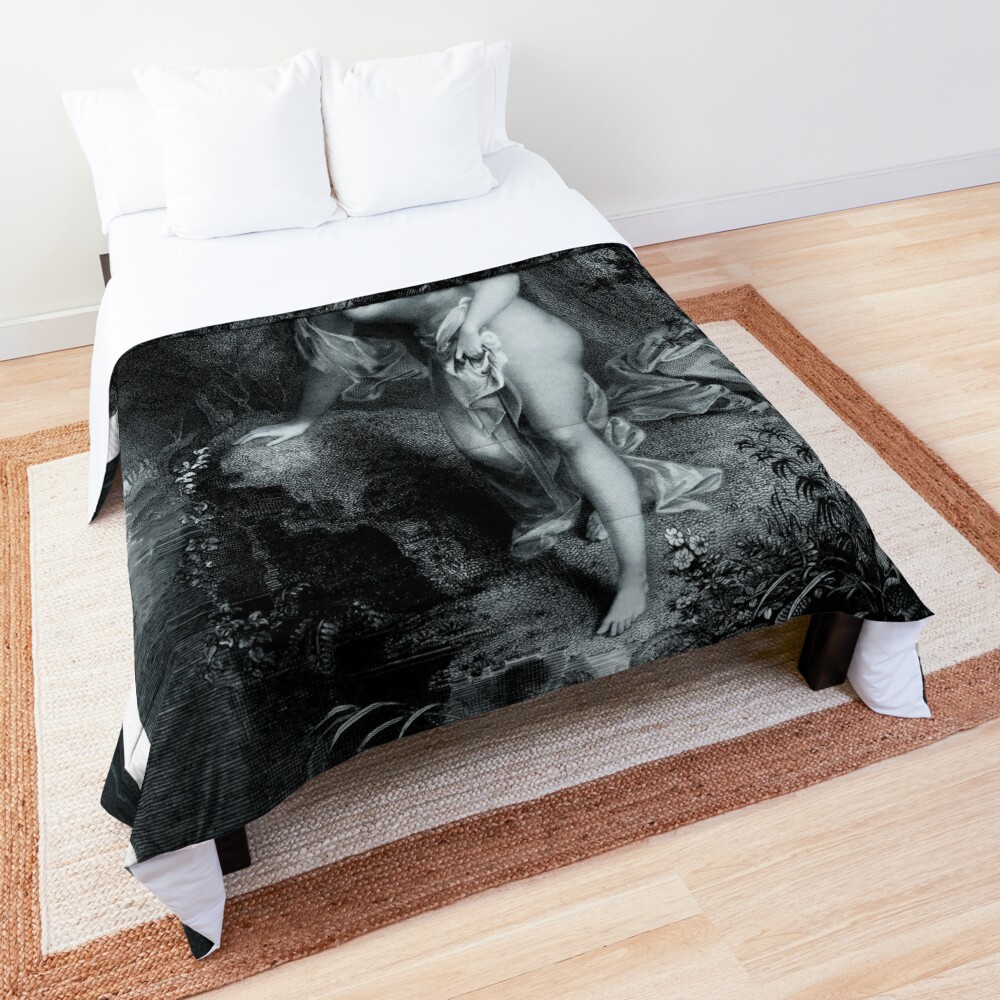
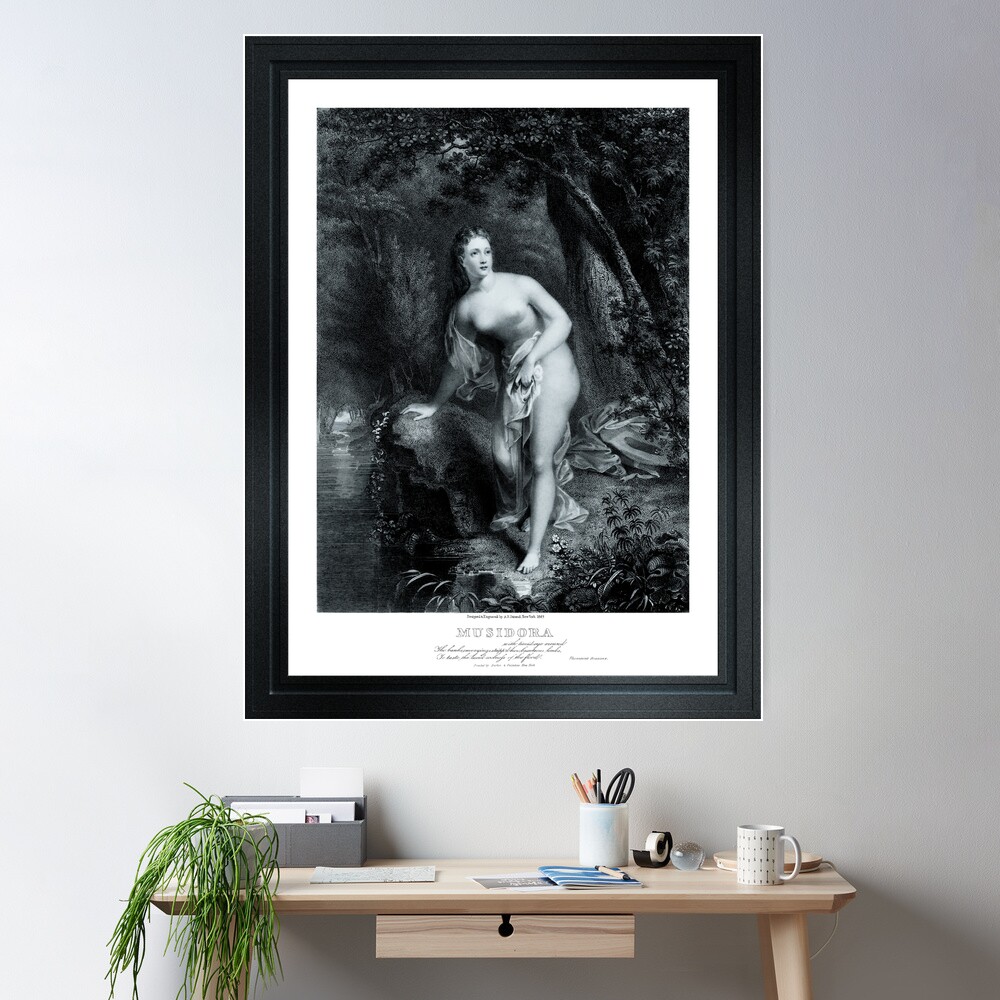
Dit is in beautiful nude portrait engraving of a young woman in a lush forest that has removed all of her outer garments, which included her hat, scarf, and dress.
She is partially covered by sheer garment that is falling off her right shoulder and that is covering the front of her waist and right leg as it falls to the floor; and that she is holding in place on the front of her waist with her left hand.
She has laid her cloths at the base of a tree that is not to far behind her as she looks off into the distant sky that is illuminating her, as she is positioned slightly turned to her left; while she leans on a medium sized boulder with the palm of her right hand that is by an embankment of a large pond.
By the embankment are an assortment of flowers and plants, as well as smaller trees; and in the distance is a dense concentration of tress, and water flowing to an arched opening in the trees where we can see light illuminating the area.
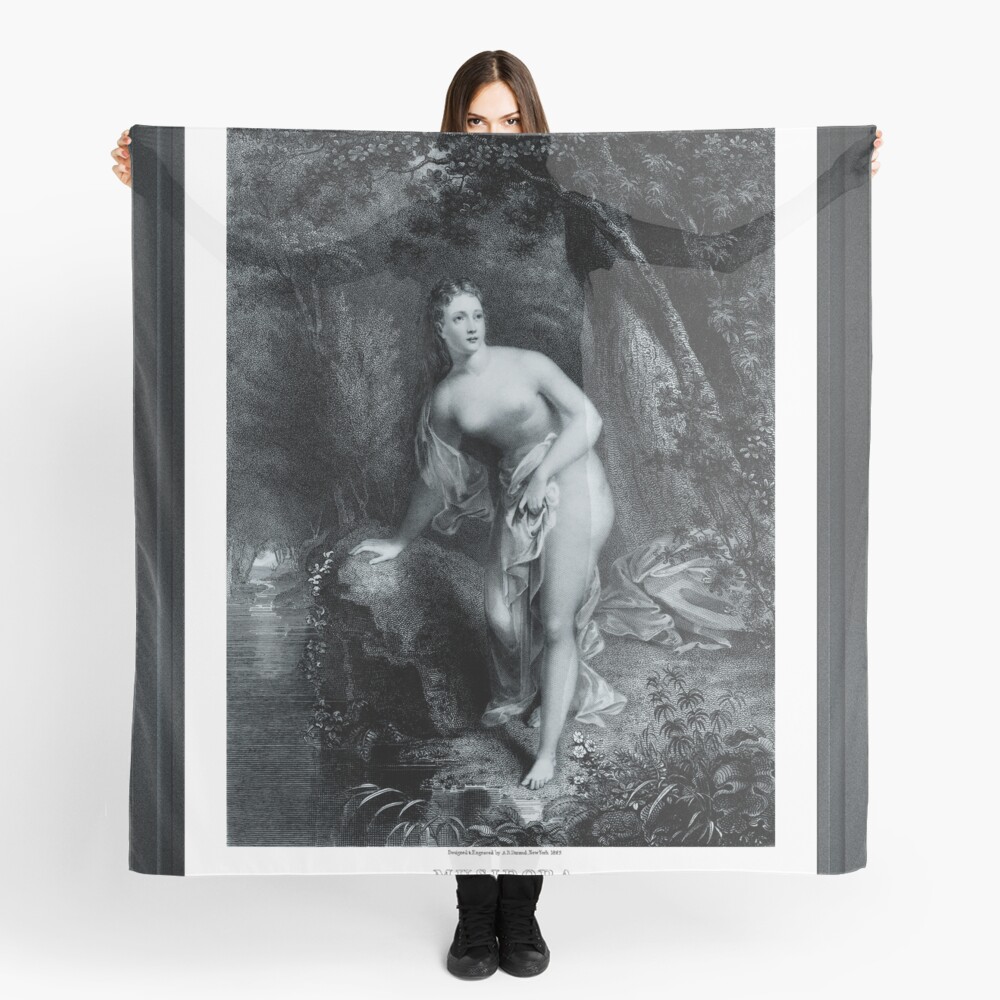
Musidora troch Asher B. Durand is a remastered digital art old masters reproduction of a public domain image that is available for purchase online as a opgerold canvas art print.
Info hjirûnder Fan Wikipedia.org
Durand was born in and died in Maplewood, New Jersey (doe neamd Jefferson Village). Hy wie de achtste fan alve bern, and his father was a watchmaker and a silversmith.
Durand waard learling oan in graveur út 1812 nei 1817 en letter in gearwurkingsferbân oangien mei de eigner fan it bedriuw, Charles Cushing Wright (1796 – 1854), dy't him frege om it kantoar fan it bedriuw yn New York te behearjen.
He engraved the Declaration of Independence for John Trumbull during 1823, dy't Durand syn reputaasje fêstige as ien fan 'e moaiste graveurs fan it lân.
Durand holp by it organisearjen fan de New York Drawing Association tidens 1825, dy't de National Academy of Design wurde soe; hy soe tsjinje de organisaasje as foarsitter fan 1845 nei 1861.
Asher syn gravueres op bankbiljetten waarden brûkt as de portretten foar Amearika syn earste postsegels, de 1847 searje. Tegearre mei syn broer Cyrus gravearre er ek guon fan 'e opfolgjende 1851 saken.
Syn wichtichste belangstelling feroare fan gravuere nei oaljeferve oer 1830 mei de oanmoediging fan syn beskermhear, Luman Reed. Tidens 1837, hy begeliede syn freon Thomas Cole op in sketsekspedysje nei it Schroon Lake yn 'e Adirondacks Mountains en koart nei't er him begûn te konsintrearjen op lânskipsskilderij.
Hy brocht simmers sketsen yn 'e Catskills, Adirondacks, en de Wite Bergen fan Nij-Hampshire, it meitsjen fan hûnderten tekeningen en oaljesketsen dy't letter waarden ferwurke yn ôfmakke akademystikken dy't holpen om de Hudson River School te definiearjen.
Durand is remembered particularly for his detailed portrayals of trees, rotsen, and foliage. He was an advocate for drawing directly from nature with as much realism as possible. Durand wrote, “Let [the artist] scrupulously accept whatever [natuer] presents him until he shall, in a degree, have become intimate with her infinity…never let him profane her sacredness by a willful departure from truth.”
Like other Hudson River School artists, Durand also believed that nature was an ineffable manifestation of God. He expressed this sentiment and his general opinions on art in his essay “Letters on Landscape Painting” in The Crayon, a mid-19th century New York art periodical. Wrote Durand, “[T]he true province of Landscape Art is the representation of the work of God in the visible creation…”
Durand is noted for his 1849 skilderjen Kindred Spirits dy't kollega Hudson River School-keunstner Thomas Cole en dichter William Cullen Bryant toant yn in lânskip fan Catskills Mountains. Dit waard skildere as earbetoan oan Cole by Cole syn dea tidens 1848, en as in kado oan Bryant.