

No Walk Today
No Walk Today von der in Frankreich geborenen britischen Malerin Sophie Gengembre Anderson (1823 – 1903); die sich auf neoklassische und italienische Genremalerei von Frauen und Kindern spezialisiert haben, im Allgemeinen in ländlichen Umgebungen.
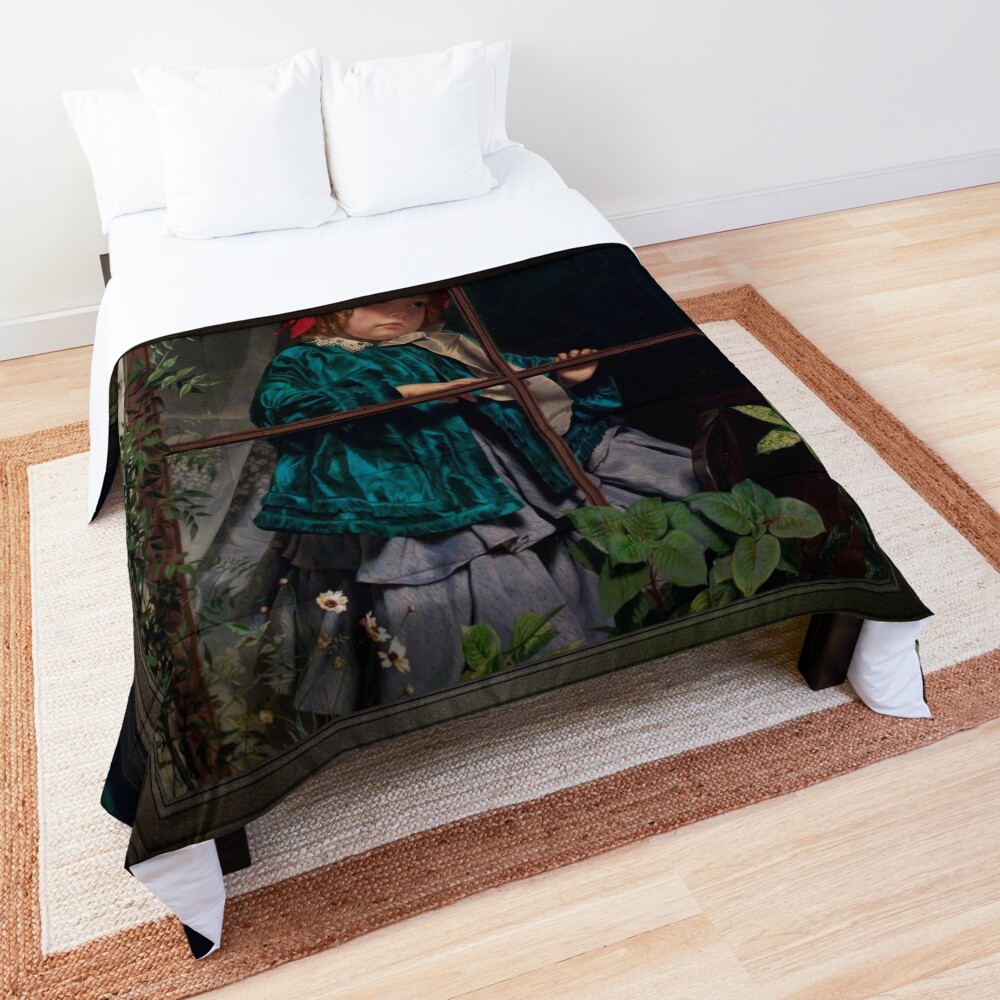
No Walk Today is a Porträt piece that shows a little girl looking sadly out the window of her home as it begins rains outside, da sie nicht nach draußen gehen kann.
No Walk Today is a retouched digital art old masters reproduction of a public domain image that is available as a gerollter Druck online.
Info unten von Wikipedia.org
Gengembre Anderson was a French-born British artist who specialized in genre painting of children and women, typically in rural settings. She began her career as a lithographer and painter of portraits, collaborating with Walter Anderson on portraits of American Episcopal bishops. Her work, Elaine, was the first public collection purchase of a woman artist. Her painting No Walk Today was purchased for more than £1 million.
Sophie was born in Paris, the daughter of Charles Antoine Colomb Gengembre, a French architect and artist,[3] and his English wife, Marianne Farey (1799-1883), a daughter of John Farey Sr. (1766-1826) and his wife Sophia Hubert (1770-1830). They married at St Pancras Church, London, an 12 April 1818 [4] Her father was born in 1790 and began working as an architect at age 19.

He worked primarily in municipal commissions, like the Mint of the City of Cassel, which he designed and built when he was 19. He was injured during the Revolution of 1830 on the same day that his son Philip was born.
The family then went to London, where Gengembre worked as an architect for Charles Fourier. He returned to France and continued his work as an architect, designing communal schools around France.
The family moved to America and adopted the surname Hubert, because of difficulties in people pronouncing their french surname.
After moving to Cincinnati, Ohio, he settled in Manchester, Pennsylvania, und von 1863 had designed pro bono the Allegheny City Hall. He stopped speaking English in protest after he was offered a share of the graft of over-inflated construction costs.
They lived in Paris during the early years of Sophie’s life, where her father was acquainted with artists, intellectuals, and actors, like François Joseph Talma. Circumstances required that the family leave Paris and live in a “remote area in France” aus 1829 zu 1843. At seventeen she developed an interest in art when a travelling portrait painter visited her town.
She had two brothers, Philip and Henry P. Gengembre. Her brother Philip changed his name to Philip Hubert, using his grandmother’s maiden name, and was a successful architect in New York City.
She was largely self-taught in art, but briefly studied portrait painting with Charles de Steuben in about 1843, when she lived with family friends in Paris. Soon after she began her studies, he left for Russia and did not return within the one year allotted for her studies. She did develop relationships with other women artists at the school where she gained a little more instruction.