

Nu Aux Roses
Delphin Enjolras’ masterpiece Nu Aux Roses (The Nude with Roses), created in 1907, stands as a beautiful representation of French academic painting during the late 19th and early 20th centuries. Enjolras, a renowned artist known for his delicate treatment of the human form and his skillful manipulation of light and texture, brings forward an intimate and sensual portrayal of the female nude.
Born in 1857 and passing in 1945, Enjolras’ career spanned a period in which the classical tradition of painting was increasingly challenged by the burgeoning modernist movements. However, works like Nu Aux Roses showcase his unyielding commitment to classical techniques, infused with a romantic sensuality that marked the mood of his era.
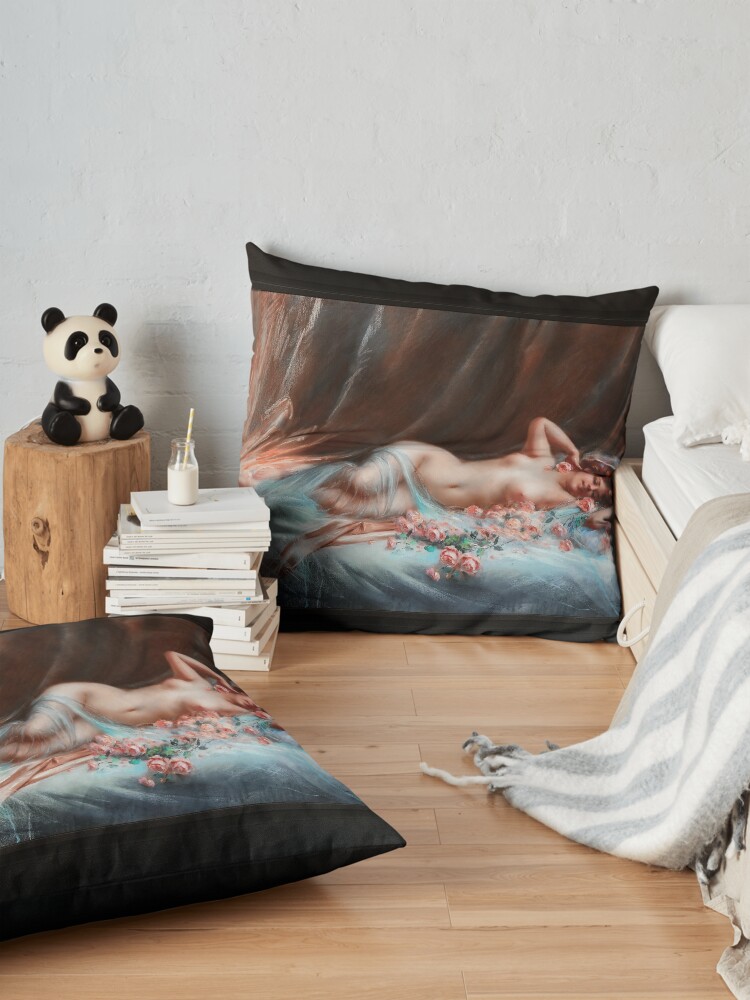
Table of Contents
The Subject and Composition
The main subject of Nu Aux Roses is a reclining female figure, rendered in soft, flowing lines that emphasize the graceful curves of her body. Her nude form lies serenely across a soft, luxurious background, bathed in the gentle light of an indistinct, almost ethereal setting. The model’s posture suggests a languorous, contemplative state, as her eyes are gently closed, her head turned slightly to the side in repose. Her expression is serene, almost dreamlike, allowing the viewer to imagine her thoughts as she drifts into a peaceful slumber. The artist has captured her in an unguarded moment, inviting the viewer to reflect on the beauty and vulnerability of the human form.
The figure is delicately surrounded by a scattering of roses, which lie softly on the surface where she reclines. The roses add a layer of texture and color to the painting, their soft pinks and whites juxtaposed against the pale tones of her skin, creating a harmonious balance between the floral elements and the nude.
The soft petals of the flowers seem to mirror the smooth contours of her body, further enhancing the painting’s romantic and sensual atmosphere. The flowers, while clearly a symbolic element of feminine beauty, do not overpower the subject but instead complement it, adding depth and interest without detracting from the central figure.
The Setting and Materials
The setting of Nu Aux Roses is minimalist, with the focus squarely on the figure and the flowers that surround her. The artist has chosen a simple backdrop of soft, swirling drapery, which serves to frame the subject while maintaining the piece’s overall softness. The warm, muted tones of the drapery, which fade seamlessly into the rest of the painting, create an inviting space for the nude figure to exist. There is no stark contrast between the figure and the surroundings; instead, the painting invites the viewer into a harmonious world of subtlety and elegance.
Enjolras uses oil paints with an evident mastery, allowing the textures of both the roses and the skin to emerge in soft, lifelike detail. The smooth, almost velvety texture of the skin contrasts with the delicate texture of the fabric and the petals of the roses, showcasing the artist’s ability to render a range of tactile sensations through his brushwork.
His careful use of light further enhances the sensuality of the scene, casting soft highlights and shadows across the body, creating depth and form. The lighting is gentle, flattering, and almost glowing, lending the entire scene an air of dreamlike quality. This use of light and shadow also highlights the artist’s exceptional understanding of human anatomy, giving the figure a realistic, three-dimensional presence while retaining an ethereal quality that elevates the piece beyond simple portraiture.
Artistic Style and Influence
Enjolras’ style in Nu Aux Roses is deeply rooted in the traditions of academic realism, but it also carries subtle influences from the more intimate and romantic movements of the late 19th century. The attention to detail in the rendering of the figure, as well as the soft, harmonious use of color, aligns him with the classical tradition of figure painting.
However, there is a certain tenderness in his depiction of the nude, a sensitivity to the subject that speaks to the influence of the Symbolist movement, which often favored a more introspective and emotional approach to art. The roses, too, can be seen as a nod to the Symbolists, whose work frequently featured delicate floral motifs imbued with meaning.
The blending of these influences, academic realism with a touch of romanticism and symbolism, creates a painting that feels both timeless and of its time, capturing the transition between the 19th and 20th centuries in French art.
Mood and Interpretation
The mood of Nu Aux Roses is one of tranquility and sensuality. The artist’s use of soft lighting and smooth textures enhances the sense of calm that envelops the scene. The figure’s repose, the closed eyes, and the quiet expression all suggest a moment of peace and contemplation, inviting the viewer to step into a world where the ordinary concerns of life are momentarily set aside.
The presence of the roses, often associated with love and beauty, further reinforces the painting’s theme of femininity and sensuality. There is a certain timelessness to the work, as the figure could easily be a vision from classical antiquity, yet the soft sensuality of the piece speaks to the more modern interpretations of beauty and grace.
The overall effect is one of intimate allure, where the viewer is not merely an observer, but is invited to share in the serene beauty of the moment. The work evokes a quiet reverence for the human form and the natural world, rendered in the delicate and thoughtful way that was characteristic of Enjolras’ approach to art. In Nu Aux Roses, the artist has captured more than just a nude figure; he has captured a mood, a fleeting moment in time that is both deeply personal and universally resonant.
This is a remastered digital art old masters reproduction of a public domain image that is available as a canvas print online.
Artist Bio
Info Below Derived From Wikipedia.org
Delphin was born in Coucouron, located in southern France to Casimir Enjolras and Delphine Laurens in 1857.
He studied watercolors under the French watercolorist Gaston Gérard at the “Ecole de Dessin de la Ville de Paris” or City of Paris Drawing School and he also studied under Jean-Léon Gérôme (1824 – 1904) at the Beaux-Arts (School of Fine Arts), and at the Pascal Dagnan-Bouveret.
In the early part of Delphins painting career, he mainly painted landscapes; but would later transition in painting portraits of young women, which he excelled at.
His portraiture focused on beautiful and elegant young women, usually by lamp light doing mundane task such as reading or sewing; clothed or in nude; with many of his later works being of a sensual and erotic nature.