

Nymphs and Satyr
Nymphs and Satyr: A Study in Classical Fantasy
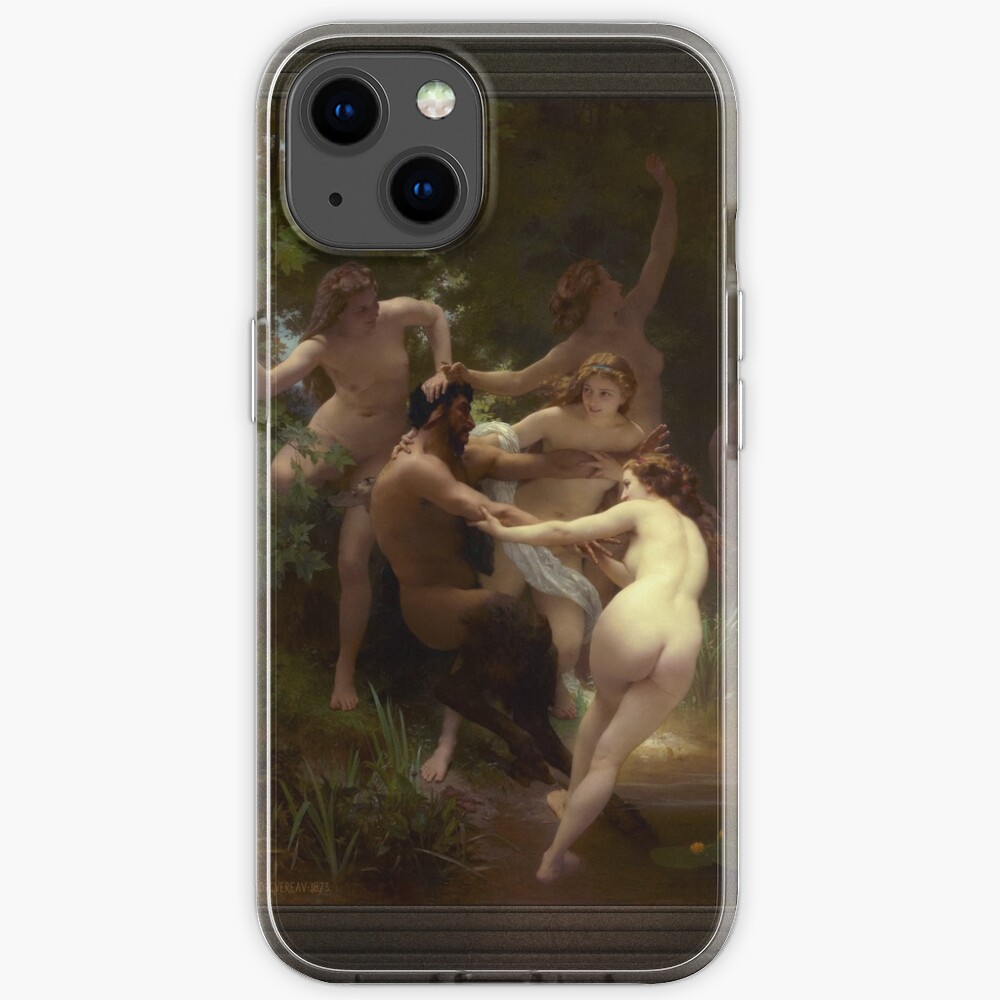
William-Adolphe Bouguereau’s “Nymphs and Satyr,” painted around 1873, exemplifies the artist’s celebrated academic style and his fascination with mythological subjects. The painting depicts a playful scene of nymphs playfully encircling a satyr within a lush woodland setting. It is a work that showcases Bouguereau’s technical mastery – particularly his ability to render flesh tones and create an atmosphere of idyllic beauty, while also reflecting the broader artistic trends of 19th-century France, specifically the revival of classical themes and allegorical narratives.
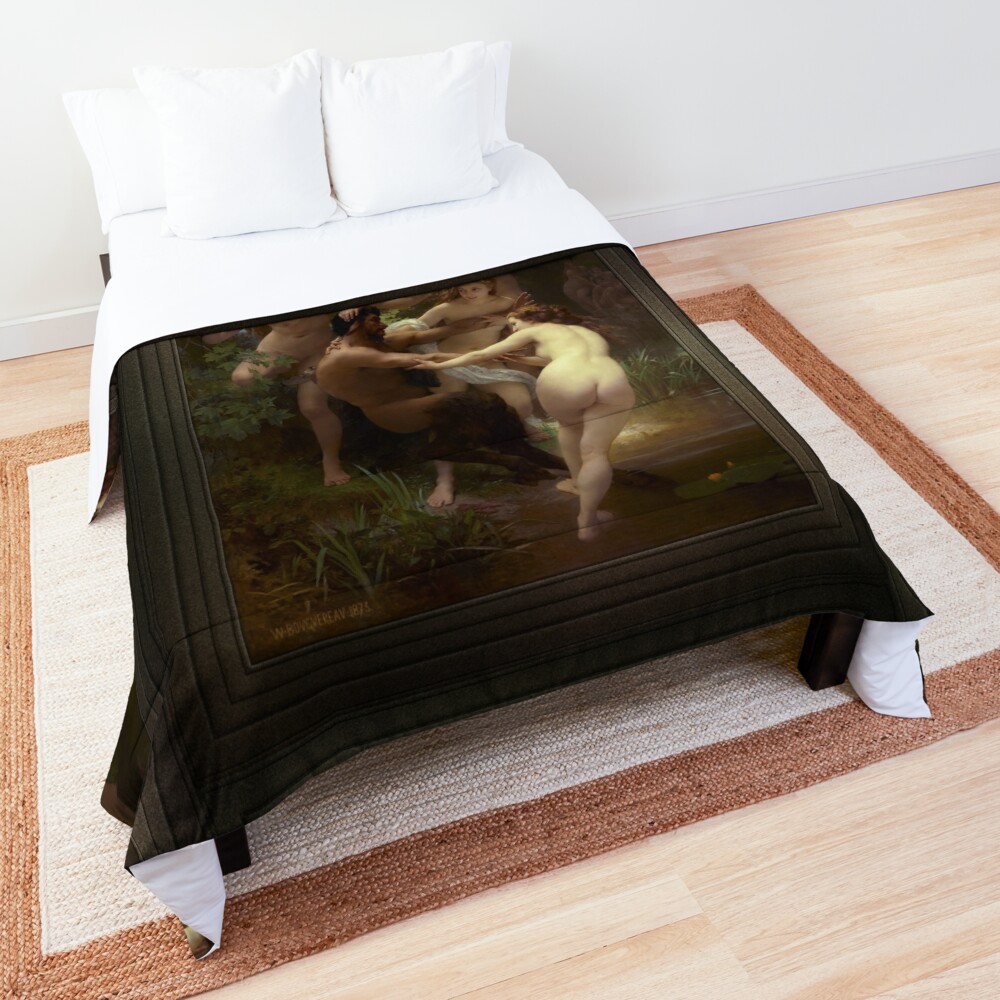
Table of Contents
Compositional Structure & Narrative
The composition is carefully structured around a central figure: the satyr. He occupies the lower center of the canvas, his dark skin contrasting with the lighter complexions of the surrounding nymphs. The arrangement isn’t one of aggression or threat; rather, it conveys a sense of lighthearted pursuit and playful entanglement.
The nymphs are positioned in a dynamic circular formation around him, their bodies intertwined and their expressions ranging from amusement to gentle teasing. This creates a visual rhythm that draws the viewer’s eye across the canvas, emphasizing the interaction between the figures. The background is deliberately blurred, receding into a dense forest of verdant foliage, which serves to isolate the group and focus attention on the central action.
The Figures: Nymphs & Satyr
Each nymph possesses distinct features and postures, contributing to the overall sense of movement and vitality. Their bodies are rendered with meticulous detail, showcasing Bouguereau’s skill in depicting the human form. They wear minimal attire – flowing drapery that clings to their forms while revealing the contours of their bodies, a common characteristic of academic nudes during this period.
Their hair is loosely arranged, cascading around their shoulders and adding to the overall sense of naturalness. The satyr, a creature from Greek mythology representing wild nature and revelry, stands out due to his darker skin tone and more rugged features. His posture suggests surprise and perhaps mild discomfort as he finds himself surrounded by the playful nymphs. He is depicted with horns and pointed ears, characteristic attributes of his mythological identity.
Color Palette & Lighting
Bouguereau’s use of color contributes significantly to the painting’s atmosphere. The palette is dominated by warm earth tones – greens, browns, and ochres – which evoke a sense of natural harmony. The nymphs’ skin tones are rendered with remarkable subtlety, capturing the play of light on their bodies. A soft, diffused light filters through the foliage, illuminating the figures from above and creating gentle shadows that enhance their three-dimensionality. The lighting is not harsh or dramatic; instead, it contributes to the overall sense of tranquility and idyllic beauty. The contrast between the satyr’s darker skin and the nymphs’ lighter complexions further emphasizes the visual dynamic within the composition.
Artistic Influences & Style
“Nymphs and Satyr” reflects Bouguereau’s training in the academic tradition, which emphasized technical skill, anatomical accuracy, and idealized beauty. His work draws inspiration from classical sculpture and Renaissance painting, evident in the graceful poses of the figures and the harmonious composition.
Bouguereau was a proponent of realism, but his paintings are not simply representational; they possess an element of idealization that elevates them beyond mere depictions of reality. The painting’s subject matter, a mythological scene, was also popular among artists during this period, reflecting a broader interest in classical themes and allegorical narratives. Bouguereau’s style is often associated with the academic tradition, characterized by its emphasis on technical proficiency and idealized beauty.
Technical Execution & Detail
The painting’s surface reveals meticulous brushwork, particularly evident in the rendering of flesh tones and foliage. Bouguereau employed a layering technique to build up color gradually, creating subtle gradations and enhancing the sense of realism.
The details are rendered with precision – from the delicate folds of drapery to the individual strands of hair, demonstrating Bouguereau’s mastery of his craft. The artist’s attention to detail extends to the background elements as well; the foliage is depicted with a remarkable degree of naturalism, creating a convincing sense of depth and atmosphere.
Legacy & Significance
“Nymphs and Satyr” remains one of Bouguereau’s most celebrated works, admired for its technical brilliance and its depiction of idyllic beauty. The painting exemplifies the artist’s ability to synthesize classical themes with contemporary artistic trends, creating a work that is both timeless and representative of its era. It stands as a testament to Bouguereau’s enduring legacy as one of the leading academic painters of his time.
Artist Bio Courtesy Wikipedia.org
William-Adolphe Bouguereau was born in La Rochelle, France, on 30 November 1825, into a family of wine and olive oil merchants.[4] The son of Théodore Bouguereau (born 1800) and Marie Bonnin (1804), known as Adeline, William was brought up a Catholic. He had an elder brother, Alfred, and a younger sister, Marie (known as Hanna), who died when she was seven.
The family moved to Saint-Martin-de-Ré in 1832. Another sibling was born in 1834, Kitty. At the age of 12, Bouguereau went to Mortagne to stay with his uncle Eugène, a priest and developed a love of nature, religion and literature.
In 1839, he was sent to study for the priesthood at a Catholic college in Pons. Here he was taught to draw and paint by Louis Sage, who had studied under Ingres. Bouguereau reluctantly left his studies to return to his family, now residing in Bordeaux.
There he met a local artist, Charles Marionneau, and commenced at the Municipal School of Drawing and Painting in November 1841. Bouguereau also worked as a shop assistant, hand-colouring lithographs and making small paintings that were reproduced using chromolithography.
He was soon the best pupil in his class, and decided to become an artist in Paris. To fund the move, he sold portraits – 33 oils in three months. All were unsigned and only one has been traced. He arrived in Paris aged 20 in March 1846.
Égalité devant la mort (Equality Before Death), 1848, oil on canvas, 141 × 269 cm (55.5 × 105.9 in), Musée d’Orsay, Paris. Equality is Bouguereau’s first major painting, produced after two years at the École des Beaux-Arts de Paris at the age of 23.
Bouguereau became a student at the École des Beaux-Arts.[4] To supplement his formal training in drawing, he attended anatomical dissections and studied historical costumes and archeology.
He was admitted to the studio of François-Édouard Picot, where he studied painting in the academic style. Dante and Virgil in Hell (1850) was an early example of his neo-classical works.
Academic painting placed the highest status on historical and mythological subjects, and Bouguereau determined to win the Prix de Rome, which would gain him a three-year residence at the Villa Medici in Rome, Italy, where in addition to formal lessons he could study first-hand the Renaissance artists and their masterpieces, as well as Greek, Etruscan, and Roman antiquities.
Nymphs and Satyr is a retouched digital art reproduction of a public domain image which is available for purchase as a rolled canvas print online.