

Odalisque c1858
“Odalisque c1858” is a masterpiece by the French artist Henri-Pierre Picou, who lived from 1824 naar 1895. Painted in 1858, this artwork represents a fine example of Romanticism, a movement that sought to convey deep emotion, sensualiteit, and vivid imagery. The subject matter and composition reflect the opulence and sensuality typical of the 19th-century French salons. Picou’s work, filled with vivid color and graceful detail, encapsulates the atmosphere of the Orient and the allure of the harem, an artistic theme that gained popularity in European art during the 19th century.
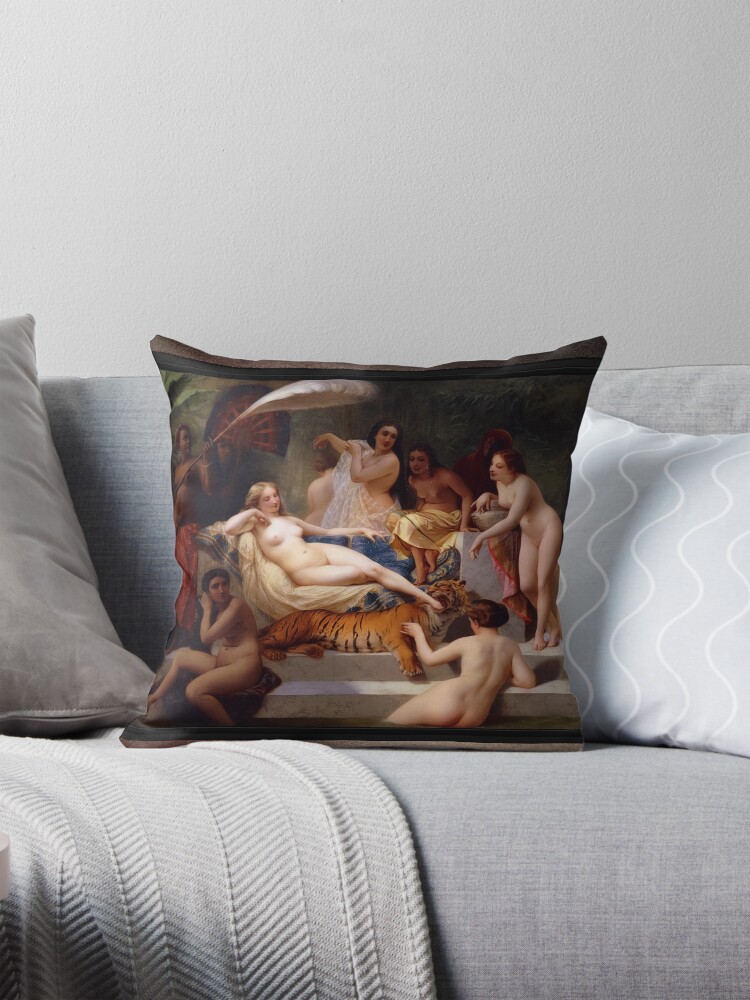
The painting depicts an exotic and opulent scene set within a lush, green garden. Op de voorgrond, a reclining nude woman lies draped over a luxurious tiger skin rug, her body elegantly posed to convey both relaxation and sensuality.
The subject of the painting, often referred to as an “odalisque” in the art world, refers to a woman in a harem, typically a concubine or servant, though in this case, the figure embodies a sense of power and beauty rather than mere submission. The subject’s position, partially turned to the side, suggests a moment of repose, and her expression, while not overly emotive, evokes a serene yet slightly aloof mood. The figure is meticulously detailed, met zacht, porcelain-like skin that contrasts with the vivid richness of her surroundings.
Inhoudsopgave
De instelling en compositie
The background of the painting is a lush, natural setting, with the surrounding foliage creating a sense of depth and enclosure. The warm tones of the earth and the deep greens of the trees contrast against the vibrant golds and turquoises of the woman’s attire, which consists of flowing, sheer fabrics. These colors and textures evoke a sense of Eastern luxury, in line with the Romanticized view of the Orient that was prevalent in European art of the time.
The setting itself, comprising not just a garden but also figures of other women and servants—adds a sense of social hierarchy to the piece. Op de achtergrond, several other figures are partially visible. Some women are depicted in various stages of undress, attending to the main figure in a way that suggests both intimacy and exotic allure. The way they are positioned around the central figure highlights the harem setting and the role of women within it. The inclusion of a tiger further adds to the exoticism, as it symbolizes power and mystery, reflecting the theme of untamed nature and luxury.
The Figures and Their Role
In addition to the reclining odalisque, the painting features a number of secondary figures, including female attendants and an exotic servant. One such figure stands at the back, holding a fan and facing the central figure, adding to the dynamic of the scene. The presence of these figures serves to reinforce the sense of the harem environment, where women are not only objects of desire but also part of a larger, intricate social structure.
The figures in the painting are rendered with remarkable attention to detail, especially in terms of their anatomy and expressions. The artist pays great care to the human form, emphasizing the smoothness and softness of the flesh in stark contrast to the more tactile textures of the tiger skin rug and the surrounding environment. The female figures, each with their unique postures and roles, form a visual harmony that draws the viewer’s eye back to the central reclining figure.
Symbolism and Theme
The central theme of the painting is the depiction of female sensuality, and by extension, the romanticized concept of the Orient. In the 19th century, the harem became a popular subject in European art, often seen as a symbol of luxury, forbidden beauty, and exotic allure. Echter, Picou’s portrayal moves beyond a simple depiction of sensuality, suggesting a more complex narrative about power, desire, and the roles of women in different cultures.
The use of the tiger skin rug as a central motif is highly symbolic. Tigers, in European art, were often associated with untamed forces, strength, and sometimes danger. The woman, by lying atop the tiger, suggests her control over the ferocity and wildness of the animal, a metaphor for both her own power and the heightened sense of mystery associated with the East. The female form, smooth and vulnerable, is in contrast with the wildness of the tiger, yet it is not subdued or submissive, it is regal, calm, and in control of her surroundings.
The harem, as depicted in this piece, is less a place of confinement than a space of empowerment and mystery, where women exist outside the usual rules of society and are able to express a more sensual and liberated existence. This is reflected in the calm demeanor of the central figure and the luxuriousness of the scene itself. By presenting the odalisque in a state of repose, Picou adds a layer of depth to the piece, suggesting that the woman’s power lies not in overt action, but in her allure, her mystery, and her presence.
The Mood and Emotional Tone
The mood of the painting is one of quiet luxury and latent power. The serene expression of the central figure contrasts with the more active, yet passive, roles of the other women and the exotic environment around her. The sensuality in the painting is not overtly provocative but is instead conveyed through the soft lines of the female form, the opulence of the setting, and the harmonious interaction between the figures and their surroundings. There is an almost dreamlike quality to the scene, enhanced by the naturalistic details and the rich color palette.
The interaction between the various figures in the painting, some passive, others active, creates a subtle tension within the composition. This interplay of emotions and roles adds a layer of narrative complexity to the piece, allowing the viewer to interpret the scene in a variety of ways, depending on their own perspective.
Conclusie
Henri-Pierre Picou’s “Odalisque c1858” is an exquisite representation of 19th-century French Romanticism. Through the lush, sensual portrayal of the reclining figure and the exotic environment, Picou creates a mood that combines luxury with mystery. The painting encapsulates the fascination with the Orient that was prevalent during the era, while also exploring themes of power, sensualiteit, and femininity. Its careful composition, aandacht voor detail, and use of symbolism make it a work of enduring beauty, capturing a moment in time when the allure of the harem was woven into the fabric of European artistic imagination.
Odalisque c1858 by French Painter Henri-Pierre Picou (1824 – 1895); bekend om zijn vroege portretwerk en historische onderwerpen en in zijn latere jaren om zijn allegorische en mythologische thema's
Een Odalisque was een vrouwelijke bediende of kamermeisje in een Turkse Seraglio (een afgezonderde woonruimte gebruikt door echtgenotes en concubines in een Ottomaans huishouden.).
Dit Odalisque-schilderij toont een naakte centrale vrouwelijke figuur die mogelijk de belangrijkste vrouw of concubine is, rust op een marmeren bank die is opgevuld met decoratieve kussens en lakens; dat deel uitmaakt van een dubbel gestapelde marmeren voet die naar een zwembad leidt; en op de achtergrond staan groene planten.
Ze wordt omringd door acht andere naakte vrouwen; twee die gedeeltelijk in de plas water liggen. met een die een jonge tijger aait die de voet van het belangrijkste vrouwtje in zijn mond stopt.
Er zijn ook nog drie vrouwtjes (die het meest lijken op de Odalisque), waarvan men kan aannemen dat het slaven zijn die voorzien in de behoeften van de andere vrouwen die zich ontspannen op het marmeren voetstuk.
Odalisque is a retouched digital art old masters reproduction of a public domain image that you can purchase as home decor wall art prints.
Deze digitale kunstcreatie, zoals bij alle kunstwerken die op de Xzendor7-website te vinden zijn, is deze online te koop in verschillende materiaalformaten, waaronder canvasafdrukken, acryl afdrukken, metalen prints, hout prints, ingelijste afdrukken, affiches, en zoals opgerolde canvasafdrukken in verschillende maten uit 12 inch tot 72 inch, afhankelijk van de grootte van het daadwerkelijke kunstwerk en de print on demand-winkel waar je de kunst wilt kopen.
Het artwork is ook beschikbaar op een breed scala aan heren- en dameskleding, mokken, bakken, sjaals, notitieboekjes en tijdschriften en veel woondecoratieproducten.
Bio -kunstenaar
Info hieronder afgeleid van Wikipedia.org
Henri-Pierre was een academische schilder en een van de oprichters van de Neo-Griekse school, samen met zijn goede vrienden Gustave Boulanger, Jean-Léon Gérôme, en Jean-Louis Hamon, ook academische schilders.
Alle mannen studeerden in de werkplaatsen van zowel Paul Delaroche als later Charles Gleyre. De stijl van Picou werd merkbaar beïnvloed door Gleyre; terwijl de rest van de groep over het algemeen klassieke en mythologische onderwerpen schilderde.
Picou debuteerde voor het eerst in artistieke stijl op de Salon in 1847; en het jaar daarop kreeg hij een tweedeklas medaille voor zijn schilderij, Cleopatra en Anthony op de Cydnus. Ook bekend als Cleopatra op de Cydnus, het wordt algemeen beschouwd als het meesterwerk van Picou.
De vertoning in de Salon in 1848 van Cléopâtre et Antoine sur le Cydnus is geschreven door de criticus Théophile Gautier, die vond dat het onderwerp te ambitieus was?, maar zei ook dat “Zoals het is, het geeft de beste hoop voor de toekomst van de jonge artiest, en behoort tot de zeven of acht belangrijkste schilderijen van de Salon.”
In 1875, het schilderij werd tentoongesteld in New York, en vond daarna een plaats op de muren van een privé-kunstgalerij in San Francisco.
Picou had een grote werkplaats in Parijs aan de Boulevard de Magenta, waardoor hij ruimte kreeg om aan zijn uitgestrekte fresco's te werken. Zijn populariteit bleef stijgen en hij won vervolgens de Tweede Prix de Rome in 1853 voor zijn schilderij, Jezus verdrijft de verkopers uit de tempel (De geldschieters verjaagd uit de tempel), en nog een tweedeklas medaille voor zijn Salonschilderij in 1857.
Vanaf het moment van zijn debuut in 1847, hij werd een vaste klant op de Salon, bijna elk jaar te zien tot zijn laatste tentoonstelling in 1893. Tegen het einde van het Tweede Franse Keizerrijk werd hij de meest modieuze schilder genoemd; en ontving veel commissies, inclusief opdrachten voor grote religieuze fresco's van vele kerken, waaronder de Église Saint-Roch.