

On the Summit c1903
“On the Summit (en los picos),” creado en 1903 del reconocido pintor francés Pascal-Adolphe-Jean Dagnan-Bouveret (1852 – 1929), is a compelling portrait that captures the serenity and grace of a woman amidst the stunning landscape of the Alps. This artwork demonstrates Dagnan-Bouveret’s exceptional skill in blending natural beauty with human emotion, portraying both the grandeur of nature and the introspection of the human spirit.
The scene is an evocative depiction of a solitary figure, a woman draped in a flowing white veil, sitting atop a rocky precipice, gazing contemplatively into the distance. The work is a perfect example of the Symbolist movement, which was prominent during the late 19th and early 20th centuries, and is also influenced by the realism and attention to detail for which Dagnan-Bouveret is known.
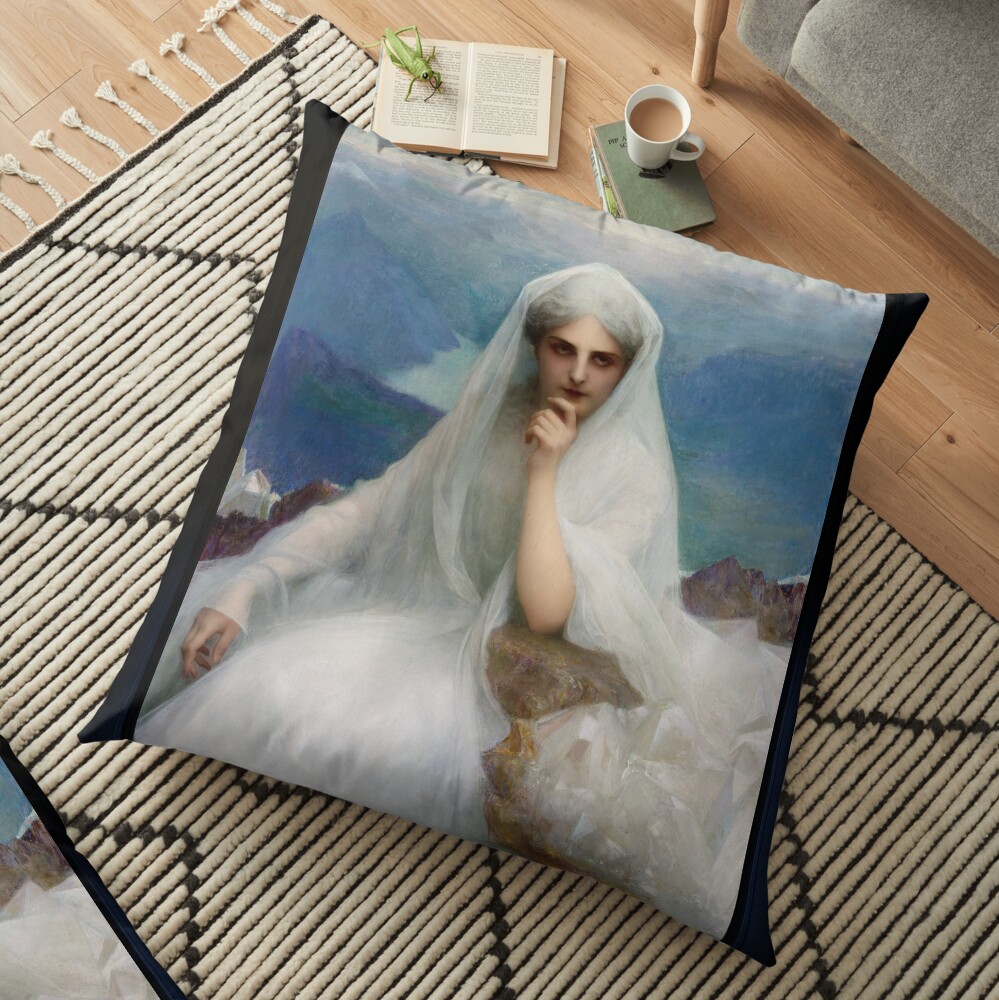
Tabla de contenido
La figura central
At the heart of the composition is the woman, whose presence dominates the scene. Ella es representada como una etérea, almost spectral figure, her face partially obscured by a veil that billows around her, reminiscent of a divine or mythical entity. El velo, white and translucent, subtly contrasts with the surrounding rocky terrain, emphasizing her otherworldly nature.
Her expression is pensive, her eyes gazing into the distance with a contemplative and almost melancholic expression, as though she is caught in a moment of deep reflection. One of her hands rests gently on a rock beside her, while the other is poised to touch her chin, suggesting a moment of introspection or quiet meditation.
Su atuendo es simple pero elegante., dominated by the white fabric of her veil and gown. The whiteness of her garments symbolizes purity, inocencia, and perhaps a spiritual connection to the natural world around her.
The softness of the fabric contrasts with the ruggedness of the mountains and rocks, reinforcing the juxtaposition between human fragility and the vast, enduring force of nature. The figure is both delicate and resilient, a representation of human vulnerability in the face of the infinite.
The Landscape
The backdrop of the painting features a breathtaking alpine landscape, with distant mountains that are hazy and almost dreamlike in their appearance. The colors of the mountains are soft, muted blues and purples, suggesting the distance and grandeur of the landscape. The peaks are shrouded in mist, which lends a mystical quality to the scene. The vastness of the terrain further enhances the solitude of the woman, emphasizing her isolation and the introspective nature of the moment.
en primer plano, the rocky outcrop on which the woman sits is painted with meticulous detail, the sharp edges and rough textures of the rocks providing a stark contrast to the smooth, flowing lines of her gown and veil. The rocks themselves are an integral part of the composition, anchoring the figure to the earth while simultaneously highlighting her detachment from the physical world around her. These elements of the landscape are bathed in soft, luz difusa, Además de la atmósfera de ensueño de la pintura.
Symbolism and Themes
Dagnan-Bouveret’s use of symbolism in “On the Summit” invites viewers to interpret the painting on multiple levels. The woman’s white attire and veil suggest purity, but they also evoke themes of spiritual transcendence, as though she is part of an eternal, ethereal world. Her introspective gaze might symbolize a quest for understanding or a search for meaning in the face of nature’s immensity. El velo, an often-used symbol in art, may suggest a barrier between the material and spiritual realms, hinting at the idea of veiled truths or the mysteries of the universe.
The woman’s isolation on the summit of the mountain evokes themes of solitude, contemplation, and perhaps even existential reflection. In the face of the infinite landscape, she is small and insignificant, yet her calm demeanor suggests a harmonious relationship with her surroundings. Her quiet presence contrasts with the powerful forces of nature that dominate the painting, perhaps symbolizing the resilience of the human spirit in the face of the vast unknown.
The symbolism of the mountain itself is significant. Mountains have long been associated with strength, endurance, y trascendencia, and in many cultures, they represent a place where the divine meets the earth. En este contexto, the summit where the woman sits could be interpreted as a spiritual or meditative place, a threshold between the earthly and the celestial.
Estilo y técnica artística
Dagnan-Bouveret’s painting demonstrates a mastery of both naturalism and idealization, characteristic of the Symbolist movement. His ability to capture the nuances of light and texture in the landscape is evident in the delicate handling of the distant mountains, which appear almost soft and vaporous in contrast to the sharp, clear lines of the figure in the foreground. The attention to detail in the woman’s clothing and the rocky terrain is indicative of the artist’s commitment to realism, while the overall composition, with its soft color palette and dreamlike quality, elevates the painting to the realm of the symbolic and the sublime.
The use of light in the painting is subtle but effective. The soft illumination on the figure’s face and the glowing whiteness of her veil contrast with the cooler, more somber tones of the surrounding landscape. This interplay of light and shadow creates a sense of depth and volume, enhancing the three-dimensionality of the figures and the natural elements. The brushwork is delicate and fluid, con transiciones suaves entre la luz y la oscuridad, lending the painting a sense of atmosphere that is both tranquil and introspective.
Conclusión
“On the Summit (en los picos)” c1903 is a profound work of art that combines realism, simbolismo, and an exploration of the relationship between humanity and nature. The solitary figure of the woman, her contemplation amidst the majestic alpine landscape, invites viewers to reflect on their own connection to the world around them. Dagnan-Bouveret’s delicate handling of light, color, and texture creates an otherworldly atmosphere, one in which the boundaries between the physical and spiritual realms seem to blur. The painting is both a visual feast and a thought-provoking meditation on solitude, trascendencia, and the eternal mysteries of the natural world.
On the Summit (en los picos) c1903 by French Painter Pascal-Adolphe-Jean Dagnan-Bouveret (1852 – 1929); uno de los principales artistas de la escuela naturalista.
Esta pintura representa a una doncella sentada en la cima de una montaña, vestida con una túnica blanca y cubierta con un velo blanco que fluye alrededor de su cuerpo y cubre parte de su cabeza que está ligeramente cubierta de escarcha blanca..
A su lado izquierdo hay una cisterna de piedra. (un tanque para almacenar agua), lleno de cristales de hielo y en la distancia a su derecha hay un valle rodeado de montañas azules y un lago glacial..
Tiene ojos oscuros y penetrantes que miran hacia arriba como si mirara algo de gran preocupación a lo lejos. Tiene la barbilla apoyada en la mano izquierda y el codo apoyado en el borde de la cisterna.; mientras su mano derecha descansa sobre su muslo derecho.
Esta es una reproducción de maestros antiguos de arte digital remasterizada de una imagen de dominio público que está disponible como impresión de la lona en línea.
Biografía del artista derivada de Wikipedia.org
Pascal nació en París Francia en enero 7, 1852 y fue criado por su abuelo, de donde tomó el nombre Bouveret después de que su padre emigró a Brasil.
Inició su educación en 1869, estudiando en la Ecole des Beaux-Arts con los pintores franceses Alexandre Cabanel (1823 – 1889) y Jean-Léon Gérôme (1824 – 1904) desde 1869 a 1875.
Desde 1875 mediante 1896 expuso en el Salón de París, exponiendo allí por primera vez en 1875, donde en 1880 ganó el primer lugar por la pintura “Un accidente”; luego en 1885 recibió la medalla de honor por su pieza “Caballos en el abrevadero”.
Durante la década de 1880 Pascal junto con el pintor francés Gustave Courtois (1852 – 1923), mantuvo un estudio en una zona de moda de París llamada Neuilly-sur-Seine; y en ese momento era un artista líder bien conocido y establecido conocido por sus escenas campesinas., creaciones místicas y composiciones religiosas.
En 1891 Pascal fue nombrado Oficial de la Legión de Honor, y nueve años más tarde se convirtió en miembro del Institut de France.