

On the Summit c1903
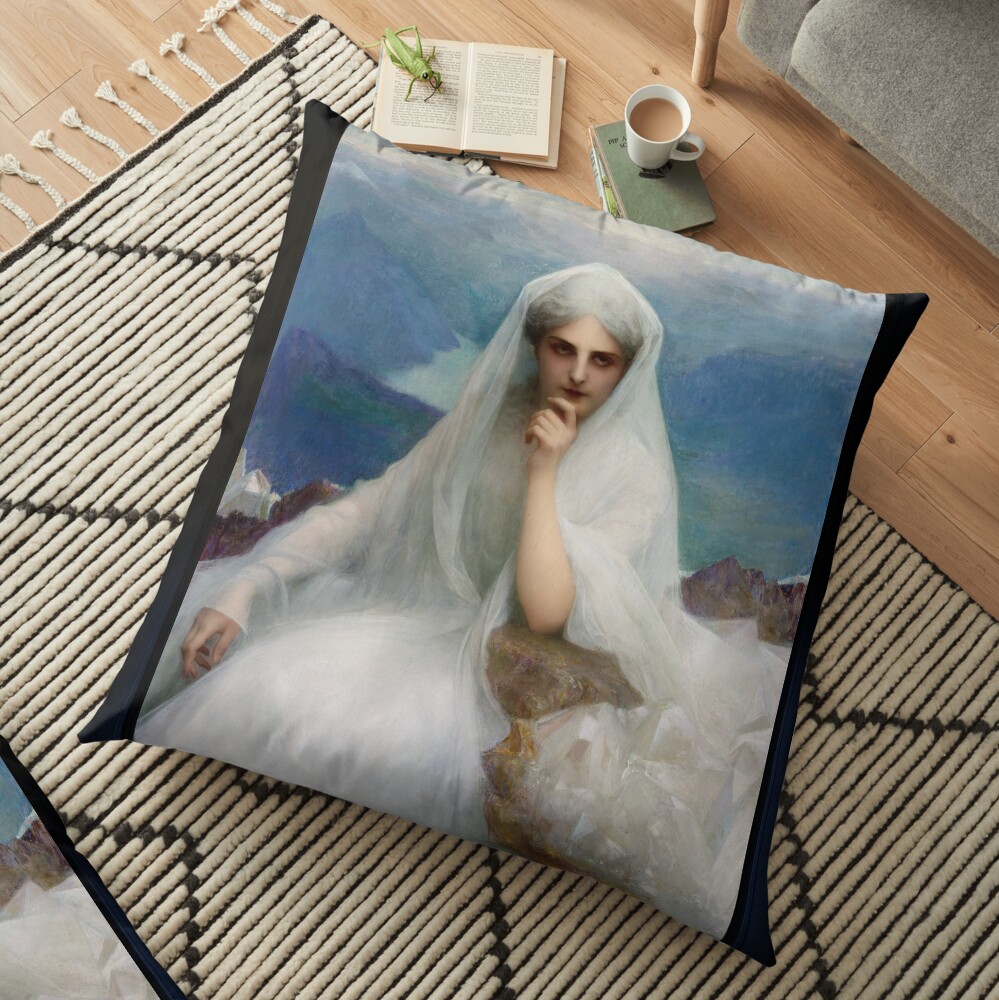
“On the Summit (Sur Les Cimes),” sortua 1903 by the renowned French painter Pascal-Adolphe-Jean Dagnan-Bouveret (1852 – 1929), is a compelling portrait that captures the serenity and grace of a woman amidst the stunning landscape of the Alps. This artwork demonstrates Dagnan-Bouveret’s exceptional skill in blending natural beauty with human emotion, portraying both the grandeur of nature and the introspection of the human spirit.
The scene is an evocative depiction of a solitary figure, a woman draped in a flowing white veil, sitting atop a rocky precipice, gazing contemplatively into the distance. The work is a perfect example of the Symbolist movement, which was prominent during the late 19th and early 20th centuries, eta Dagnan-Bouveret ezaguna den errealismoaren eta xehetasunen arretaren eragina ere badu.
Edukien taula
Erdiko Irudia
Konposizioaren muina emakumea dago, zeinen presentzia nagusi den eszenan. Etereo gisa irudikatzen da, irudi ia espektralea, aurpegia partzialki ilundua bere inguruan ibiltzen den belo batek, entitate jainkotiar edo mitiko bat gogorarazten duena. Beloa, zuria eta zeharrargitsua, sotilki kontraste egiten du inguruko lur harritsuarekin, bere beste munduko izaera azpimarratuz.
Bere adierazpena pentsakor da, bere begiak urrutira begiratzen zituen adierazpen kontenplatibo eta ia malenkoniatsu batekin, hausnarketa sakoneko une batean harrapatuta balego bezala. Eskuetako bat ondoan dagoen harkaitz baten gainean gelditzen da, bestea, berriz, kokotsa ukitzeko prest dago, introspekzio edo meditazio lasaia iradokiz.
Bere jantzi sinplea baina dotorea da, bere beloaren eta bataren ehun zuria nagusitu zen. Bere jantzien zuritasunak garbitasuna sinbolizatzen du, lañotasun, eta beharbada bere inguruko mundu naturalarekiko lotura espirituala.
Ehunaren leuntasuna mendien eta arroken malkarrarekin kontraste egiten du, giza hauskortasunaren eta zabalaren arteko juxtaposizioa indartuz, naturaren indarra iraunkorra. Figura delikatua eta sendoa da, giza zaurgarritasunaren irudikapena infinituaren aurrean.
Paisaia
The backdrop of the painting features a breathtaking alpine landscape, with distant mountains that are hazy and almost dreamlike in their appearance. The colors of the mountains are soft, muted blues and purples, suggesting the distance and grandeur of the landscape. The peaks are shrouded in mist, which lends a mystical quality to the scene. The vastness of the terrain further enhances the solitude of the woman, emphasizing her isolation and the introspective nature of the moment.
Lehen planoan, the rocky outcrop on which the woman sits is painted with meticulous detail, the sharp edges and rough textures of the rocks providing a stark contrast to the smooth, flowing lines of her gown and veil. The rocks themselves are an integral part of the composition, anchoring the figure to the earth while simultaneously highlighting her detachment from the physical world around her. These elements of the landscape are bathed in soft, argi lausoa, margolanaren giro onirikoari gehituz.
Sinbolismoa eta gaiak
Dagnan-Bouveret’s use of symbolism in “On the Summit” invites viewers to interpret the painting on multiple levels. The woman’s white attire and veil suggest purity, but they also evoke themes of spiritual transcendence, as though she is part of an eternal, ethereal world. Her introspective gaze might symbolize a quest for understanding or a search for meaning in the face of nature’s immensity. Beloa, an often-used symbol in art, may suggest a barrier between the material and spiritual realms, hinting at the idea of veiled truths or the mysteries of the universe.
Emakumearen isolamenduak mendiaren tontorrean bakardadearen gaiak ekartzen ditu gogora, kontenplazioa, eta, agian, baita hausnarketa existentziala ere. Paisaia infinituaren aurrean, txikia eta hutsala da, hala ere, bere jarrera lasaiak bere inguruarekin harreman harmoniatsua iradokitzen du. Bere presentzia lasaiak pinturan nagusi diren naturaren indar indartsuekin kontrajartzen du, beharbada, ezezagun zabalaren aurrean giza izpirituaren erresilientzia sinbolizatzea.
Mendiaren beraren sinbologia esanguratsua da. Mendiak aspalditik egon dira indarrarekin lotuta, erresistentzia, eta transzendentzia, eta kultura askotan, jainkozkoak lurrarekin bat egiten duen lekua adierazten dute. Testuinguru honetan, emakumea esertzen den gailurra leku espiritual edo meditazio gisa interpreta liteke, lurrekoaren eta zerukoaren arteko atalasea.
Estilo artistikoa eta teknika
Dagnan-Bouveret’s painting demonstrates a mastery of both naturalism and idealization, characteristic of the Symbolist movement. His ability to capture the nuances of light and texture in the landscape is evident in the delicate handling of the distant mountains, which appear almost soft and vaporous in contrast to the sharp, clear lines of the figure in the foreground. The attention to detail in the woman’s clothing and the rocky terrain is indicative of the artist’s commitment to realism, while the overall composition, with its soft color palette and dreamlike quality, elevates the painting to the realm of the symbolic and the sublime.
The use of light in the painting is subtle but effective. Irudiaren aurpegiko argiztapen leunak eta bere beloaren zuri distiratsuak freskoarekin kontrajartzen du, inguruko paisaiaren tonu ilunagoak. Argi eta itzalen arteko elkarrekintza honek sakontasun eta bolumen sentsazioa sortzen du, figuren eta elementu naturalen hiru dimentsioa indartuz. Pintzela delikatua eta arina da, argiaren eta iluntasunaren arteko trantsizio leunekin, koadroari giro lasaia eta barnera begirako sentipena emanez.
Bukaera
“On the Summit (Sur Les Cimes)” c1903 errealismoa uztartzen duen artelan sakona da, sinbolismoa, eta gizateriaren eta naturaren arteko harremana aztertzea. Emakumearen figura bakartia, bere kontenplazioa paisaia alpino dotorearen artean, inguratzen duten munduarekin duten loturari buruz hausnartzera gonbidatzen ditu ikusleak. Dagnan-Bouvereten argiaren maneiu delikatua, kolorea, and texture creates an otherworldly atmosphere, one in which the boundaries between the physical and spiritual realms seem to blur. The painting is both a visual feast and a thought-provoking meditation on solitude, transzendentzia, and the eternal mysteries of the natural world.
On the Summit (Sur Les Cimes) c1903 by French Painter Pascal-Adolphe-Jean Dagnan-Bouveret (1852 – 1929); a leading artists of the Naturalist School.
This painting depicts a maiden sitting on a mountain top that is dressed in a white robe and covered in a white veil which flows around her body and covers part of her head that is lightly covered with white frost.
By her left side is a stone cistern (a tank for storing water), filled with ice crystals and in the distance on her right is a valley that is surrounded by blue mountains and a glacial lake.
She has dark piercing eyes that are looking upward as if looking at something of great concern in the far distance has she rest her chin on her left hand with her elbow resting on the edge of the cistern; while her right hand rest on her right thigh.
Domeinu publikoko irudi baten erreprodukzioa da mihise inprimatua sarean.
Bio artista honetatik eratorria Wikipedia.org
Pascal was born in Paris France on January 7, 1852 and was raised by his grandfather, from which he took the name Bouveret after his father emigrated to Brazil.
He started his education in 1869, studying at the École des Beaux-Arts under French Painters Alexandre Cabanel (1823 – 1889) and Jean-Léon Gérôme (1824 – 1904) tik 1869 to 1875.
Bertatik 1875 bidez 1896 he exhibited at the Paris Salon, first exhibiting there in 1875, where in 1880 he won the first place for the painting “An Accident”; gero sartu 1885 he received the medal of honor for his piece “Horses At The Watering Trough”.
During the 1880s Pascal along with French Painter Gustave Courtois (1852 – 1923), maintained a studio in a fashionable part of Paris called Neuilly-sur-Seine; and by this time was a well known and established leading artist known for his peasant scenes, mystical creations and religious compositions.
In 1891 Pascal was made an Officer of the Legion of Honour, and nine years later became a member of the Institut de France.