

Fleurs De Printemps – Flowers Of Spring
Artelanaren aurkezpena
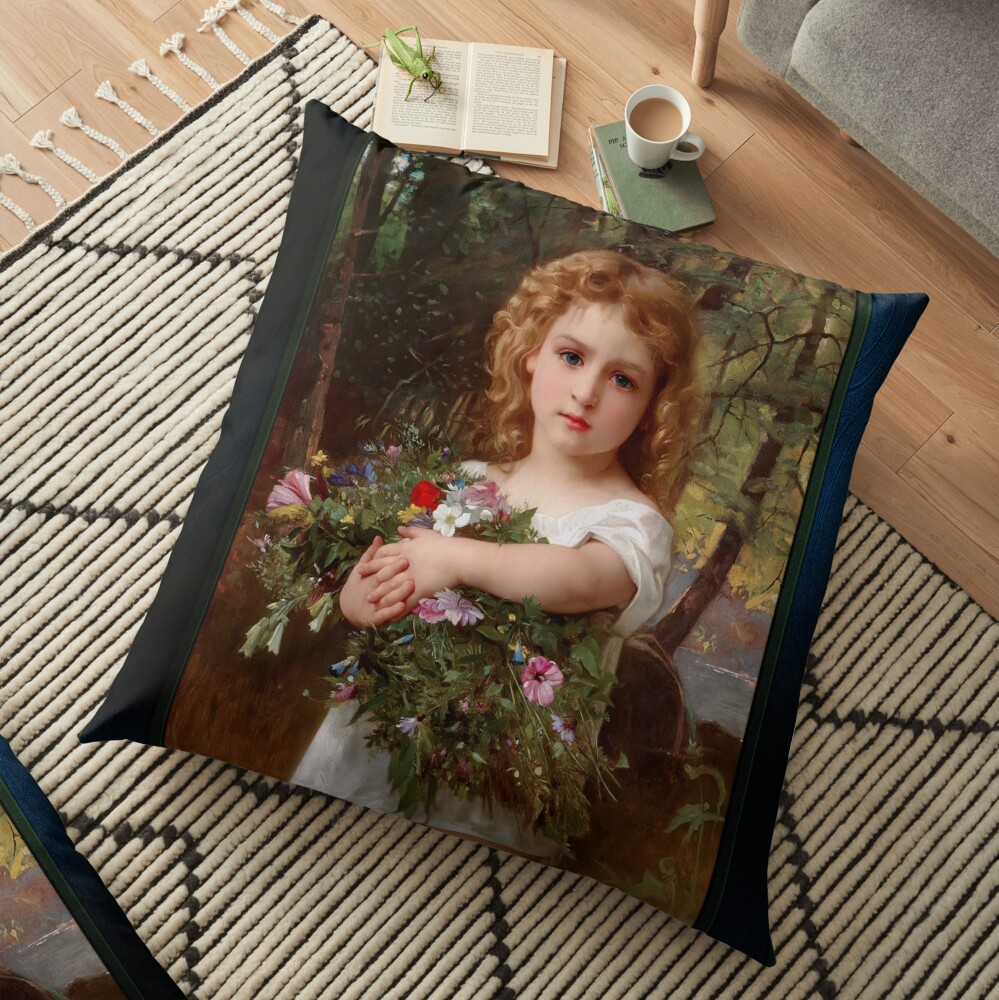
Fleurs De Printemps (“Flowers of Spring”) is an exquisite work painted in 1878 by the renowned French artist William-Adolphe Bouguereau (1825 – 1905). Known for his mastery in rendering human figures with astonishing realism, Bouguereau’s “Fleurs De Printemps” epitomizes his prowess in depicting delicate details and soft textures, capturing the purity of youth and the vibrancy of springtime. This painting is a perfect example of Bouguereau’s signature style, showcasing his ability to merge portraiture with the natural world, offering an intimate glimpse into the innocence of childhood and the richness of nature.
Edukien taula
Gaia
At the heart of the composition is a young girl, delicately posed as if she were an embodiment of spring itself. She is dressed in a simple white gown, her bare feet standing on the soft, earthy ground as she cradles an abundant bouquet of wildflowers against her chest. The floral arrangement she holds is a mixture of vibrant colors—deep purples, pinks, zuriak, and reds, evoking the fresh blossoms of the season. Her golden curls tumble down around her shoulders, contrasting against the pure whiteness of her garment. The girl gazes softly at the viewer with a subtle, almost shy expression, her features marked by a youthful innocence and purity that evoke a sense of nostalgia and tranquility.
The girl’s portrayal exudes the timeless theme of childhood innocence, yet it is also a nod to the floral symbolism of spring—a time of renewal, hazkundea, eta ugalkortasuna. The flowers are as much a part of her as she is a part of them, suggesting a harmonious connection between human and nature.
Ezarpena
ren atzealdea “Fleurs De Printemps” is equally significant, as it sets the stage for the narrative of the young girl. The artist has chosen a wooded, eguzkitsu dagoen paisaia, with trees partially obscured by a soft mist of morning dew. This ethereal backdrop suggests a tranquil rural setting, possibly near a forest or meadow, and reflects the peaceful serenity of nature. The earthy tones of the surrounding trees, hostoa, and ground create a contrast with the purity and brightness of the girl’s figure. The light filters through the foliage, casting dappled shadows on the earth, which enhances the sense of a serene and harmonious relationship between the figure and the environment.
Bouguereau’s attention to detail in the landscape—each leaf, each flower, and each blade of grass—is striking, further elevating the realism of the work. The natural surroundings appear to frame the girl, subtly emphasizing her as the focal point while also suggesting her belonging to the world around her.
Estiloa eta Teknika
William-Adolphe Bouguereau was a master of the academic style, which was rooted in the traditions of realism and fine detail. His technique in “Fleurs De Printemps” showcases the soft, almost ethereal quality of light and texture that defined his work. Bouguereau’s use of light is exceptional, with the interplay of soft sunlight across the girl’s face and the flowers accentuating the contours of her delicate features. The fine brushwork creates a smooth surface, itxura ia belusatua, making the girl’s skin seem radiant and lifelike.
The precise modeling of the face and hands is characteristic of Bouguereau’s meticulous approach to human anatomy. The tender folds of the gown, the gentle curve of the child’s arms, and the weightlessness of her pose all reflect a sophisticated understanding of human form. This technique not only gives a sense of realism but also imbues the figure with a sense of inner life, as though the viewer is encountering a moment of real beauty rather than a mere representation.
The flowers themselves are rendered with an almost botanical accuracy. Bouguereau was particularly adept at painting flora and fauna, and the bouquet in this painting is a testament to his skill in capturing the intricate textures and colors of nature. The flowers appear fresh and vibrant, as if plucked from the ground just moments before.
Aldartea eta Gaia
ren aldartea “Fleurs De Printemps” is serene and contemplative, evoking a sense of nostalgia for a simpler, more innocent time. The young girl’s gaze, though soft, carries a depth of emotion that invites the viewer to reflect on themes of purity, gazteria, and the fleeting nature of time. The softness of the figure, the gentle curvature of her body, and the expression on her face all suggest a sense of vulnerability, yet also an inherent strength. The connection to the natural world further amplifies these emotions, symbolizing life’s transient beauty, much like the blooming of flowers in spring that are destined to wither, only to be replaced by new growth.
The flowers themselves play a symbolic role in this painting. Traditionally, flowers represent the cycle of life, hazkundea, and death, eta hemen, they symbolize the innocence and vitality of youth. In spring, the flowers’ bloom mirrors the girl’s own youthful energy and unspoiled beauty. Bouguereau’s careful juxtaposition of the girl’s purity with the vibrant spring flowers suggests an inevitable passage of time, a theme that resonates deeply in the art of the 19th century.
Bukaera
“Fleurs De Printemps” is a quintessential example of William-Adolphe Bouguereau’s mastery in blending realism with emotional depth. The artwork encapsulates the beauty of the natural world and the fragility of youth, themes that were deeply significant to the artist and his contemporaries. Bouguereau’s attention to detail, his gentle rendering of the human form, eta argiaren eta itzalaren ulermenak bat egiten du bisualki harrigarria ez ezik, oihartzun emozionalarekin ere aberatsa den pintura bat sortzeko.. Lan honek Bouguereauren ondarearen lekuko izaten jarraitzen du XIX. mendeko margolari onenetako bat bezala..
Artelanari buruz
Fleurs De Printemps William Bouguereauren Little Girl With Flowers c1878 piezaren beste bertsio bat da.; atzealde osoarekin.
Pieza honen beste bertsioa, berriz, belaunen azpian moztuta zegoen eta hondo beltza zuen; bertsio honek basoaren ezarpenak ditu.
Pieza aldatzera behartu ninduten, bertsio honen atzeko planoa hondatuta zegoelako, basoko atzealdearen zatirik handiena ezabatuta eta ikusgai zeuden zatiak ia guztiz beltzak zirelako..
To remedy this an give the artwork a fresh new look, I decided to replace the background with the landscape piece Kahnpartie im Spreewald c1910 by German Painter Edward Theodore Compton (1849 – 1921).
This modification produces a background of trees and plants that blends nicely with the young girl and the tall grass behind her; and adds an additional light source and river to the far right.
I then went about repairing the cuts, cracks, dropouts and dirt from the painting; as well as blending the ground that had lost paint and just looked bad, so that it would blend with the rest of the scene.
The final result is that of an adorable bare foot lovely little girl, with light brown golden hair dressed in a white robe, with an angelic look to her; that is standing on a forest path carrying in her arms and close to her body, a very large assortment of wild flowers and plants that she has gathered during her forest outing.
Fleurs De Printemps is a remastered digital art old masters reproduction of a public domain image that is available as a rolled canvas, akrilikoa, metal and wood prints online.
Artistari buruz
Informazioa Behean Deribatua Wikipedia.org
William Adolphe Bouguereau La Rochellen jaio zen, Frantzia, on 30 Azaroa 1825, ardo eta oliba olio merkatarien familia batean. Théodore Bouguereau guraso katolikoen semea b1800 eta Marie Bonnin b1804, Adeline izenez ezaguna.
Anaia nagusi bat zuen, Alfred, eta ahizpa txiki bat, Marie (Hanna izenez ezagutzen dena), zazpi urte zituela hil zena. Familia Saint-Martin-de-Ré-ra joan zen bizitzera 1832. urtean beste anai-arreba bat jaio zen 1834, Kitty.
Urtean 12, Bouguereau Mortagnera joan zen bere osaba Eugènerekin egotera, apaiza eta naturarekiko maitasuna garatu zuen, erlijioa eta literatura. In 1839, Ponseko kolegio katoliko batera apaizgaia ikastera bidali zuten.
Kolegio Katolikoan Louis Sage-k marrazten eta margotzen irakatsi zion, Ingresekin ikasi zuena. Bouguereauk gogoz kontra utzi zituen ikasketak bere familiara itzultzeko, orain Bordelen bizi da. Azaroan Bordelen berriz 1841 bertako artista bat ezagutu zuen, Charles Marioneau, eta marrazketa eta pintura Udal Eskolan jarraitu zituen arte ikasketak.
Bouguereau dendako laguntzaile gisa ere aritu zen, litografiak eskuz margotu eta kromolitografia erabiliz erreproduzitzen ziren koadro txikiak egitea. Bere klaseko ikaslerik onena izan zen laster, eta Parisen artista izatea erabaki zuen. Mugimendua finantzatzeko, saldu zuen 33 sinatu gabeko olio erretratuak hiru hilabetetan; eta irabazitako diruarekin, urterekin heldu zen Parisera 20 martxoan 1846.
Parisera iritsi ondoren Bouguereau École des Beaux-Arts-eko ikaslea izan zen; eta marrazketan duen prestakuntza formala osatzeko, disekzio anatomikoetara joan zen eta jantzi historikoak eta arkeologia ikasi zituen. In 1848 Heriotzaren Aurretik Berdintasuna sortu zuen (Hil aurretik berdintasuna), his first Bmajor painting.
Geroago François-Édouard Picot-en estudioan postu bat lortu zuen, bertan pintura ikasi zuen estilo akademikoan; Dante eta Virgilio infernuan ekoizten c1850, bere artelan neoklasikoaren hasierako adibidea dena.
Bere bizitzan Bouguereauk ospe handia izan zuen Frantzian eta Estatu Batuetan, eta ohore ofizial ugari eman zizkion, bere artelanagatik prezio gorena ordaintzen ari zirelarik. Bere belaunaldiko apaindegi margolari nagusi gisa, abangoardia inpresionistak gaitzetsi zuen.
Bere bizitzan zehar, Bouguereau exekutatu zuen 822 amaitutako margolan ezagunak, askoren nondik norakoak oraindik ezezagun badira ere.