

Sur le sommet c1903
“Au sommet (Sur Les Cimes),” créé dans 1903 par le célèbre peintre français Pascal-Adolphe-Jean Dagnan-Bouveret (1852 – 1929), est un portrait fascinant qui capture la sérénité et la grâce d'une femme au milieu du magnifique paysage des Alpes.. Cette œuvre démontre le talent exceptionnel de Dagnan-Bouveret à allier la beauté naturelle à l’émotion humaine., dépeignant à la fois la grandeur de la nature et l'introspection de l'esprit humain.
La scène est une représentation évocatrice d'un personnage solitaire, une femme drapée dans un voile blanc fluide, assis au sommet d'un précipice rocheux, regarder contemplativement au loin. L'œuvre est un parfait exemple du mouvement symboliste, qui était important à la fin du 19e et au début du 20e siècle, et est également influencé par le réalisme et l'attention aux détails pour lesquels Dagnan-Bouveret est connu.
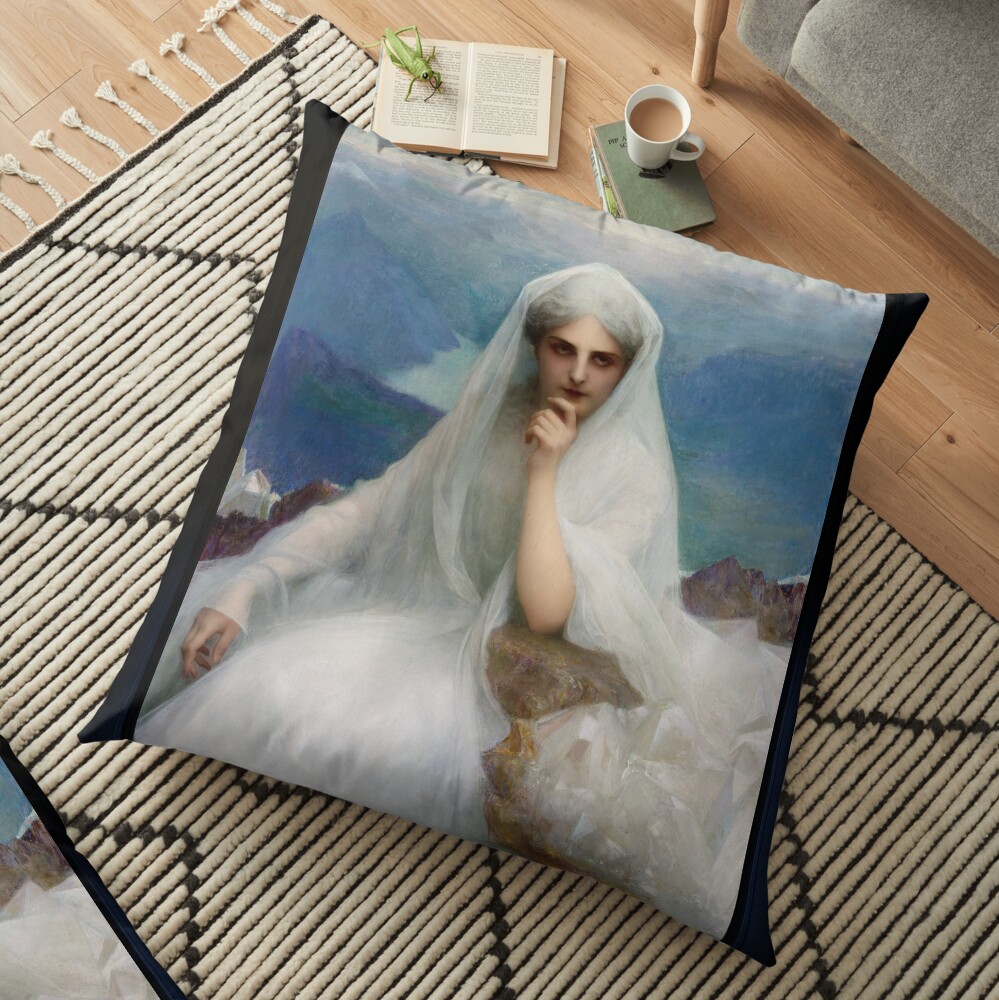
Table des matières
La figure centrale
At the heart of the composition is the woman, whose presence dominates the scene. She is depicted as an ethereal, almost spectral figure, her face partially obscured by a veil that billows around her, reminiscent of a divine or mythical entity. Le voile, white and translucent, subtly contrasts with the surrounding rocky terrain, soulignant sa nature surnaturelle.
Son expression est pensive, her eyes gazing into the distance with a contemplative and almost melancholic expression, as though she is caught in a moment of deep reflection. One of her hands rests gently on a rock beside her, while the other is poised to touch her chin, suggérant un moment d'introspection ou de méditation tranquille.
Sa tenue est simple mais élégante, dominée par le tissu blanc de son voile et de sa robe. La blancheur de ses vêtements symbolise la pureté, innocence, et peut-être une connexion spirituelle avec le monde naturel qui l'entoure.
La douceur du tissu contraste avec la rudesse des montagnes et des rochers, renforçant la juxtaposition entre la fragilité humaine et le vaste, force durable de la nature. La silhouette est à la fois délicate et résistante, une représentation de la vulnérabilité humaine face à l’infini.
The Landscape
La toile de fond du tableau présente un paysage alpin à couper le souffle, avec des montagnes lointaines, brumeuses et presque oniriques dans leur apparence. Les couleurs des montagnes sont douces, bleus et violets atténués, suggérant la distance et la grandeur du paysage. Les sommets sont enveloppés de brume, which lends a mystical quality to the scene. The vastness of the terrain further enhances the solitude of the woman, emphasizing her isolation and the introspective nature of the moment.
Au premier plan, the rocky outcrop on which the woman sits is painted with meticulous detail, the sharp edges and rough textures of the rocks providing a stark contrast to the smooth, flowing lines of her gown and veil. The rocks themselves are an integral part of the composition, anchoring the figure to the earth while simultaneously highlighting her detachment from the physical world around her. These elements of the landscape are bathed in soft, lumière diffuse, adding to the dreamlike atmosphere of the painting.
Symbolisme et thèmes
Dagnan-Bouveret’s use of symbolism in “Au sommet” invites viewers to interpret the painting on multiple levels. La tenue blanche et le voile de la femme suggèrent la pureté, mais ils évoquent aussi des thèmes de transcendance spirituelle, comme si elle faisait partie d'un éternel, monde éthéré. Son regard introspectif pourrait symboliser une quête de compréhension ou une recherche de sens face à l’immensité de la nature.. Le voile, un symbole souvent utilisé dans l'art, peut suggérer une barrière entre les domaines matériel et spirituel, faisant allusion à l'idée de vérités voilées ou aux mystères de l'univers.
L’isolement de la femme au sommet de la montagne évoque les thèmes de la solitude, contemplation, et peut-être même une réflexion existentielle. Face au paysage infini, elle est petite et insignifiante, pourtant son attitude calme suggère une relation harmonieuse avec son environnement. Her quiet presence contrasts with the powerful forces of nature that dominate the painting, perhaps symbolizing the resilience of the human spirit in the face of the vast unknown.
The symbolism of the mountain itself is significant. Mountains have long been associated with strength, endurance, et transcendance, and in many cultures, they represent a place where the divine meets the earth. Dans ce contexte, the summit where the woman sits could be interpreted as a spiritual or meditative place, a threshold between the earthly and the celestial.
Style artistique et technique
Dagnan-Bouveret’s painting demonstrates a mastery of both naturalism and idealization, characteristic of the Symbolist movement. His ability to capture the nuances of light and texture in the landscape is evident in the delicate handling of the distant mountains, which appear almost soft and vaporous in contrast to the sharp, clear lines of the figure in the foreground. The attention to detail in the woman’s clothing and the rocky terrain is indicative of the artist’s commitment to realism, while the overall composition, with its soft color palette and dreamlike quality, elevates the painting to the realm of the symbolic and the sublime.
The use of light in the painting is subtle but effective. The soft illumination on the figure’s face and the glowing whiteness of her veil contrast with the cooler, more somber tones of the surrounding landscape. This interplay of light and shadow creates a sense of depth and volume, enhancing the three-dimensionality of the figures and the natural elements. The brushwork is delicate and fluid, avec des transitions douces entre la lumière et l'obscurité, lending the painting a sense of atmosphere that is both tranquil and introspective.
Conclusion
“Au sommet (Sur Les Cimes)” c1903 is a profound work of art that combines realism, symbolisme, and an exploration of the relationship between humanity and nature. The solitary figure of the woman, her contemplation amidst the majestic alpine landscape, invites viewers to reflect on their own connection to the world around them. Dagnan-Bouveret’s delicate handling of light, Couleur, and texture creates an otherworldly atmosphere, one in which the boundaries between the physical and spiritual realms seem to blur. The painting is both a visual feast and a thought-provoking meditation on solitude, transcendance, and the eternal mysteries of the natural world.
Au sommet (Sur Les Cimes) c1903 par le peintre français Pascal-Adolphe-Jean Dagnan-Bouveret (1852 – 1929); un des principaux artistes de l'école naturaliste.
This painting depicts a maiden sitting on a mountain top that is dressed in a white robe and covered in a white veil which flows around her body and covers part of her head that is lightly covered with white frost.
By her left side is a stone cistern (a tank for storing water), filled with ice crystals and in the distance on her right is a valley that is surrounded by blue mountains and a glacial lake.
She has dark piercing eyes that are looking upward as if looking at something of great concern in the far distance has she rest her chin on her left hand with her elbow resting on the edge of the cistern; while her right hand rest on her right thigh.
Il s'agit d'une reproduction de maîtres anciens d'art numérique remasterisée d'une image du domaine public qui est disponible en tant que impression sur toile en ligne.
Biographie de l'artiste dérivée de Wikipedia.org
Pascal was born in Paris France on January 7, 1852 and was raised by his grandfather, from which he took the name Bouveret after his father emigrated to Brazil.
He started his education in 1869, studying at the École des Beaux-Arts under French Painters Alexandre Cabanel (1823 – 1889) and Jean-Léon Gérôme (1824 – 1904) de 1869 à 1875.
De 1875 par 1896 he exhibited at the Paris Salon, first exhibiting there in 1875, where in 1880 he won the first place for the painting “An Accident”; puis dans 1885 he received the medal of honor for his piece “Horses At The Watering Trough”.
During the 1880s Pascal along with French Painter Gustave Courtois (1852 – 1923), maintained a studio in a fashionable part of Paris called Neuilly-sur-Seine; and by this time was a well known and established leading artist known for his peasant scenes, mystical creations and religious compositions.
Dans 1891 Pascal was made an Officer of the Legion of Honour, and nine years later became a member of the Institut de France.